The dot product works in every and returns a number. The cross product is its opposite in both respects: it is defined only in , and it returns a vector. For and ,
Each component is a determinant — the number that Chapter 4 studies at length — built from the other two components of and : the first component uses the second and third, the second uses the third and first, the third uses the first and second. The middle sign is the one people get wrong; written as it follows the same cyclic pattern as the others.
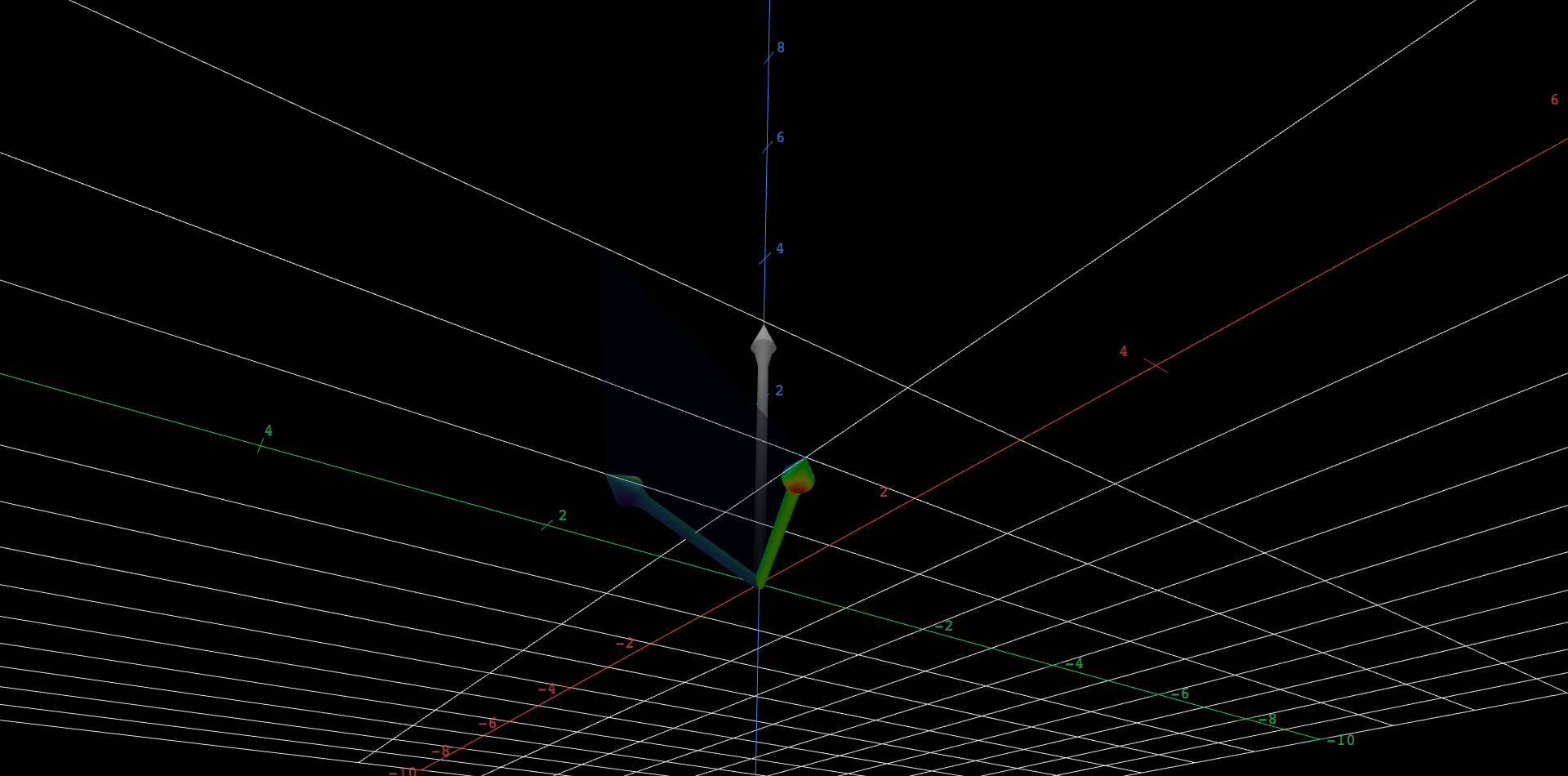
Rather than memorize the formula, watch what it produces. The figure fixes in the floor, puts on a slider that lifts its tip out of the floor, and draws together with the parallelogram the two vectors span.
A faint translucent dark blue parallelogram, outlined by a thin light gray line, with one corner at the origin, spanned by a thick shaded arrow u ending at (2, 1, 0) and a second thick arrow v ending at (1, 2, c), where c is set by a slider that starts at 0. A third, thicker arrow rises from the origin to (c, -2c, 3): the cross product u times v. At c = 0 the parallelogram lies flat on the floor and that arrow stands straight up, 3 units tall, and 3 is also the area of the parallelogram. Dragging c to 2 lifts the arrow v, tilting the parallelogram out of the floor; the cross-product arrow leans away to (2, -4, 3), staying perpendicular to both u and v, and grows to length the square root of 29, which is the new area. Dragging c to -2 leans it the other way, to (-2, 4, 3), with the same length. A fourth, thinner arrow is v times u, pointing to (-c, 2c, -3), below the floor and exactly opposite to the cross-product arrow at every slider value.
The two arrows spanning the faint translucent parallelogram, outlined in light gray, are and ; the third and thickest is the cross product . The fourth, thinner arrow, pointing below the floor, is .
Explore the figure
At the starting value both vectors lie in the floor, and the cross-product arrow stands straight up: . Orbit to confirm it is perpendicular to the floor, and so to both vectors at once.
Its length is . Now compute the area of the flat parallelogram: base times the height of above the line of , which by Section 0.7 is the perpendicular part of , of length . The area is — the same number.
Drag to . The arrow lifts off the floor, the parallelogram tilts, and the cross-product arrow leans away to to stay perpendicular to the tilted sheet. Orbit until you look along it: the parallelogram is seen face-on, which is what "perpendicular to the sheet" looks like. Its length is now , and so is the area.
Look below the floor at the fourth arrow, . It is the cross-product arrow exactly reversed, , at every slider value: swapping the factors flips the sign.
Drag to . The cross-product arrow leans the other way, to , but its third component is still : that component comes from the floor shadow of the parallelogram, which the slider never changes.
What the formula guarantees
Three properties hold for every pair of vectors, and each is a short computation with the components.
Orthogonality. Dot with : . Every product appears twice with opposite signs — from the first term cancels from the second, and so on — so the sum is . The same happens with . So is orthogonal to both and , which is why it stood perpendicular to the sheet in every position of the slider.
Anticommutativity. Swapping and swaps the two products in every component, so . In particular , which forces : a vector crossed with itself, or with any multiple of itself, gives nothing, because two parallel vectors span no parallelogram. Which of the two perpendicular directions takes is fixed by the formula and remembered by the right-hand rule: curl the fingers of your right hand from toward , and the thumb points along . The standard unit vectors are the check: .
Length. Multiply out — three squared components, nine terms after expansion — and compare with , also expanded. They agree term by term, an identity worth verifying once with patience:
Now substitute the angle formula : the right side becomes , and since for angles between and ,
That is base times height: is the base of the parallelogram spanned by the two vectors, and is its height. The length of the cross product is the area of the parallelogram — the fact step 2 checked by hand and step 3 checked again after the tilt.
The cross product's first component, on the slider ✓ Computed · mojocas 0.1.0✓ Agrees with the text The cross product's first component, on the slider, computed exactly by mojocas 0.1.0, and confirmed to agree with the result stated in the text.
The determinant of the second and third components of and , computed by a computer algebra system: , the first component of the cross-product arrow.
The second component, before its sign ✓ Computed · mojocas 0.1.0✓ Agrees with the text The second component, before its sign, computed exactly by mojocas 0.1.0, and confirmed to agree with the result stated in the text.
The determinant of the first and third components, . The second component of the cross product is its negative, — the middle sign of the formula.
The third component ✓ Computed · mojocas 0.1.0✓ Agrees with the text The third component, computed exactly by mojocas 0.1.0, and confirmed to agree with the result stated in the text.
The determinant of the first and second components, : the third component, which the slider never touches, and the height of the cross-product arrow at .
The whole figure, in one card ✓ Computed · mojocas 0.1.0✓ Agrees with the text The whole figure, in one card, computed exactly by mojocas 0.1.0, and confirmed to agree with the result stated in the text.
The figure's two vectors with the slider left as the symbol , crossed by a computer algebra system: . Every position of the slider at once, including the ones you do not drag to — and the third component really is free of , which is why the arrow's height never changes.
Its length, which is the area ✓ Computed · mojocas 0.1.0✓ Agrees with the text Its length, which is the area, computed exactly by mojocas 0.1.0, and confirmed to agree with the result stated in the text.
The length of that cross product, still symbolic: . It gives at and at — the two areas the exploration measured — and it says what happens between and beyond them.
Perpendicular to u, at every slider value ✓ Computed · mojocas 0.1.0✓ Agrees with the text Perpendicular to u, at every slider value, computed exactly by mojocas 0.1.0, and confirmed to agree with the result stated in the text.
The orthogonality argument, checked rather than trusted: dotted with is for every .
And to v ✓ Computed · mojocas 0.1.0✓ Agrees with the text And to v, computed exactly by mojocas 0.1.0, and confirmed to agree with the result stated in the text.
The same for : , again for every . Two symbolic zeros are the whole content of "the cross product is perpendicular to both".
The worked example's cross product ✓ Computed · mojocas 0.1.0✓ Agrees with the text The worked example's cross product, computed exactly by mojocas 0.1.0, and confirmed to agree with the result stated in the text.
, computed rather than assembled by hand from the three determinants.
And the area it measures ✓ Computed · mojocas 0.1.0✓ Agrees with the text And the area it measures, computed exactly by mojocas 0.1.0, and confirmed to agree with the result stated in the text.
Its length, : the area of the parallelogram those two vectors span.
The triangle's normal ✓ Computed · mojocas 0.1.0✓ Agrees with the text The triangle's normal, computed exactly by mojocas 0.1.0, and confirmed to agree with the result stated in the text.
The two edges of the triangle example, crossed: . Section 0.10 uses this vector again, as the normal of the plane through the three points.
Twice the triangle's area ✓ Computed · mojocas 0.1.0✓ Agrees with the text Twice the triangle's area, computed exactly by mojocas 0.1.0, and confirmed to agree with the result stated in the text.
Its length is exactly , the area of the parallelogram on the two edges — so the triangle, which is half of it, has area .
An original work of XYZ Homework, built around interactive XYZ 3D figures. Chapters 1–6 follow the topic sequence of Interactive Linear Algebra (Margalit & Rabinoff, Georgia Tech, GNU FDL). Chapter 0's scope (its topics, their order, and the idea each figure shows) follows the Vectors chapter of Ximera's Linear Algebra: An Interactive Introduction. The prose, worked examples and figures were written for this book, which is not affiliated with or endorsed by the authors of either work. License: CC-BY-NC-SA-4.0.
These eBooks are a prerelease and are not yet certified conformant with WCAG 2.1 AA or any other accessibility standard. Every page is built against an automated accessibility gate, and our target for the published editions is WCAG 2.2 Level AA. If something is unusable, please tell us.

 Explore in 3D (opens in a new tab)