The second operation on vectors is multiplication by a number. Doubling a vector doubles its length and keeps its direction; halving it halves the length. A number used this way is called a scalar, because scaling is exactly what it does, and the product is a scalar multiple of . Two cases need a moment's thought. Multiplying by gives , the vector of the same length pointing the opposite way — the additive inverse of the last section — and any negative scalar both scales and reverses. Multiplying by gives the zero vector, whatever was.
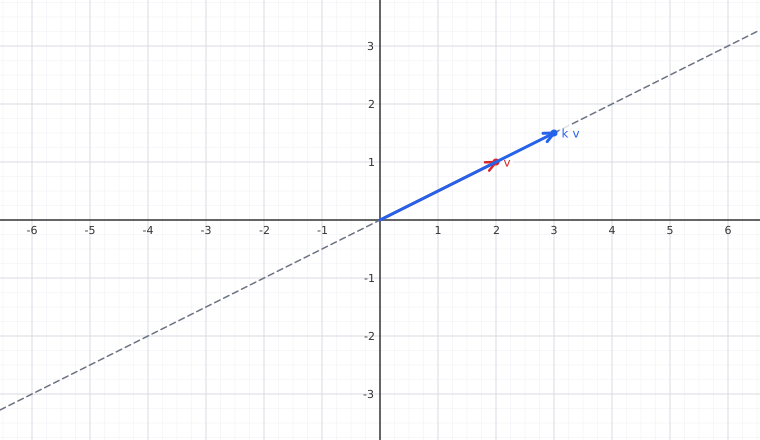
The figure keeps a fixed vector and draws on a slider that runs through negative values, over the dashed line of all multiples.
Interactive figureScalar multiples of a vectorDrag the the scalar slider from -3 to 3.
XYZ Graph · viewer build 5edf91b
The vector in red and its multiple in blue, with on a slider. The dashed line through the origin is the set of all multiples of .
Explore the figure
At the starting value , the blue arrow ends at : each component of multiplied by . It points the way points and is one and a half times as long.
Drag to . The arrow is half of , ending at the midpoint of the red arrow. Now drag to : the arrow triples, to .
Drag to . The blue arrow shrinks to nothing: is the zero vector, with no length to draw and no direction to point.
Drag to . The arrow reappears on the other side of the origin, ending at , the same length as and pointing the opposite way. That is ; at it is twice as long and still reversed.
Sweep across its whole range and watch the blue tip. It never leaves the dashed line. The multiples of one nonzero vector fill exactly one line through the origin, and every point of that line is one of them.
Why components scale
The figure shows components scaling with the arrow, and a similar-triangles argument says why. The arrow is the hypotenuse of a right triangle with legs and along the axes. Stretching the hypotenuse by a factor from the origin produces a similar triangle, with every side stretched by ; its legs are and , and those are the components of the stretched arrow. A negative reflects the triangle through the origin as well, which negates both legs. The same argument runs in space with three legs, and in we take the component rule as the definition:
Length behaves as the picture promised. Squaring each component multiplies it by , so and
with the absolute value on because a length cannot be negative: is twice as long as , not minus twice as long.
Two nonzero vectors that are scalar multiples of each other lie along one line, and we call them parallel — which includes the case of pointing opposite ways. Conversely, if lies on the line through then for the unique that scales to the right length and sign. Testing for parallelism is therefore a component question: is there one number that works for every component at once?
Scalar multiplication brings the last four rules of vector arithmetic, again because each is a rule of ordinary numbers applied in every component. For all vectors , and scalars , :
and : scaling distributes over both kinds of addition.
and .
The first is worth writing out once. The th component of is , which is the th component of ; and two vectors whose components all agree are the same vector. Together with the four rules for addition, these eight are everything the rest of the book uses about the two operations. That is worth saying precisely, because it is what Chapter 2 leans on: every argument there about spans, subspaces and independence is built from these eight rules and nothing else about what a vector is. Mathematicians take the same eight as the definition of a vector space, which is what lets the subject reach objects that are not lists of numbers at all — functions, polynomials, matrices. This book stays inside , so that generalization is a door we point at rather than walk through.
The combination, computed ✓ Computed · mojocas 0.1.0✓ Agrees with the text The combination, computed, computed exactly by mojocas 0.1.0, and confirmed to agree with the result stated in the text.
The vector of the worked example, with written out as a column and added by a computer algebra system: .
The length of v ✓ Computed · mojocas 0.1.0✓ Agrees with the text The length of v, computed exactly by mojocas 0.1.0, and confirmed to agree with the result stated in the text.
The length of : .
And the length of 3v ✓ Computed · mojocas 0.1.0✓ Agrees with the text And the length of 3v, computed exactly by mojocas 0.1.0, and confirmed to agree with the result stated in the text.
The same vector with every component tripled. The engine returns rather than , so the two cards can be read side by side: scaling by multiplied the length by exactly , which is the rule with the scalar left visible in the answer.
A negative scalar gives the same length ✓ Computed · mojocas 0.1.0✓ Agrees with the text A negative scalar gives the same length, computed exactly by mojocas 0.1.0, and confirmed to agree with the result stated in the text.
And , whose length is too. That is the absolute value in the rule: a negative scalar reverses the arrow without shortening it, and a length is never negative.
Parallel vectors, as a rank ✓ Computed · mojocas 0.1.0✓ Agrees with the text Parallel vectors, as a rank, computed exactly by mojocas 0.1.0, and confirmed to agree with the result stated in the text.
The two rows and stacked into a matrix. A computer algebra system reports rank : the pair contains only one independent direction, which is what "parallel" means. Rank is Chapter 2's word for this; here it is only a machine-checkable form of the worked example's yes.
Not parallel, as a rank ✓ Computed · mojocas 0.1.0✓ Agrees with the text Not parallel, as a rank, computed exactly by mojocas 0.1.0, and confirmed to agree with the result stated in the text.
The rows and : rank , two genuinely different directions. The worked example's no, certified.
An original work of XYZ Homework, built around interactive XYZ 3D figures. Its chapter sequence is aligned to Interactive Linear Algebra (Margalit & Rabinoff, Georgia Tech, GNU FDL); this work is original, copies nothing from it, and is not affiliated with or endorsed by its authors. License: CC-BY-NC-SA-4.0.
These eBooks are a prerelease and are not yet certified conformant with WCAG 2.1 AA or ADA Title II. Every page is built against an automated accessibility gate, and the published editions will meet ADA Title II requirements when they release in late September 2026. If something is unusable, please tell us.