
0.5 Unit Vectors and Direction
A unit vector is a vector of length . Since its length is fixed, a unit vector carries exactly one piece of information — a direction — and that is what unit vectors are for: they are directions, packaged as vectors. The most important ones point along the axes. In they are
the standard unit vectors; physics texts call them , , . In there are of them, having a in position and zeros elsewhere. The staircase of Section 0.2 is a statement about them: walking along the first axis, along the second and up is , and in general
An expression of this shape — vectors scaled and added — is called a linear combination, and the whole of Chapter 2 is about them. Here the combination is a bookkeeping device: it says that the standard unit vectors, scaled by the components, rebuild any vector.
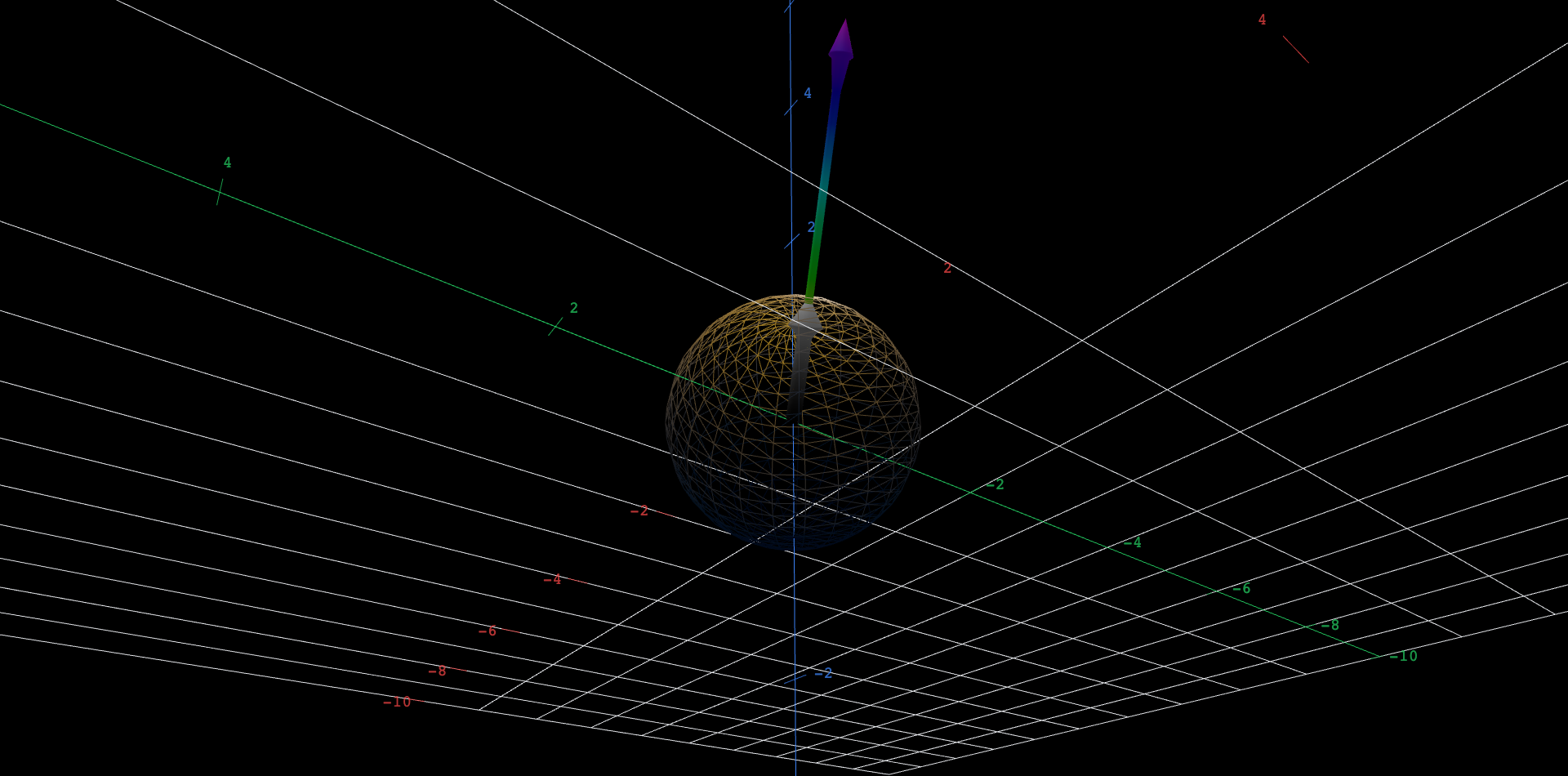
Every other direction has a unit vector too, and the recipe for it is the subject of the figure: divide a vector by its own length.
 Explore in 3D (opens in a new tab)
A wireframe globe of radius 1 centered at the origin, its mesh drawn in fine pale lines so that anything inside it stays visible. A thin shaded arrow runs from the origin to the point (a, b, c), the vector v, whose three components are set by three sliders starting at 2, 1 and 2. A shorter, much thicker arrow runs from the origin along the same direction and stops exactly at the globe's surface: the unit vector in the direction of v, wrapped around the first part of the thin one. At the starting values v has length exactly 3, so the thick arrow covers the first third of the thin one. Dragging any slider swings the thin arrow to its new tip, and the thick arrow turns with it while its tip slides over the globe's surface, never leaving it and never reaching past it. As a slider approaches zero the thin arrow shortens without ever turning round, and with all three at zero both arrows vanish, since the zero vector has neither a length to draw nor a direction to point in.
Explore the figure
- At the starting values , a vector of length . The thick arrow covers exactly the first third of the thin one and ends at , on the globe: dividing by took the length to and changed nothing else.
- Drag to . Now , still of length , and the thick arrow's tip has slid across the globe to . Same length, new direction, new unit vector.
- Set and , leaving . The thin arrow points straight up and the thick one is , the north pole of the globe. The standard unit vectors are what this recipe produces from vectors along the axes.
- Keep and and drag down to . The thin arrow shrinks to nothing, and the thick one vanishes with it. The zero vector has no direction, so it has no unit vector — the recipe divides by and rightly refuses.
- Set , and . The length is once more, and the unit vector is . Three sliders, but the globe is a surface: the unit vector has only two degrees of freedom, because it has forgotten the length.
Dividing by the length
Take any nonzero and set , a scalar multiple with the positive scalar . Because the scalar is positive, points the way points. Because scaling multiplies length by the scalar, . So is the unit vector in the direction of — there is only one, since two unit vectors in the same direction are the same arrow — and in components
Reversing the recipe builds a vector of any length you like. To point the way points but have length , take copies of the unit vector: has direction and length .
The thick arrow at the figure's starting values, measured: exactly . Dividing by the length worked, and the answer is the integer rather than a decimal that rounds to it.
The length of : , the number every component is about to be divided by.
The same vector after that division. Length , exactly — which is what makes the fractions the honest answer and an approximation to one of them.
Ten copies of the unit vector in the direction of : length , as required. The recipe is scale to , then scale to whatever you wanted.
An original work of XYZ Homework, built around interactive XYZ 3D figures. Chapters 1–6 follow the topic sequence of Interactive Linear Algebra (Margalit & Rabinoff, Georgia Tech, GNU FDL). Chapter 0's scope (its topics, their order, and the idea each figure shows) follows the Vectors chapter of Ximera's Linear Algebra: An Interactive Introduction. The prose, worked examples and figures were written for this book, which is not affiliated with or endorsed by the authors of either work. License: CC-BY-NC-SA-4.0.