
0.3 Adding Vectors: Parallelograms and Boxes
Two displacements performed one after the other are a single displacement. Walk along , then along : you end up somewhere, and the arrow from where you started to where you ended is the sum . Drawn, that is the head-to-tail rule — slide so its tail sits on the head of , and the sum runs from the tail of to the head of . Walking first and then lands you at the same place, so , and the two routes together trace a parallelogram whose sides are copies of and . The sum is its diagonal from the shared tail.
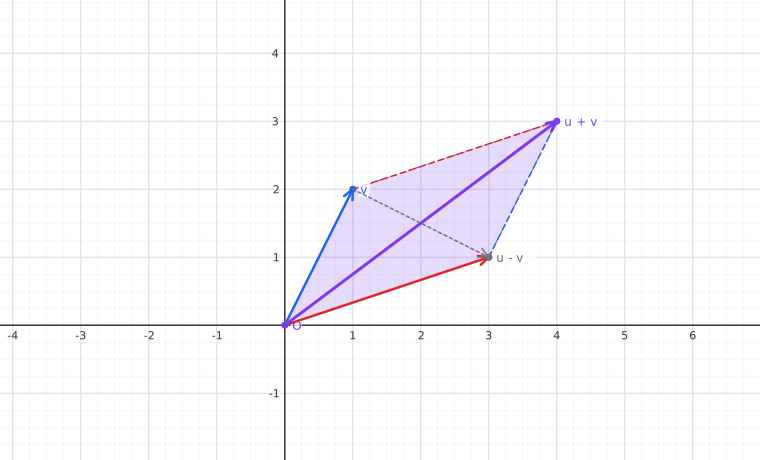
Parallelograms live in a plane, so the first figure is drawn in one: two vectors on four sliders, their sum, and the parallelogram they span.
Explore the figure
- At the starting values and , read the far corner: it sits at , which is . Adding the components adds the arrows. As a bonus, the sum has length .
- Follow the dashed blue copy of that starts at the tip of . It ends at the far corner: that is head-to-tail addition. The dashed red copy of , starting at the tip of , ends at the same corner — the other order, the same sum.
- Drag to . Now and the far corner is at : the parallelogram leans backward and the sum points straight up. A sum can be shorter than either of its parts.
- Set and , so that . The parallelogram flattens to a segment and the purple arrow disappears: .
- Return to the starting values and look at the dotted gray arrow from the tip of to the tip of . Head minus tail gives , which is : the other diagonal of the same parallelogram, and the arrow you would add to to reach .
Adding by components
The corner did the algebra for you. Sliding to start at the head of moves its head by exactly the components of , so the head of the sum is at . In the same sentence has clauses:
Subtraction is addition of the opposite: , where has every component negated, so the difference is computed component by component too. Geometrically is the arrow from the head of to the head of — head minus tail once more — which is why it appears as the second diagonal.
Because addition happens one component at a time, it inherits the arithmetic of ordinary numbers. For all vectors , , of :
- , and , so a sum of several vectors needs no parentheses and no order.
- , and .
Each is checked by looking at one component: the th component of is , which equals , the th component of . Four more rules arrive in the next section once scalars join in, and the eight together are the rules of the game for the whole book.
Three vectors, one diagonal
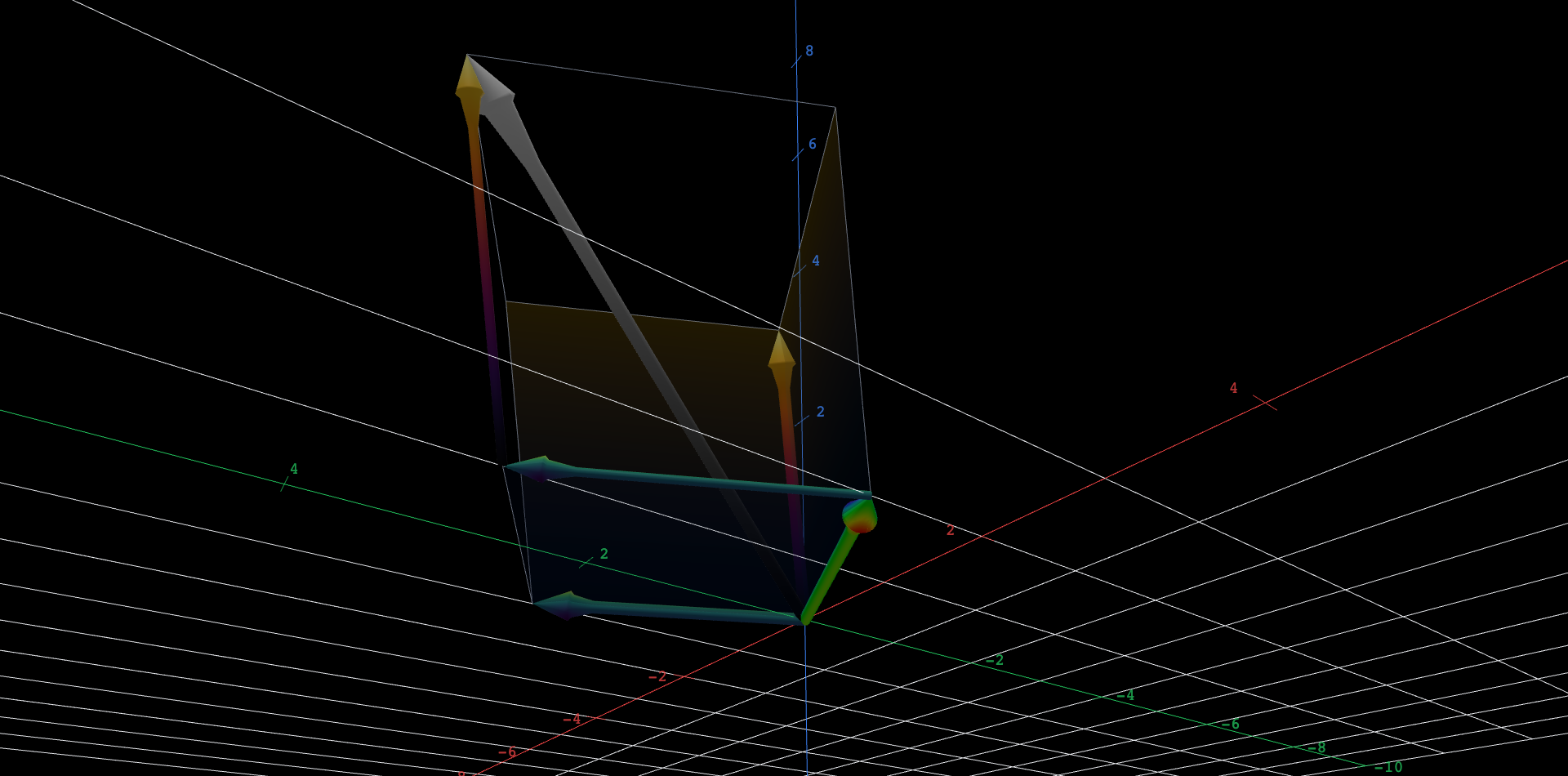
Head-to-tail addition is not a plane fact — it works for arrows anywhere in space, and it works for more than two arrows. The second figure adds three: and lie in the floor, and climbs by a slider. Three vectors that are not all in one plane span a parallelepiped, a box with parallelogram faces, and their sum is its long diagonal.
 Explore in 3D (opens in a new tab)
A slanted box, a parallelepiped, standing on a horizontal grid with one corner at the origin. Three thick shaded arrows leave the origin: one, u, to (2, 1, 0) and another, v, to (-1, 2, 0), both flat on the floor and at right angles to each other, and a third, w, rising to (1, 1, h), where h is set by a slider that starts at 2. The three faces that meet at the origin are shaded translucent, and the remaining nine edges are thin gray lines. A thinner copy of v starts at the tip of u, a thinner copy of w starts where that copy ends, and the head-to-tail path finishes at the far corner of the box, at (2, 4, h). A fourth thick arrow runs from the origin straight to that corner: the diagonal, which is the sum u + v + w. Dragging h raises or lowers the top of the box, and the diagonal arrow tilts to keep its tip on the moving corner; at h = 0 the box flattens onto the floor and the diagonal lies flat with it, and at negative h the box hangs below the floor.
Explore the box
- Orbit the box at the starting value . The thin copy of leaves the tip of , the thin copy of leaves the tip of that, and the path ends at the box's far corner. Read the corner: , which is .
- The diagonal arrow goes straight from the origin to that corner, so it is the sum. Every one of the box's other diagonals is a sum too, with different signs: the one from the tip of to the opposite corner is .
- Drag to . All three vectors now lie in the floor, the box collapses to a flat parallelogram, and the diagonal lies flat with it, ending at . Three vectors in one plane span no volume — a fact Chapter 4 will measure with a determinant.
- Drag to . The box hangs below the floor and the diagonal dips to . Only the third component of the sum has changed, because only 's third component did.
The vectors and of the box, stacked as columns and added by a computer algebra system: , the corner of the floor parallelogram.
The same sum with added at : , the far corner of the box. Head-to-tail addition is associative, so it does not matter that this was done in two steps.
The difference , computed component by component: .
An original work of XYZ Homework, built around interactive XYZ 3D figures. Chapters 1–6 follow the topic sequence of Interactive Linear Algebra (Margalit & Rabinoff, Georgia Tech, GNU FDL). Chapter 0's scope (its topics, their order, and the idea each figure shows) follows the Vectors chapter of Ximera's Linear Algebra: An Interactive Introduction. The prose, worked examples and figures were written for this book, which is not affiliated with or endorsed by the authors of either work. License: CC-BY-NC-SA-4.0.