Two points determine a line, and a point with a direction does too. Three points that are not in a line determine a plane — that is why a tripod never wobbles — but the description that will matter most in this book uses a point and a vector, as the line did, with one change: the vector stands perpendicular to the plane instead of lying along it. A nonzero vector that is orthogonal to every vector lying in a plane is called a normal vector for the plane. The vector is a normal for the floor; so is , and so is , since only the direction of a normal matters. Infinitely many planes share a given normal — a whole stack of parallel sheets — and picking one point selects a single sheet from the stack.
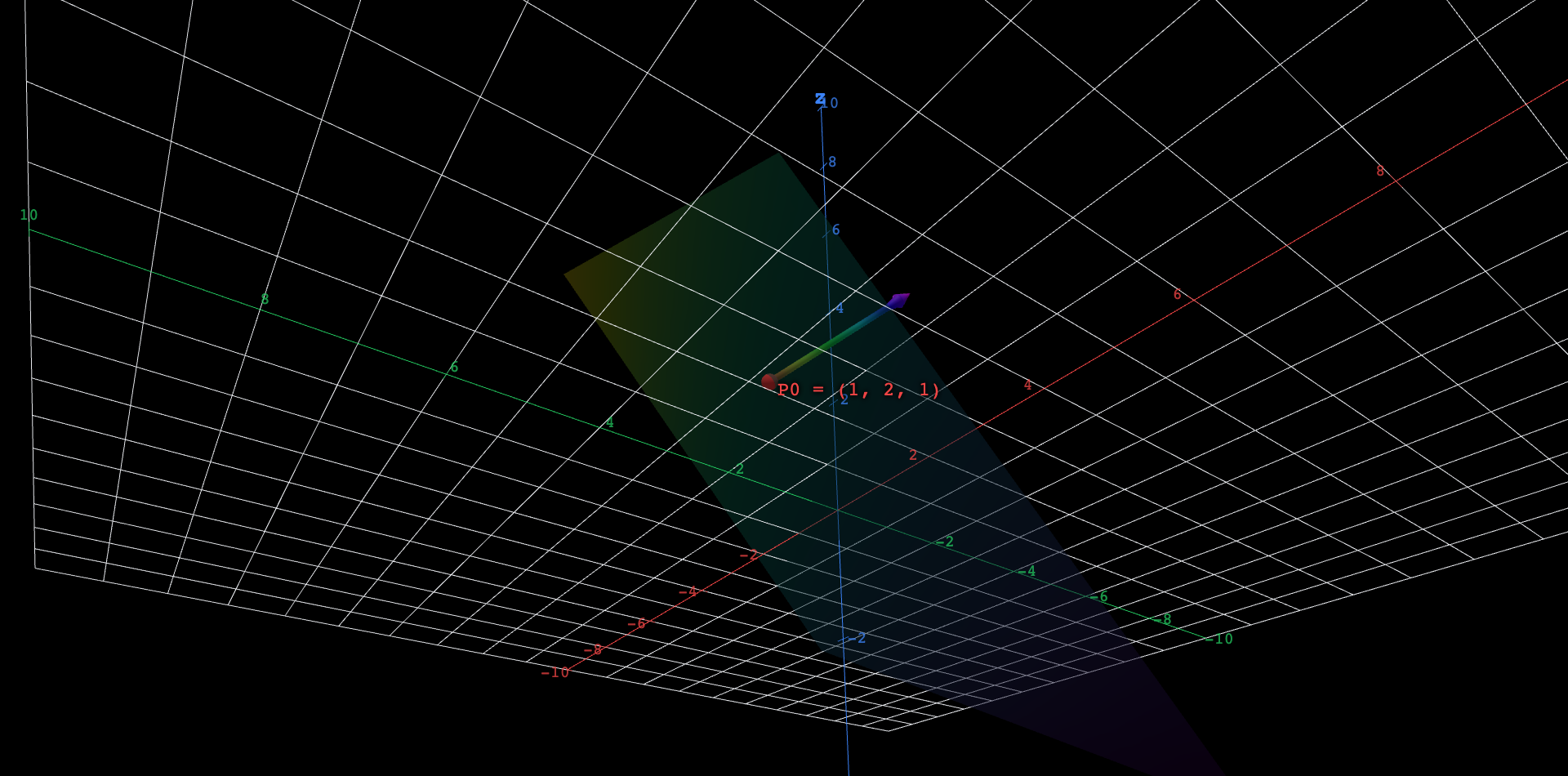
The figure draws the plane through with normal , and puts the whole stack on a slider.
A translucent tilted sheet outlined by a thin light gray line, the plane x minus 2y plus 2z equals d, with a slider d that starts at -1. A red point P0 at (1, 2, 1) sits on the sheet, and a thick shaded arrow leaves P0 at right angles to the sheet, ending at (2, 0, 3): the normal vector n = (1, -2, 2), of length 3. Dragging d slides the sheet parallel to itself along the direction of that arrow: for d above -1 the sheet moves up and away from P0, for d below -1 it moves down through P0 to the other side, and only at d = -1 does the sheet pass through P0 itself. The arrow never turns while the sheet slides, since every plane in the family has the same normal. A blue point Q at (1, 0, -1) and a thin arrow from P0 to Q are also drawn: at d = -1 that arrow lies inside the sheet, and it meets the normal arrow at a right angle.
The plane on a slider , with the red point and the normal vector drawn as an arrow from it. At the starting value the plane passes through ; other values slide it along the normal. A blue point and a thin arrow from to lie in the starting plane.
Explore the figure
At the starting value , check that is on the sheet by substituting: . Orbit until you see the sheet edge-on; the normal arrow then stands at a right angle to the line the sheet has become.
Drag to . The sheet slides upward along the normal, leaving beneath it, and the normal does not turn. Every plane in the family has the same normal, because the normal is read from the coefficients on the left, which the slider does not touch.
Drag to . The sheet has passed back down through to the far side. Exactly one value of puts the sheet through : a normal fixes the tilt of a plane, and one point fixes which plane.
Set back to and look at the blue point and the thin arrow from to . Substitution puts on the sheet, , and that arrow, , lies inside it. Dot it with the normal: . A vector in the plane is orthogonal to the normal — and that single fact is the plane's equation.
From a dot product to a linear equation
A point lies on the plane through with normal exactly when the displacement from to lies in the plane, that is, when it is orthogonal to :
Multiplying out and moving the constants to the right gives with . So every plane is the solution set of one linear equation in three unknowns, and — reading the argument backward — the solution set of any equation with , , not all zero is a plane with normal . The coefficients are the normal. For the figure, and give : the equation , and the slider's other values are the parallel planes with the same left side.
Two consequences are immediate. Planes with proportional normals are parallel, since a normal is only a direction; and a plane through three points , , has normal , because Section 0.8 built the cross product to be orthogonal to both edge vectors, and therefore to the whole plane they span.
The same shape of equation exists in every dimension. In , is a line, and is perpendicular to it — check it against the slope . In , describes a hyperplane, an -dimensional flat sheet with normal , invisible but governed by the same dot product. Chapter 1 begins by stacking several such equations and asking where their planes meet.
The normal of the three-point plane, as a null space ✓ Computed · mojocas 0.1.0✓ Agrees with the text The normal of the three-point plane, as a null space, computed exactly by mojocas 0.1.0, and confirmed to agree with the result stated in the text.
The two edge vectors of the three-point example, stacked as rows. A computer algebra system finds the vectors orthogonal to both rows — the null space of this matrix, in Chapter 2's language — and there is exactly one direction of them: the direction of , the normal the cross product produced.
The figure's plane, as one dot product ✓ Computed · mojocas 0.1.0✓ Agrees with the text The figure's plane, as one dot product, computed exactly by mojocas 0.1.0, and confirmed to agree with the result stated in the text.
Step 4's check, done by the engine: the normal against the arrow that runs from to inside the sheet. Zero — and that single number is the plane's equation, before it is multiplied out into .
The three-point plane's normal, against one edge ✓ Computed · mojocas 0.1.0✓ Agrees with the text The three-point plane's normal, against one edge, computed exactly by mojocas 0.1.0, and confirmed to agree with the result stated in the text.
The cross product from Section 0.8 dotted with the first edge : zero, so it is orthogonal to that edge.
And against the other ✓ Computed · mojocas 0.1.0✓ Agrees with the text And against the other, computed exactly by mojocas 0.1.0, and confirmed to agree with the result stated in the text.
And with the second edge : zero again. Orthogonal to both edges means orthogonal to every vector in the plane they span, which is exactly what "normal" asks for — so is the plane, and the point fixes .
Parallel planes, by their normals ✓ Computed · mojocas 0.1.0✓ Agrees with the text Parallel planes, by their normals, computed exactly by mojocas 0.1.0, and confirmed to agree with the result stated in the text.
The normals and as rows: rank , so they are proportional and the planes are parallel.
Crossing planes, by their normals ✓ Computed · mojocas 0.1.0✓ Agrees with the text Crossing planes, by their normals, computed exactly by mojocas 0.1.0, and confirmed to agree with the result stated in the text.
The normals and : rank , two directions, so the planes are not parallel and must cross.
An original work of XYZ Homework, built around interactive XYZ 3D figures. Chapters 1–6 follow the topic sequence of Interactive Linear Algebra (Margalit & Rabinoff, Georgia Tech, GNU FDL). Chapter 0's scope (its topics, their order, and the idea each figure shows) follows the Vectors chapter of Ximera's Linear Algebra: An Interactive Introduction. The prose, worked examples and figures were written for this book, which is not affiliated with or endorsed by the authors of either work. License: CC-BY-NC-SA-4.0.
These eBooks are a prerelease and are not yet certified conformant with WCAG 2.1 AA or any other accessibility standard. Every page is built against an automated accessibility gate, and our target for the published editions is WCAG 2.2 Level AA. If something is unusable, please tell us.

 Explore in 3D (opens in a new tab)