
9.7 Higher Roots
Simplify Expressions with Higher Roots
Up to now, in this chapter we have worked with squares and square roots. We will now extend our work to include higher powers and higher roots.
Let’s review some vocabulary first.
The terms ‘squared’ and ‘cubed’ come from the formulas for area of a square and volume of a cube.
It will be helpful to have a table of the powers of the integers from . See Figure 9.4.
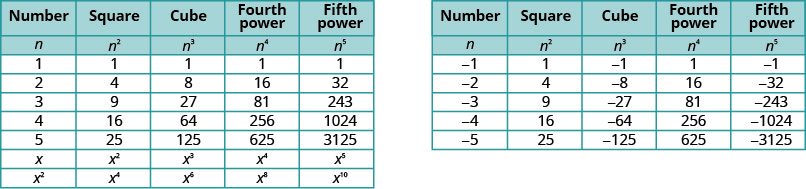
Notice the signs in Figure 9.4. All powers of positive numbers are positive, of course. But when we have a negative number, the even powers are positive and the odd powers are negative. We’ll copy the row with the powers of below to help you see this.

Earlier in this chapter we defined the square root of a number.
And we have used the notation to denote the principal square root. So always.
We will now extend the definition to higher roots.
We do not write the index for a square root. Just like we use the word ‘cubed’ for , we use the term ‘cube root’ for .
We refer to Figure 9.4 to help us find higher roots.
Could we have an even root of a negative number? No. We know that the square root of a negative number is not a real number. The same is true for any even root. Even roots of negative numbers are not real numbers. Odd roots of negative numbers are real numbers.
When we worked with square roots that had variables in the radicand, we restricted the variables to non-negative values. Now we will remove this restriction.
The odd root of a number can be either positive or negative. We have seen that .
But the even root of a non-negative number is always non-negative, because we take the principal nth root.
Suppose we start with .
How can we make sure the fourth root of −5 raised to the fourth power, is 5? We will see in the following property.
Use the Product Property to Simplify Expressions with Higher Roots
We will simplify expressions with higher roots in much the same way as we simplified expressions with square roots. An nth root is considered simplified if it has no factors of .
We will generalize the Product Property of Square Roots to include any integer root .
Don’t forget to use the absolute value signs when taking an even root of an expression with a variable in the radical.
Use the Quotient Property to Simplify Expressions with Higher Roots
We can simplify higher roots with quotients in the same way we simplified square roots. First we simplify any fractions inside the radical.
Previously, we used the Quotient Property ‘in reverse’ to simplify square roots. Now we will generalize the formula to include higher roots.
If the fraction inside the radical cannot be simplified, we use the first form of the Quotient Property to rewrite the expression as the quotient of two radicals.
Add and Subtract Higher Roots
We can add and subtract higher roots like we added and subtracted square roots. First we provide a formal definition of like radicals.
Like radicals have the same index and the same radicand.
- and are like radicals.
- and are not like radicals. The radicands are different.
- and are not like radicals. The indices are different.
We add and subtract like radicals in the same way we add and subtract like terms. We can add and the result is .
When an expression does not appear to have like radicals, we will simplify each radical first. Sometimes this leads to an expression with like radicals.
Key Concepts
- Properties of
- when is an even number and
- , then is a real number
- , then is not a real number
- When is an odd number, is a real number for all values of a.
- For any integer , when n is odd
- For any integer , when n is even
- is considered simplified if a has no factors of .
- Product Property of nth Roots
- Quotient Property of nth Roots
- To combine like radicals, simply add or subtract the coefficients while keeping the radical the same.
Practice Makes Perfect
Simplify Expressions with Higher Roots
In the following exercises, simplify.
ⓐ ⓑ ⓒ
ⓐ ⓑ ⓒ
ⓐ ⓑ ⓒ
ⓐ ⓑ ⓒ
ⓐ ⓑ ⓒ
ⓐ ⓑ ⓒ
ⓐ ⓑ ⓒ
ⓐ ⓑ ⓒ
ⓐ ⓑ ⓒ
ⓐ ⓑ ⓒ
ⓐ ⓑ ⓒ
ⓐ ⓑ not a real number ⓒ
ⓐ ⓑ
ⓐ
ⓑ

ⓐ ⓑ
ⓐ ⓑ
ⓐ ⓑ
ⓐ ⓑ
ⓐ ⓑ
ⓐ ⓑ
ⓐ ⓑ
ⓐ ⓑ
ⓐ ⓑ
ⓐ ⓑ
ⓐ ⓑ
ⓐ ⓑ
ⓐ ⓑ
ⓐ ⓑ
ⓐ ⓑ
ⓐ ⓑ
Use the Product Property to Simplify Expressions with Higher Roots
In the following exercises, simplify.
ⓐ ⓑ
ⓐ ⓑ
ⓐ ⓑ
ⓐ ⓑ
ⓐ ⓑ
ⓐ ⓑ
ⓐ ⓑ
ⓐ ⓑ
ⓐ ⓑ
ⓐ ⓑ
ⓐ ⓑ
ⓐ ⓑ
ⓐ ⓑ
ⓐ ⓑ
ⓐ ⓑ
ⓐ ⓑ
ⓐ ⓑ
ⓐ ⓑ
ⓐ ⓑ
ⓐ ⓑ
ⓐ ⓑ
ⓐ ⓑ
ⓐ ⓑ
ⓐ ⓑ
Use the Quotient Property to Simplify Expressions with Higher Roots
In the following exercises, simplify.
ⓐ ⓑ
ⓐ ⓑ
ⓐ ⓑ
ⓐ ⓑ
ⓐ ⓑ
ⓐ ⓑ
ⓐ ⓑ
ⓐ ⓑ
ⓐ ⓑ
ⓐ ⓑ
ⓐ ⓑ
ⓐ ⓑ
ⓐ ⓑ
ⓐ ⓑ
ⓐ ⓑ
ⓐ ⓑ
ⓐ ⓑ
ⓐ ⓑ
Add and Subtract Higher Roots
In the following exercises, simplify.
ⓐ ⓑ
ⓐ ⓑ
ⓐ ⓑ
ⓐ ⓑ
ⓐ 

ⓐ 

ⓐ ⓑ
ⓐ ⓑ
ⓐ ⓑ
ⓐ ⓑ
ⓐ ⓑ
ⓐ ⓑ
ⓐ ⓑ
ⓐ ⓑ
ⓐ ⓑ
Mixed Practice
In the following exercises, simplify.
Everyday Math
Population growth The expression models the growth of a mold population after generations. There were 10 spores at the start, and each had offspring. So is the number of offspring at the fifth generation. At the fifth generation there were 10,240 offspring. Simplify the expression to determine the number of offspring of each spore.
Spread of a virus The expression models the spread of a virus after cycles. There were three people originally infected with the virus, and each of them infected people. So is the number of people infected on the fourth cycle. At the fourth cycle 1875 people were infected. Simplify the expression to determine the number of people each person infected.
Writing Exercises
Explain how you know that .
Explain why is not a real number but is.
Answers may vary.
Self Check
ⓐ After completing the exercises, use this checklist to evaluate your mastery of the objectives of this section.
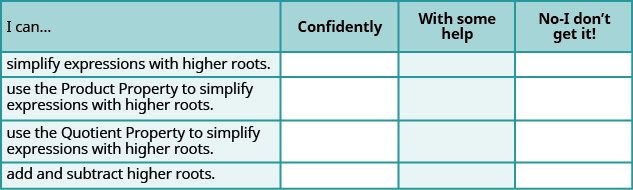
ⓑ What does this checklist tell you about your mastery of this section? What steps will you take to improve?
Adapted from Elementary Algebra 2e by OpenStax (openstax.org), licensed under CC BY-NC-SA 4.0. Changes were made. License: CC-BY-NC-SA-4.0.