
9.2 Simplify Square Roots
In the last section, we estimated the square root of a number between two consecutive whole numbers. We can say that is between 7 and 8. This is fairly easy to do when the numbers are small enough that we can use Figure 9.2.
But what if we want to estimate ? If we simplify the square root first, we’ll be able to estimate it easily. There are other reasons, too, to simplify square roots as you’ll see later in this chapter.
A square root is considered simplified if its radicand contains no perfect square factors.
So is simplified. But is not simplified, because 16 is a perfect square factor of 32.
Use the Product Property to Simplify Square Roots
The properties we will use to simplify expressions with square roots are similar to the properties of exponents. We know that . The corresponding property of square roots says that .
We use the Product Property of Square Roots to remove all perfect square factors from a radical. We will show how to do this in Example 1.
Notice in the previous example that the simplified form of is , which is the product of an integer and a square root. We always write the integer in front of the square root.
We could use the simplified form to estimate . We know is between 2 and 3, and is . So is between 20 and 30.
The next example is much like the previous examples, but with variables.
We follow the same procedure when there is a coefficient in the radical, too.
In the next example both the constant and the variable have perfect square factors.
We have seen how to use the Order of Operations to simplify some expressions with radicals. To simplify we must simplify each square root separately first, then add to get the sum of 17.
The expression cannot be simplified—to begin we’d need to simplify each square root, but neither 17 nor 7 contains a perfect square factor.
In the next example, we have the sum of an integer and a square root. We simplify the square root but cannot add the resulting expression to the integer.
The next example includes a fraction with a radical in the numerator. Remember that in order to simplify a fraction you need a common factor in the numerator and denominator.
Use the Quotient Property to Simplify Square Roots
Whenever you have to simplify a square root, the first step you should take is to determine whether the radicand is a perfect square. A perfect square fraction is a fraction in which both the numerator and the denominator are perfect squares.
If the numerator and denominator have any common factors, remove them. You may find a perfect square fraction!
In the last example, our first step was to simplify the fraction under the radical by removing common factors. In the next example we will use the Quotient Property to simplify under the radical. We divide the like bases by subtracting their exponents, .
Remember the Quotient to a Power Property? It said we could raise a fraction to a power by raising the numerator and denominator to the power separately.
We can use a similar property to simplify a square root of a fraction. After removing all common factors from the numerator and denominator, if the fraction is not a perfect square we simplify the numerator and denominator separately.
Be sure to simplify the fraction in the radicand first, if possible.
Key Concepts
- Simplified Square Root is considered simplified if has no perfect-square factors.
- Product Property of Square Roots If a, b are non-negative real numbers, then
- Simplify a Square Root Using the Product Property To simplify a square root using the Product Property:
- Find the largest perfect square factor of the radicand. Rewrite the radicand as a product using the perfect square factor.
- Use the product rule to rewrite the radical as the product of two radicals.
- Simplify the square root of the perfect square.
- Quotient Property of Square Roots If a, b are non-negative real numbers and , then
- Simplify a Square Root Using the Quotient Property To simplify a square root using the Quotient Property:
- Simplify the fraction in the radicand, if possible.
- Use the Quotient Rule to rewrite the radical as the quotient of two radicals.
- Simplify the radicals in the numerator and the denominator.
Practice Makes Perfect
Use the Product Property to Simplify Square Roots
In the following exercises, simplify.
Use the Quotient Property to Simplify Square Roots
In the following exercises, simplify.
Everyday Math
- ⓐ Elliott decides to construct a square garden that will take up 288 square feet of his yard. Simplify to determine the length and the width of his garden. Round to the nearest tenth of a foot.
- ⓑ Suppose Elliott decides to reduce the size of his square garden so that he can create a 5-foot-wide walking path on the north and east sides of the garden. Simplify to determine the length and width of the new garden. Round to the nearest tenth of a foot.
ⓐ ⓑ
- ⓐ Melissa accidentally drops a pair of sunglasses from the top of a roller coaster, 64 feet above the ground. Simplify to determine the number of seconds it takes for the sunglasses to reach the ground.
- ⓑ Suppose the sunglasses in the previous example were dropped from a height of 144 feet. Simplify to determine the number of seconds it takes for the sunglasses to reach the ground.
Writing Exercises
Explain why . Then explain why .
Answers will vary.
Explain why is not equal to .
Self Check
ⓐ After completing the exercises, use this checklist to evaluate your mastery of the objectives of this section.
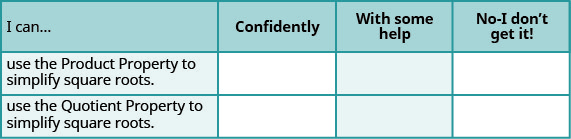
ⓑ After reviewing this checklist, what will you do to become confident for all objectives?
Adapted from Elementary Algebra 2e by OpenStax (openstax.org), licensed under CC BY-NC-SA 4.0. Changes were made. License: CC-BY-NC-SA-4.0.