
9.4 Multiply Square Roots
Multiply Square Roots
We have used the Product Property of Square Roots to simplify square roots by removing the perfect square factors. The Product Property of Square Roots says
We can use the Product Property of Square Roots ‘in reverse’ to multiply square roots.
Remember, we assume all variables are greater than or equal to zero.
We will rewrite the Product Property of Square Roots so we see both ways together.
So we can multiply in this way:
Sometimes the product gives us a perfect square:
Even when the product is not a perfect square, we must look for perfect-square factors and simplify the radical whenever possible.
Multiplying radicals with coefficients is much like multiplying variables with coefficients. To multiply we multiply the coefficients together and then the variables. The result is . Keep this in mind as you do these examples.
When we have to multiply square roots, we first find the product and then remove any perfect square factors.
The results of the previous example lead us to this property.
By realizing that squaring and taking a square root are ‘opposite’ operations, we can simplify and get 2 right away. When we multiply the two like square roots in part (a) of the next example, it is the same as squaring.
Use Polynomial Multiplication to Multiply Square Roots
In the next few examples, we will use the Distributive Property to multiply expressions with square roots.
We will first distribute and then simplify the square roots when possible.
When we worked with polynomials, we multiplied binomials by binomials. Remember, this gave us four products before we combined any like terms. To be sure to get all four products, we organized our work—usually by the FOIL method.
Note that some special products made our work easier when we multiplied binomials earlier. This is true when we multiply square roots, too. The special product formulas we used are shown below.
We will use the special product formulas in the next few examples. We will start with the Binomial Squares formula.
In the next two examples, we will find the product of conjugates.
Key Concepts
- Product Property of Square Roots If a, b are nonnegative real numbers, then
- Special formulas for multiplying binomials and conjugates:
- The FOIL method can be used to multiply binomials containing radicals.
Practice Makes Perfect
Multiply Square Roots
In the following exercises, simplify.
ⓐ ⓑ
ⓐ ⓑ
ⓐ ⓑ
ⓐ ⓑ
ⓐ ⓑ 160
ⓐ ⓑ
ⓐ ⓑ
ⓐ ⓑ
ⓐ ⓑ
ⓐ ⓑ
ⓐ ⓑ
ⓐ ⓑ
ⓐ ⓑ
ⓐ ⓑ
ⓐ 11 ⓑ 21
ⓐ ⓑ
ⓐ
ⓑ
ⓐ 23 ⓑ 3
ⓐ ⓑ
ⓐ ⓑ
ⓐ −234 ⓑ 180
ⓐ ⓑ
ⓐ ⓑ
ⓐ ⓑ 56
Use Polynomial Multiplication to Multiply Square Roots
In the following exercises, simplify.
ⓐ ⓑ
ⓐ ⓑ
ⓐ ⓑ
ⓐ ⓑ
ⓐ ⓑ
ⓐ ⓑ
ⓐ ⓑ
ⓐ ⓑ
ⓐ ⓑ
ⓐ ⓑ
ⓐ ⓑ
ⓐ ⓑ
ⓐ
ⓑ
ⓐ ⓑ
ⓐ ⓑ
ⓐ ⓑ
ⓐ ⓑ
ⓐ ⓑ
97
39
33
Mixed Practice
In the following exercises, simplify.
Everyday Math
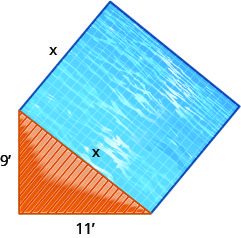
A landscaper wants to put a square reflecting pool next to a triangular deck, as shown below. The triangular deck is a right triangle, with legs of length 9 feet and 11 feet, and the pool will be adjacent to the hypotenuse.
- ⓐ Use the Pythagorean Theorem to find the length of a side of the pool. Round your answer to the nearest tenth of a foot.
- ⓑ Find the exact area of the pool.
An artist wants to make a small monument in the shape of a square base topped by a right triangle, as shown below. The square base will be adjacent to one leg of the triangle. The other leg of the triangle will measure 2 feet and the hypotenuse will be 5 feet.
- ⓐ Use the Pythagorean Theorem to find the length of a side of the square base. Round your answer to the nearest tenth of a foot.
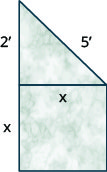
- ⓑ Find the exact area of the face of the square base.
ⓐ ⓑ
A square garden will be made with a stone border on one edge. If only feet of stone are available, simplify to determine the area of the largest such garden. Round your answer to the nearest tenth of a foot.
A garden will be made so as to contain two square sections, one section with side length yards and one section with side length yards. Simplify to determine the total area of the garden. Round your answer to the nearest tenth.
Suppose a third section will be added to the garden in the previous exercise. The third section is to have a width of yards. Write an expression that gives the total area of the garden.
Writing Exercises
- ⓐ Explain why is always positive, for .
- ⓑ Explain why is always negative, for .
ⓐ when squaring a negative, it becomes a positive ⓑ since the negative is not included in the parenthesis, it is not squared, and remains negative
Use the binomial square pattern to simplify . Explain all your steps.
Self Check
ⓐ After completing the exercises, use this checklist to evaluate your mastery of the objectives of this section.
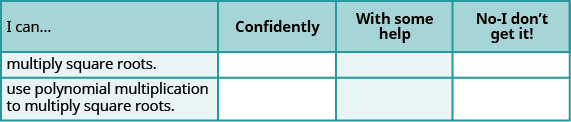
ⓑ On a scale of 1–10, how would you rate your mastery of this section in light of your responses on the checklist? How can you improve this?
Adapted from Elementary Algebra 2e by OpenStax (openstax.org), licensed under CC BY-NC-SA 4.0. Changes were made. License: CC-BY-NC-SA-4.0.