
9.1 Simplify and Use Square Roots
Simplify Expressions with Square Roots
Remember that when a number is multiplied by itself, we write and read it “n squared.” For example, reads as “15 squared,” and 225 is called the square of 15, since .
Sometimes we will need to look at the relationship between numbers and their squares in reverse. Because 225 is the square of 15, we can also say that 15 is a square root of 225. A number whose square is is called a square root of .
Notice also, so is also a square root of 225. Therefore, both 15 and are square roots of 225.
So, every positive number has two square roots—one positive and one negative. What if we only wanted the positive square root of a positive number? The radical sign, , denotes the positive square root. The positive square root is also called the principal square root.
We also use the radical sign for the square root of zero. Because , . Notice that zero has only one square root.
Since 15 is the positive square root of 225, we write . Fill in Figure 9.2 to make a table of square roots you can refer to as you work this chapter.

We know that every positive number has two square roots and the radical sign indicates the positive one. We write . If we want to find the negative square root of a number, we place a negative in front of the radical sign. For example, .
When using the order of operations to simplify an expression that has square roots, we treat the radical as a grouping symbol.
Estimate Square Roots
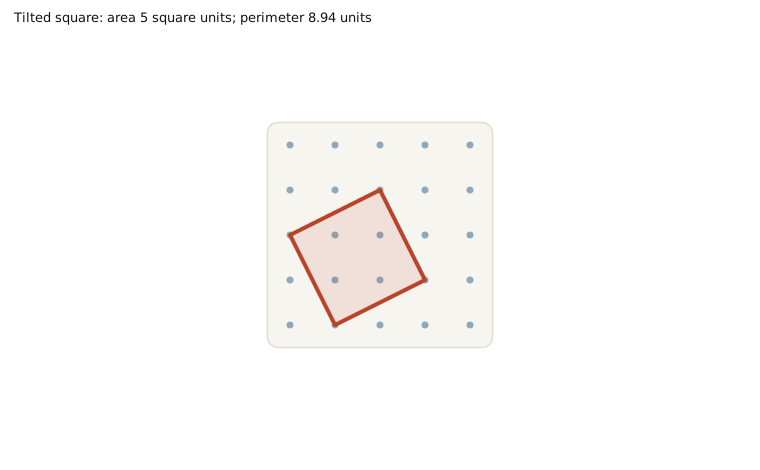
So far we have only considered square roots of perfect square numbers. The square roots of other numbers are not whole numbers. Look at Table 9.1 below.
| Number | Square Root |
|---|---|
| 4 | = 2 |
| 5 | |
| 6 | |
| 7 | |
| 8 | |
| 9 | = 3 |
The square roots of numbers between 4 and 9 must be between the two consecutive whole numbers 2 and 3, and they are not whole numbers. Based on the pattern in the table above, we could say that must be between 2 and 3. Using inequality symbols, we write:
Approximate Square Roots
There are mathematical methods to approximate square roots, but nowadays most people use a calculator to find them. Find the key on your calculator. You will use this key to approximate square roots.
When you use your calculator to find the square root of a number that is not a perfect square, the answer that you see is not the exact square root. It is an approximation, accurate to the number of digits shown on your calculator’s display. The symbol for an approximation is and it is read ‘approximately.’
Suppose your calculator has a 10-digit display. You would see that
If we wanted to round to two decimal places, we would say
How do we know these values are approximations and not the exact values? Look at what happens when we square them:
Their squares are close to 5, but are not exactly equal to 5.
Using the square root key on a calculator and then rounding to two decimal places, we can find:
Simplify Variable Expressions with Square Roots
What if we have to find a square root of an expression with a variable? Consider . Can you think of an expression whose square is ?
When we use the radical sign to take the square root of a variable expression, we should specify that to make sure we get the principal square root.
However, in this chapter we will assume that each variable in a square-root expression represents a non-negative number and so we will not write next to every radical.
What about square roots of higher powers of variables? Think about the Power Property of Exponents we used in Chapter 6.
If we square , the exponent will become .
How does this help us take square roots? Let’s look at a few:
Key Concepts
- Note that the square root of a negative number is not a real number.
- Every positive number has two square roots, one positive and one negative. The positive square root of a positive number is the principal square root.
- We can estimate square roots using nearby perfect squares.
- We can approximate square roots using a calculator.
- When we use the radical sign to take the square root of a variable expression, we should specify that to make sure we get the principal square root.
Practice Makes Perfect
Simplify Expressions with Square Roots
In the following exercises, simplify.
6
8
3
10
not a real number
not a real number
5
7
Estimate Square Roots
In the following exercises, estimate each square root between two consecutive whole numbers.
Approximate Square Roots
In the following exercises, approximate each square root and round to two decimal places.
4.36
7.28
Simplify Variable Expressions with Square Roots
In the following exercises, simplify.
Everyday Math
Decorating Denise wants to have a square accent of designer tiles in her new shower. She can afford to buy 625 square centimeters of the designer tiles. How long can a side of the accent be?
25 centimeters
Decorating Morris wants to have a square mosaic inlaid in his new patio. His budget allows for 2025 square inch tiles. How long can a side of the mosaic be?
Writing Exercises
Why is there no real number equal to ?
Answers will vary.
What is the difference between and ?
Self Check
ⓐ After completing the exercises, use this checklist to evaluate your mastery of the objectives of this section.
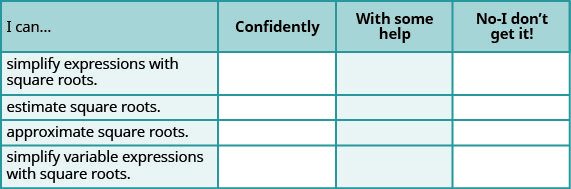
ⓑ On a scale of 1–10, how would you rate your mastery of this section in light of your responses on the checklist? How can you improve this?
Adapted from Elementary Algebra 2e by OpenStax (openstax.org), licensed under CC BY-NC-SA 4.0. Changes were made. License: CC-BY-NC-SA-4.0.