
9.6 Solve Equations with Square Roots
Solve Radical Equations
In this section we will solve equations that have the variable in the radicand of a square root. Equations of this type are called radical equations.
As usual, in solving these equations, what we do to one side of an equation we must do to the other side as well. Since squaring a quantity and taking a square root are ‘opposite’ operations, we will square both sides in order to remove the radical sign and solve for the variable inside.
But remember that when we write we mean the principal square root. So always. When we solve radical equations by squaring both sides we may get an algebraic solution that would make negative. This algebraic solution would not be a solution to the original radical equation; it is an extraneous solution. We saw extraneous solutions when we solved rational equations, too.
Now we will see how to solve a radical equation. Our strategy is based on the relation between taking a square root and squaring.
When we use a radical sign, we mean the principal or positive root. If an equation has a square root equal to a negative number, that equation will have no solution.
If one side of the equation is a binomial, we use the binomial squares formula when we square it.
Don’t forget the middle term!
When there is a coefficient in front of the radical, we must square it, too.
Sometimes after squaring both sides of an equation, we still have a variable inside a radical. When that happens, we repeat Step 1 and Step 2 of our procedure. We isolate the radical and square both sides of the equation again.
Use Square Roots in Applications
As you progress through your college courses, you’ll encounter formulas that include square roots in many disciplines. We have already used formulas to solve geometry applications.
We will use our Problem Solving Strategy for Geometry Applications, with slight modifications, to give us a plan for solving applications with formulas from any discipline.
We used the formula to find the area of a rectangle with length L and width W. A square is a rectangle in which the length and width are equal. If we let s be the length of a side of a square, the area of the square is .
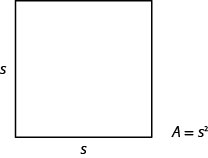
The formula gives us the area of a square if we know the length of a side. What if we want to find the length of a side for a given area? Then we need to solve the equation for s.
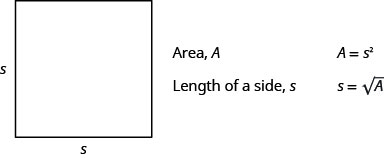
We can use the formula to find the length of a side of a square for a given area.
We will show an example of this in the next example.
Another application of square roots has to do with gravity.
For example, if an object is dropped from a height of 64 feet, we can find the time it takes to reach the ground by substituting into the formula.
 | |
|---|---|
 | |
| Take the square root of 64. |  |
| Simplify the fraction. |  |
It would take 2 seconds for an object dropped from a height of 64 feet to reach the ground.
Police officers investigating car accidents measure the length of the skid marks on the pavement. Then they use square roots to determine the speed, in miles per hour, a car was going before applying the brakes.
Key Concepts
- To Solve a Radical Equation:
- Isolate the radical on one side of the equation.
- Square both sides of the equation.
- Solve the new equation.
- Check the answer. Some solutions obtained may not work in the original equation.
- Solving Applications with Formulas
- Read the problem and make sure all the words and ideas are understood. When appropriate, draw a figure and label it with the given information.
- Identify what we are looking for.
- Name what we are looking for by choosing a variable to represent it.
- Translate into an equation by writing the appropriate formula or model for the situation. Substitute in the given information.
- Solve the equation using good algebra techniques.
- Check the answer in the problem and make sure it makes sense.
- Answer the question with a complete sentence.
- Area of a Square
- Falling Objects
- On Earth, if an object is dropped from a height of feet, the time in seconds it will take to reach the ground is found by using the formula .
- Skid Marks and Speed of a Car
- If the length of the skid marks is d feet, then the speed, s, of the car before the brakes were applied can be found by using the formula .
Practice Makes Perfect
Solve Radical Equations
In the following exercises, check whether the given values are solutions.
For the equation : ⓐ Is a solution? ⓑ Is a solution?
ⓐ ⓑ
For the equation : ⓐ Is a solution? ⓑ Is a solution?
For the equation : ⓐ Is a solution? ⓑ Is a solution?
ⓐ no ⓑ yes
For the equation : ⓐ Is a solution? ⓑ Is a solution?
In the following exercises, solve.
3
14
14
ⓐ
ⓑ
ⓐ
ⓑ
ⓐ ⓑ
ⓐ
ⓑ
ⓐ
ⓑ
ⓐ ⓑ
not a real number
ⓐ
ⓑ
ⓐ
ⓑ
ⓐ ⓑ
ⓐ
ⓑ
ⓐ
ⓑ
ⓐ ⓑ 6
no solution
36
15
Use Square Roots in Applications
In the following exercises, solve. Round approximations to one decimal place.
Landscaping Reed wants to have a square garden plot in his backyard. He has enough compost to cover an area of 75 square feet. Use the formula to find the length of each side of his garden. Round your answer to the nearest tenth of a foot.
Landscaping Vince wants to make a square patio in his yard. He has enough concrete to pave an area of 130 square feet. Use the formula to find the length of each side of his patio. Round your answer to the nearest tenth of a foot.
Gravity While putting up holiday decorations, Renee dropped a light bulb from the top of a 64 foot tall tree. Use the formula to find how many seconds it took for the light bulb to reach the ground.
Gravity An airplane dropped a flare from a height of 1024 feet above a lake. Use the formula to find how many seconds it took for the flare to reach the water.
Gravity A hang glider dropped his cell phone from a height of 350 feet. Use the formula to find how many seconds it took for the cell phone to reach the ground.
Gravity A construction worker dropped a hammer while building the Grand Canyon skywalk, 4000 feet above the Colorado River. Use the formula to find how many seconds it took for the hammer to reach the river.
Accident investigation The skid marks for a car involved in an accident measured 54 feet. Use the formula to find the speed of the car before the brakes were applied. Round your answer to the nearest tenth.
Accident investigation The skid marks for a car involved in an accident measured 216 feet. Use the formula to find the speed of the car before the brakes were applied. Round your answer to the nearest tenth.
Accident investigation An accident investigator measured the skid marks of one of the vehicles involved in an accident. The length of the skid marks was 175 feet. Use the formula to find the speed of the vehicle before the brakes were applied. Round your answer to the nearest tenth.
Accident investigation An accident investigator measured the skid marks of one of the vehicles involved in an accident. The length of the skid marks was 117 feet. Use the formula to find the speed of the vehicle before the brakes were applied. Round your answer to the nearest tenth.
Writing Exercises
Explain why an equation of the form has no solution.
- ⓐ Solve the equation .
- ⓑ Explain why one of the “solutions” that was found was not actually a solution to the equation.
Answers will vary.
Self Check
ⓐ After completing the exercises, use this checklist to evaluate your mastery of the objectives of this section.

ⓑ After reviewing this checklist, what will you do to become confident for all objectives?
Adapted from Elementary Algebra 2e by OpenStax (openstax.org), licensed under CC BY-NC-SA 4.0. Changes were made. License: CC-BY-NC-SA-4.0.