
10.5 Chapter Summary and Review
Key Concepts
- In the polar plane, the coordinate grid lines are circles centered at the pole, with equations , and lines through the pole, with equations .
- To convert an equation from Cartesian to polar coordinates, we replace each with and each with with . To convert an equation from polar to Cartesian coordinates, look for expressions of the form , or .
- When graphing an equation in polar coordinates, we think of sweeping around the pole in the counterclockwise direction, and at each angle the -value tells us how far the graph is from the pole.
- Standard graphs in polar coordinates include circles and roses, cardioids and limaçons, lemniscates, and spirals.
- To find the intersection points of the polar graphs and we solve the equation . In addition, we should always check whether the pole is a point on both graphs.
- The square root of a negative number is an imaginary number: if
- A complex number is the sum of a real number and an imaginary number, .
- We can perform the four arithmetic operations on complex numbers.
- The product of a nonzero complex number and its conjugate is always a positive real number. .
- We can graph complex numbers in the complex plane.
- We can visualize the sum of two complex numbers by vector addition in the complex plane.
- The nonreal zeros of a polynomial with real coefficients always occur in conjugate pairs.
- Multiplying a complex number by rotates its graph by around the origin.
Review Problems
For Problems 1–4, use the grid at right to plot the points whose polar coordinates are given.
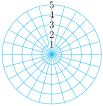


For Problems 5–8, convert the polar coordinates to Cartesian coordinates.
For Problems 9–12, convert the Cartesian coordinates to polar coordinates with and . Give exact values for and .
For Problems 13–16, sketch the region described by the inequalities.


For Problems 17–20, convert the equation into Cartesian coordinates.
For Problems 21–24, convert the equation into polar coordinates.
For Problems 25–28, use the catalog of polar graphs to help you identify and sketch the curve. Check your work by graphing with a calculator.
Circle of radius 3 centered at the origin
Circle of radius 3 centered at
For Problems 29–32, write a polar equation for the graph.


For Problems 33–36, find the coordinates of the intersection points of the two curves analytically. Then graph the curves to verify your answers.
,
and the pole
For Problems 37–40, perform the indicated operations on the complex numbers.
For Problems 41–44, evaluate the polynomial for the given values of the variable.
Verify that and are roots of the equation .
Verify that and are roots of the equation .
For Problems 47–50, expand the product of polynomials.
For Problems 51–52, sketch the set of points in the complex plane.
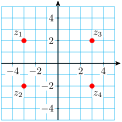
For Problems 53–56,
- Given one solution of a quadratic equation with rational coefficients, find the other solution.
- Write a quadratic equation that has those solutions.
For Problems 57–60, write the complex numbers in standard form. Give exact values for your answers.
For Problems 61–66, write the complex numbers in polar form. Give exact values for your answers.
For Problems 67–70, find the product and the quotient .
For Problems 71–74, find the power.
For Problems 75–78,
- Find the roots and plot them in the complex plane.
- Write the roots in standard form.
The square roots of
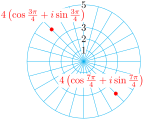
- ,
The cube roots of
The cube roots of
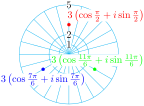
- , ,
The square roots of
For Problems 79–82, solve the equation.
for
for
Trigonometry by Katherine Yoshiwara (yoshiwarabooks.org), GNU Free Documentation License 1.2 or later. Adapted for the XYZ HTML edition with the authors' permission (recorded 2026-07-04). License: GFDL-1.2-or-later.