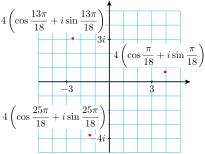
In Section 10.3 we represented the sum of two complex numbers graphically as a vector addition. Is there a way to visualize the product or quotient of two complex numbers? One way to explore a new idea is to consider a simple case. What happens to the vector representing a complex number when we multiply the number by ?
Let and calculate and .
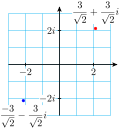
Plot and as points on the complex plane.
The previous example suggests that multiplication by a complex number results in a rotation. Polar coordinates are well suited to processes that involve rotation, because they use angles to specify location. Thus, we will next represent complex numbers in an alternate polar form.
Polar Form
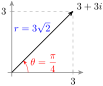
The figure below shows the complex number , represented as a vector in the complex plane. The distance from the origin to is
and the angle from the real axis to the vector is .
Using right triangle trigonometry, we see that
In general, we can write the real and imaginary parts of in terms of and as
Thus, the complex number can also be written as
.
Find the polar form for .
Of course, we can always recover the Cartesian form of a complex number from its polar form by evaluating the trigonometric functions. We'll check the result of the previous example:
Products and Quotients in Polar Form
The polar form is especially convenient for computing the product or quotient of two complex numbers.
This formula, which you will prove in the Homework Problems, says that the product of two complex numbers in polar form is the complex number with modulus and argument . Thus, to find the product of two complex numbers, we multiply their lengths and add their arguments.
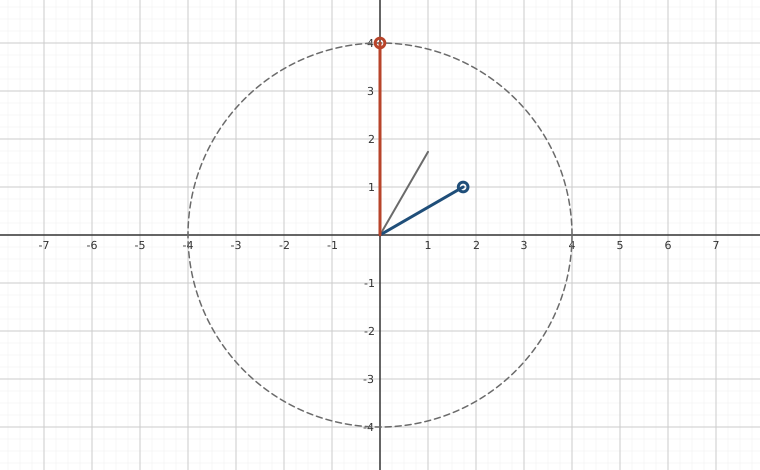
Interactive figureMultiplying complex numbers: lengths multiply, arguments addDrag the Modulus r of z and Argument α of z, in radians (steps of π/12) sliders.
XYZ Graph · viewer build 5edf91b
The product rule this sentence states, drawn in the complex plane. The gray vector is the fixed multiplier w = 2(cos 60° + i sin 60°); the blue vector is z, with its modulus r and argument α on sliders; the red vector is the product zw. Whatever you do with the sliders, two things hold: the red vector is exactly twice as long as the blue one (the moduli multiply, and ‖w‖ = 2), and it sits exactly 60° counterclockwise of the blue one (the arguments add, and w contributes π/3). So multiplying by w is a rotation-and-stretch — the geometric meaning of complex multiplication this section builds toward De Moivre's theorem. At the starting values z = 2(cos π/6 + i sin π/6), the product is the book's own worked example: zw = 4(cos π/2 + i sin π/2) = 4i, straight up the imaginary axis. The dashed circle of radius 2r traces every product you can reach by turning α alone.
Find the polar forms of and .
Compute the product .
,
The quotient of two complex numbers in polar form is computed in a similar fashion. We divide the moduli and subtract the arguments.
Compute the quotient for and .
Powers and Roots of Complex Numbers
Because raising to a power is just repeated multiplication, we can also use the polar form to simplify powers of a complex number. For example, if , then
We compute by squaring the modulus, , and doubling the argument, , so the polar form is
An analogous result holds for all positive integers , and is known as De Moivre's Theorem.
Compute , for .
DeMoivre's Theorem also works for rational values of , so we can compute roots of complex numbers. For example, by applying the theorem with , we see that one of the square roots of
is
Now, every number,whether real or complex, has two square roots. To find the other root, remember that we can add a multiple of to the argument of , that is, we can also write the polar form of as
The second square root of is thus
As an example consider whose polar form is
or by adding to the argument,
The two square roots of are
You can verify that both of these numbers are square roots of , for instance,
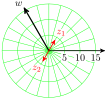
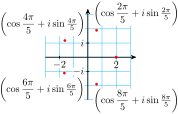
The graphs of and its two square roots are shown at right.
It is not hard to show that every number has three complex cube roots, four complex fourth roots, and so on.
Write in polar form.
Find four complex fourth roots of .
, , ,
Review the following skills you will need for this section.
Section 10.4 Summary
Vocabulary
Argument
Modulus
Concepts
Multiplying a complex number by rotates its graph by around the origin.
Study Questions
What happens to the vector representing a complex number when we multiply the number by ?
If , what do these expressions represent?
If and lie on the unit circle, explain why and also lie on the unit circle.
Explain how you could use DeMoivre's theorem to compute .
Skills
Convert from polar form to standard form #5–12
Write a complex number in polar form #13-22
Find the product or quotient of two complex numbers in polar form #25–32
Find a power of a complex number #33–42
Find the complex roots of a number #43–48, 51–52, 55–60
Homework 10-4
For Problems 1–4, simplify and plot each complex number as a point on the complex plane.
and
, , ,,
and
and
,
and
For Problems 5–8, write the complex numbers in standard form. Give exact values for your answers.
For Problems 9–12, write the complex numbers in standard form. Round your answers to hundredths.
)
For Problems 13–16, write the complex numbers in polar form. Give exact values for your answers.
and
,
and
and
,
and
For Problems 17–22, write the complex numbers in polar form. Round your answers to hundredths.
and
and
and
and
and
and
What can you conclude about the polar forms of and ?
If then
What can you conclude about the polar forms of and ?
For Problems 25–28, find the product and the quotient .
;
;
For Problems 29–32, convert the complex numbers to polar form, then find the product and the quotient .
;
,
;
,
For Problems 33–38, find the power.
For Problems 39–42, use De Moivre's theorem to find the reciprocal.
For Problems 43–48,
Find the roots and plot them in the complex plane.
Write the roots in standard form.
The square roots of
,
,
The fourth roots of
The fifth roots of
, , ,
, , ,
The cube roots of
The cube roots of
, ,
, ,
The square roots of
Show that any complex number of the form lies on the unit circle in the complex plane.
Show that if , then .
Find three distinct cube roots of 1.
Find four distinct fourth roots of 1.
Find five distinct fifth roots of 1.
Find six distinct sixth roots of 1.
Find the sum of the three distinct cube roots of 1. (Hint: Plot the roots.)
Find the sum of the four distinct fourth roots of 1.
Find the sum of the five distinct fifth roots of 1.
Find the sum of the six distinct sixth roots of 1.
If is a positive integer, define
for Show that . (We call an
root of unity.)
Let , where is a positive integer. Show that the distinct roots of unity are .
For Problems 55-60, solve the equation.
, , ,
, , , ,
,
, ,
,
Let . Compute by expanding the product.
Use De Moivre's theorem to compute .
Compare your answers to (a) and (b) to write identities for and .
Let . Compute by expanding the product.
Use De Moivre's theorem to compute .
Compare your answers to (a) and (b) to write identities for and .
Problems 63 and 64 show that multiplication by results in a rotation of .
Suppose that and that the real numbers and are both nonzero.
What is the slope of the segment in the complex plane joining the origin to ?
What is the slope of the segment in the complex plane joining the origin to ?
What is the product of the slopes of the two segments from parts (a) and (b)? What can you conclude about the angle between the two segments?
,
Suppose that and that and are both real numbers.
If and , then what is the slope of the segment in the complex plane joining the origin to ? What is the slope of the segment joining the origin to ?
If and , then what is the slope of the segment in the complex plane joining the origin to ? What is the slope of the segment joining the origin to ?
What can you conclude about the angle between the two segments from parts (a) and (b)?
Prove the product rule by following the steps.
Suppose and . Compute .
Now suppose that and . Write and in terms of and .
Substitute your expressions for and into your formula for .
Use the laws of sines and cosines to simplify your answer to part (c).
Let and . Prove the quotient rule as follows: Set and show that .
Trigonometry by Katherine Yoshiwara (yoshiwarabooks.org), GNU Free Documentation License 1.2 or later. Adapted for the XYZ HTML edition with the authors' permission (recorded 2026-07-04). License: GFDL-1.2-or-later.
These eBooks are a prerelease and are not yet certified conformant with WCAG 2.1 AA or ADA Title II. Every page is built against an automated accessibility gate, and the published editions will meet ADA Title II requirements when they release in late September 2026. If something is unusable, please tell us.