
Chapter 6: Radians
Have you ever wonderd why we divide the circle into 360 degrees? Nobody really knows the answer, but it may well have started around 600 BCE with the Babylonians.
The Babylonians lived between the Tigris and Euphrates rivers in present day Turkey and Syria. They kept written records using a stylus to press cuneiform, or wedge-shaped, symbols into wet clay tablets, which were then baked in the sun. Thousands of these tablets have survived and give us detailed information about the mathematical practices of the time.
The Babylonians used a base 60 number system because the number 60 has many factors. They did not invent decimal fractions, so they found it difficult to deal with remainders when doing division. But 60 can be divided evenly by 2, 3, 4, 5, and 6, which made calculations with common fractions much easier.
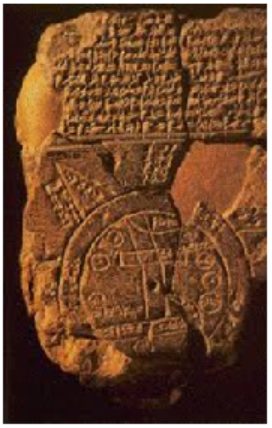
We still see traces of their base 60 system in our own day: there are 60 seconds in a minute, and 60 minutes in an hour.
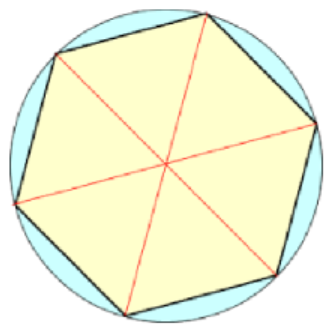
In geometry, Babylonian mathematicians used the corner of an equilateral triangle as their basic unit of angular measure, and naturally divided that angle into 60 smaller angles. Now, if the corners of six equilateral triangles are placed together they form a complete circle, and that is why there are six times 60, or 360 degrees of arc in a circle.
During the reign of Nebuchadnezzar, using the tools and technology available to them, Babylonian astronomers calculated that a complete year numbered 360 days. This made dividing the circle into 360 degrees even more useful.
So the number 360 is not fundamental to the nature of a circle. If ancient civilizations had defined the full circle to be some other number of degrees, we'd probably be using that number today.
But why do we need another, different way to measure angles? In this chapter we'll study radian measure, which at first may seem awkward and unnatural. As a hint, consider that although 360 is not fundamental to circles, the number is.
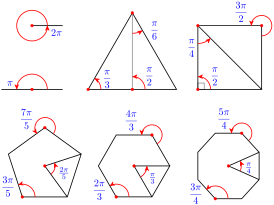
Radians connect the measure of an angle with the arclength it cuts out on a circle.
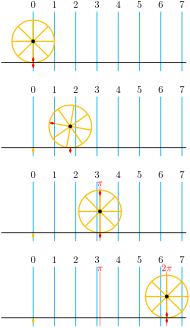
Imagine a circle of radius 1unit rolling along a straight line. The circumference of a circle is times the length of its radius, so when the circle has turned through one complete revolution, it has traveled a distance of units. When the circle has turned through half a revolution, it has taveled a distance of units.
In radian measure, the angle through which the circle has turned is equal to the distance the circle has traveled, or the length of the arc that has unrolled on the line.
The idea of radian measure was developed by Roger Cotes, an English mathematician who worked closely with Isaac Newton. He described the radian in everything but name, and recognized its naturalness as a unit of angular measure.
The term radian first appeared in print on June 5, 1873, on an exam written by James Thomson, the brother of Lord Kelvin, at Queen's College in Belfast.
In calculus and most other branches of mathematics beyond practical geometry, angles are nearly always measured in radians. Because radians arise naturally when dealing with circles, important relationships are expressed more concisely in radians. In particular, results involving trigonometric functions are simpler when the variables are expressed in radians.
Trigonometry by Katherine Yoshiwara (yoshiwarabooks.org), GNU Free Documentation License 1.2 or later. Adapted for the XYZ HTML edition with the authors' permission (recorded 2026-07-04). License: GFDL-1.2-or-later.