
9.4 Chapter Summary and Review
Key Concepts
- A quantity defined by both a magnitude (such as a distance) and a direction is called a vector.
- Two vectors are equal if they have the same length and direction; it does not matter where the vector starts.
- The length of a vector is called its magnitude, and is denoted by .
- The sum of two vectors and is a new vector, , starting at the tail of the first vector and ending at the head of the second vector. The sum is called the resultant vector.
- Addition of vectors is commutative. The rule for adding vectors is sometimes called the parallelogram rule.
- Any vector can be written as the sum of its horizontal and vertical vector components, and .
- The components of a vector whose direction is given by the angle in standard position are the scalar quantities
- The magnitude and direction of a vector with components and are given by
- To add two vectors using components, we can resolve each vector into its horizontal and vertical components, add the corresponding components, then compute the magnitude and direction of the resultant.
- A vector of magnitude 1 is called a unit vector. The unit vector in the direction of the -axis is denoted by . The unit vector in the direction of the -axis is called .
- The dot product is a way of multiplying two vectors that depends on the angle between them.
- The component of a vector in the direction of vector is the length of the vector projection of onto .
- Two vectors and are orthogonal if
Review Problems
For Problems 1–4, sketch an arrow to represent the vector. Find its components in the directions north and east.
A hawk is flying at a speed of 20 mph in the direction west of north.
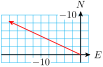
mph, mph
The island is located 36 miles from port on a bearing of .
The tractor pulls with a force of 1200 pounds in the direction west of south.
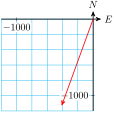
lbs, lbs
The current runs southeast at a speed of 4 mph.
For Problems 5–6, find the magnitude and direction of the vector.
For Problems 7–8, find the coordinate form of the vector.
For Problems 9–12,
- sketch the displacement vector and give its coordinate form,
- find the magnitude and direction of the vector.
The displacement vector from to

The displacement vector from to
This morning we began hiking from our camp 4 miles east and 2 miles south of the lodge, and this evening we are 6 miles east and 8 miles south of the lodge.
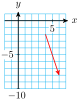
The tunnel should start 100 meters east and 400 meters north of the survey point, and should end 500 meters west and 150 meters north of the survey point.
For Problems 13–16,
- sketch the given vectors,
- calculate the magnitude and direction of the resultant vector.
A fire crew is located 2 kilometers due west of the fire station. The station reports a new hot spot 6 kilometers away in the direction east of north. How far is the hot spot from the fire crew, and in what direction?

A helicopter has just delivered a patient to the hospital located 15 miles northwest of the heliport. The pilot gets a call to pick up a passenger located 18 miles from the heliport on a bearing of . How far is the passenger from the helicopter, and in what direction?
Red Rock is located at from the town of Dry Gulch, measured in miles, and Skull Point is located at from Dry Gulch. How far is it from Red Rock to Skull Point, and in what direction?

A coast guard cutter is located 7 miles south and 5 miles west of port when it gets a distress call from a sailboat that reports its location as 1 mile north and 5 miles east of port. How far is it from the cutter to the sailboat, and in what direcion?
For Problems 17–18,
- find the horizontal and vertical components of the forces,
- use the components to calculate the resultant force.
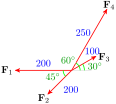
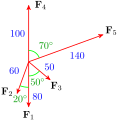
For Problems 19–22, find the vector, where
For Problems 23–26, find the vector described.
The unit vector in the same direction as .
The unit vector in the same direction as .
The vector of length 3 in the same direction as .
The vector of magnitude 6 in the same direction as
For Problems 27–28, find the component of in the direction of .
For Problems 29–30, compute the dot product .
For Problems 31–32, find the angle between the vectors.
Trigonometry by Katherine Yoshiwara (yoshiwarabooks.org), GNU Free Documentation License 1.2 or later. Adapted for the XYZ HTML edition with the authors' permission (recorded 2026-07-04). License: GFDL-1.2-or-later.