
9.1 Geometric Form
Introduction
One way to specify a location is to give a direction and a distance from a fixed landmark. For example, we might say that the airport is located 8 miles northeast of the town hall, or that a ship has been sighted 20 miles from the lighthouse in the direction 10° west of north. It's not enough to give just the distance to the object or just the direction; we need both to describe the object's location.
In mathematics, a quantity defined by both a magnitude (such as a distance) and a direction is called a vector. A vector used to designate location relative to a fixed landmark, as in the examples above, is called a position vector. Vectors are also used to analyze motion and velocity in two or three dimensions, to study forces such as gravity and electric fields, and to design computer graphics and animation.
We often illustrate a vector by an arrow. The length of the arrow represents the magnitude of the vector, and the direction of the vector is indicated by the head of the arrow.
Draw an arrow to represent the velocity of an airplane travelling southeast at a speed of 300 miles per hour.

Notation for Vectors
In print, we use boldface characters such as and to represent vectors. When writing by hand, we use an arrow above a variable to indicate that it is a vector, like this: .
It is important to distinguish vectors from quantities that have magnitude only, such as length or temperature. These quantities are called scalars. They are the constants and variables you are used to dealing with, which are usually denoted by italic letters such as or .
The length of a vector is called its magnitude, and is denoted by .
Two vectors may have the same length, but point in different directions. The figure at right shows two vectors, and , that have the same magnitude but different directions. For this example, , but . Two vectors are equal if and only if they have the same length and the same direction, but they can start at different locations. The fact that we can move vectors from one location to another is a useful property.

Sketch a vector that is equal to the vector shown at right, but that starts at the point .
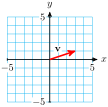
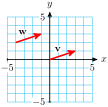
Scalar Multiplication of Vectors
We can multiply a vector by a scalar. The figure below shows the vector and the vector . Multiplying by a positive scalar changes the length of a vector but not its direction.
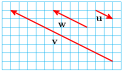
Thus, the vector is 3 times as long as the vector . If we multiply a vector by a negative scalar, we alter its length and reverse its direction; that is, we change the direction by . For example, the vector . It is half the length of , and points in the opposite direction.
In general, if is a real number, then represents the vector with magnitude times the magnitude of . It points in the same direction as when and in the opposite direction from when . Real numbers are called scalars because they “scale” vectors in this way, and multiplying a scalar times a vector is called scalar multiplication.
For the vector shown at right, draw the vectors and .


Addition of Vectors
A displacement vector represents the change in position from one point to another.
For example, suppose you leave home and travel 6 miles east and then 8 miles north. These two displacements are represented by the vectors and shown at right. When we follow one displacement vector by a second one, the net displacement is a new vector, , starting at the base of the first vector and ending at the head of the second vector.
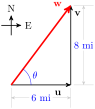
In this example, notice that forms the hypotenuse of a right triangle, so we can calculate its magnitude and direction.
The net displacement gives your current position relative to home: 10 miles in the direction north of east. When we follow one vector by a second vector as described above, we are adding the two vectors. The sum is called the resultant vector.
Draw the resultant vector .
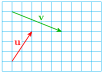

When the resultant vector forms the third side of a triangle, we can use the laws of sines and cosines to calculate its length and direction.
Delbert has gone sailing with friends. After leaving the marina, they sail for 5 miles on a bearing of and stop at Gull Island for lunch. (Recall that bearings are measured clockwise from north.) After lunch, they have sailed for 3 miles on a bearing of when they get a phone call to return home. What bearing is the most direct route back to the marina, and how far is it?
W of N, 3.58 mi
It doesn't matter which order we choose to add two vectors. As with the ordinary addition of scalars, the addition of vectors is commutative, so that . To see this, first draw and starting at the same point.

- To represent , we place the base of at the head of , and draw the resultant vector as shown at left.
- To represent , we place the base of at the head of , and the resultant vector is the same as the vector .
Because the vector sum forms the diagonal of a parallelogram in this picture, the rule for adding vectors is sometimes called the parallelogram rule.
We summarize the operations on vectors as follows.
Velocity
Physicists and mathematicians use the word velocity to mean not simply speed but the combination of speed and direction of motion. The interesting thing about velocities is that they add like vectors; if an object's motion consists of two simultaneous components, the resulting displacement is the same as if the motions had occurred one after the other.
For example, imagine a beetle walking across a moving conveyor belt, as shown in the figure below. The beetle walks across the belt at 2 inches per second. But the conveyor belt is moving at a speed of 4 inches per second from left to right in the figure, so the actual path of the beetle relative to the ground is diagonally across the belt.
After 1 second, the beetle has traveled from his starting point at on one side of he belt to point on the other side, a distance of , or about 4.47 inches. So his actual velocity relative to the ground is 4.47 inches per second, at an angle of from the direction of the conveyor belt.
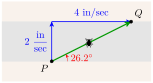
Notice that if the two motions were performed in succession instead of simultaneously, the resulting displacement would be the same. In other words, if the beetle had walked across the belt for 1 second before it started moving, and then ridden the belt for 1 second without walking, he would still end up at point .
Thus, velocity is a vector quantity, and we can calculate the result of two simultaneous motions by using the parallelogram rule. We treat the two motions as if they had occurred one after the other, by starting one vector at the endpoint of the other. (Remember we can move a vector from one location to another, as long as we preserve its length and direction.)
A plane heads due north at an airspeed of 120 miles per hour. There is a 45 mph wind traveling south of due east. What are the plane’s actual speed and direction relative to the ground?
124.4 mph, east of north
In some situations, instead of calculating a vector sum, we would like to find a vector to produce a particular sum. That is, we know vectors and , and we want to find a vector so that .
Ahab would like to sail at 20 kilometers per hour due west towards a whale reported at that position. However, a steady ocean current is moving east of north at 8 kilometers per hour. At what speed and heading should Ahab sail?
26.76 kph south of west
Components of a Vector
We have seen that we can add two vectors to get a third or resultant vector. We can also break down a vector into two or more component vectors. For many applications, it is useful to break a vector into horizontal and vertical components.
For example, the beetle on the conveyor belt moved at 4.47 inches per second in the direction . If we set up coordinate axes as shown below, the vector representing his velocity is the sum of the beetle's motion in the -direction, , at 4 inches per second, and his motion in the -direction, , at 2 inches per second.
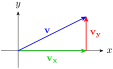
We can break down any vector into its - and -components, and the sum of those components is equal to the original vector. In other words, .
The horizontal and vertical vectors and are called the vector components of . If we designate the direction of by an angle measured counter-clockwise from the positive -axis, then the scalar quantities given by
are called simply the components of the vector .
Note that the components and of a vector are scalars; they are not vectors themselves. They can be either positive or negative (or zero).
The wind is blowing 50 kilometers per hour in a direction south of due west. Find the - and -components of its velocity.
kph, kph
Using Components
We can describe a vector completely using either magnitude and direction or components. Many calculations with vectors are simpler when we use components. For example, to add two vectors using components, we don't need the laws of sines and cosines. We resolve each vector into its horizontal and vertical components, add the corresponding components, then compute the magnitude and direction of the resultant vector.
To calculate magnitude and direction from the components, we need only right triangle trigonometry.
A plane is flying in a wind blowing 50 kilometers per hour in a direction south of due west. The plane has an airspeed of 200 kph and bearing What is the ground speed and actual direction of the plane?
groundspeed 182 kph, S of E
Review the following skills you will need for this section.
Section 9.1 Summary
Vocabulary
- Vector
- Scalar
- Magnitude
- Scalar multiplication
- Displacement vector
- Resultant vector
- Parallelogram rule
- Velocity
- Vector components
- Components
Concepts
- A quantity defined by both a magnitude (such as a distance) and a direction is called a vector.
- Two vectors are equal if they have the same length and direction; it does not matter where the vector starts.
- The length of a vector is called its magnitude, and is denoted by .
- The sum of two vectors and is a new vector, , starting at the tail of the first vector and ending at the head of the second vector. The sum is called the resultant vector.
- Addition of vectors is commutative. The rule for adding vectors is sometimes called the parallelogram rule.
- Any vector can be written as the sum of its horizontal and vertical vector components, and .
- The components of a vector whose direction is given by the angle in standard position are the scalar quantities
- The magnitude and direction of a vector with components and are given by
- To add two vectors using components, we can resolve each vector into its horizontal and vertical components, add the corresponding components, then compute the magnitude and direction of the resultant.
Study Questions
- What is the difference between a scalar and a vector?
- If velocity is represented by a vector, what is its magnitude called?
- Does ? Does ?
- What is the parallelogram rule?
- What are the components of a vector? Does ?
Skills
- Sketch a vector #1–6
- Identify equal vectors #7–10
- Sketch a scalar multiple of a vector #11–14
- Sketch the sum of two vectors #15–22
- Calculate a resultant vector #23–32, 45–48
- Use vectors to solve problems #33–36
- Find components of a vector #37–40
- Find the magnitude and direction of a vector given in components #41–44
- Subtract vectors #49–58
Homework 9-1
For Problems 1–6, sketch a vector to represent the quantity.
The waterfall is 3 km away, in a direction south of west.

The cave entrance is 450 meters away, north of east.
The current is moving 6 feet per second in a direction east of north.

The bird is flying due south at 45 mile per hour.
The projectile was launched at a speed of 40 meters per second, at an angle of above horizontal.

The baseball was hit straight up at a speed of 60 miles per hour.
For Problems 7–10, which vectors are equal?
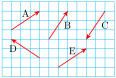
and

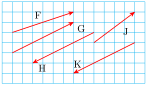
and
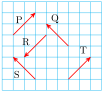
For Problems 11–14, sketch a vector equal to , but starting at the given point.


For Problems 15–18, draw the scalar multiples of the given vectors.

and


and

and


and
For Problems 19–26,
- draw the resultant vector,
- calculate the length and direction of the resultant vector.


For Problems 27–30, find the magnitude and direction of the vector.
For Problems 31–38, sketch the vectors, then calculate the resultant.
Add the vector of length 45 pointing east of north to the vector of length 32 pointing south of west.

Add the vector of length 105 pointing west of south to the vector of length 77 pointing west of north.
Let have length 8 and point in the direction counterclockwise from the positive -axis. Let have length 13 and point in the direction counterclockwise from the positive -axis. Find .
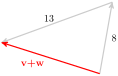
Let have length 43 and point in the direction counterclockwise from the positive -axis. Let have length 19 and point in the direction counterclockwise from the positive -axis. Find .
Esther swam 3.6 miles heading east of north. However, the water current displaced her by 0.9 miles in the direction east of north. How far is Esther from her starting point, and in what direction?

4.47 mi, east of north
Rani paddles her canoe 4.5 miles in the direction west of north. The water current pushes her 0.3 miles off course in the direction east of north. How far is Rani from her starting point, and in what direction?
Brenda wants to fly to an airport that is 103 miles due west in 1 hour. The prevailing winds blow in the direction east of north at 28 miles per hour, so Brenda will head her plane somewhat north of due west to compensate. What airspeed and direction should Brenda take?

129.4 mph, west of north
Ryan wants to cross a 300 meter wide river running due south at 80 meters per minute. There are rocks upstream and rapids downstream, so he wants to paddle straight across from east to west. In what direction should he point his kayak, and how fast should his water speed be in order to cross the river in 2 minutes? (Hint: The current will move him 160 meters due south compared with where his speed and direction would take him if the current stopped. Compute the distance he would have traveled, then divide by 2 minutes to get the speed.)
For Problems 39–42,
- find the horizontal and vertical components of the vectors,
- use the components to calculate the resultant vector.
A ship maintains a heading of east of north and a speed of 20 miles per hour. There is a current in the water running south of east at a speed of 10 miles per hour. What is the actual direction and speed of the ship?
- 19.9 mph, east of north
A plane is heading due south, with an airspeed of 180 kilometers per hour. The wind is blowing at 50 kilometers per hour in a direction south of west. What is the actual direction and speed of the plane?
The campground is 3.6 kilometers from the trail head in the direction west of north. A ranger station is located 2.3 kilometers from the campsite in a direction of west of south. What is the distance and direction from the trail head to the ranger station?
- 1.9 km, west of north
The treasure is buried 40 paces due east from the dead tree. From the buried treasure, a hidden mine shaft is 100 paces distant in a direction of north of west. What is the distance and direction from the dead tree to mine shaft?
Subtracting Vectors
Multiplying a vector by gives a vector that has the same magnitude as but points in the opposite direction. We define subtraction of two vectors the same way we define subtraction of integers:
That is, to subtract a vector , we add its opposite.
For Problems 43–50, draw the resultant vector.


Find the horizontal and vertical components of , , and from Problem 43. What do you notice when you compare the horizontal components of two vectors with the horizontal component of the difference?
, , ,, , ; ,
Find the horizontal and vertical components of , , and from Problem 44. What do you notice when you compare the vertical components of two vectors with the vertical component of the difference?
Trigonometry by Katherine Yoshiwara (yoshiwarabooks.org), GNU Free Documentation License 1.2 or later. Adapted for the XYZ HTML edition with the authors' permission (recorded 2026-07-04). License: GFDL-1.2-or-later.