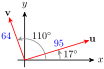
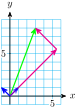
We have seen that it can be useful to resolve a vector into horizontal and vertical components. We can also break a vector into components that point in other directions.
Imagine the following experiment: Delbert holds a ball at shoulder height and then drops it, so that it falls to the ground. Francine holds a ball at shoulder height on an inclined ramp, then releases it so that it rolls downhill. Which ball will reach the ground first?
Although gravity causes both balls to speed up, the free-falling ball will reach the ground first. The force of gravity pulls straight down, the same direction as the motion of the free-falling ball, but the rolling ball must move at an angle to the pull of gravity, along the surface of the ramp. Only part of the gravitational force accelerates the rolling ball, and the rest of the force is counteracted by the surface of the ramp. What fraction of the gravitational force causes the ball to roll?
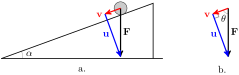
In figure (a), the gravitational force is resolved into the sum of two vectors, , where points down the ramp, and is perpendicular to the ramp. The magnitude of is called the component of in the direction of motion, and is denoted by . This is the portion of the gravitational force that moves the ball. From figure (b), we see that , where is the angle between and .
With a little geometry, you can verify that in this example the angle is the complement of the angle of inclination of the ramp, . (Think of similar triangles.) Now suppose that we increase the angle of inclination. As increases, decreases, increases, and hence increases. This result agrees with our experience: as the ramp gets steeper, the ball rolls faster.
Delbert pushes a lawn mower whose handle makes a angle with the horizontal. If he applies a force of 30 pounds in the direction of the handle, what is the component of the force in the horizontal direction?
23 pounds
Coordinate Form for Components
In the examples above, we computed the component of a force in the direction of a vector by knowing the angle between and . If the vectors are given in coordinate form (that is, ), we may not know the angle between them. Can we compute the component of a vector in the direction of , in terms of the coordinates of and?
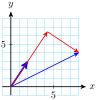
Suppose and , as shown below. We will need to compute the cosine of in terms of and .
First verify that
Because , we use the subtraction formula for cosine.
And finally,
Now we have a fromula for the component of a vector in the direction of a vector .
Write the vector as the sum of two components, one parallel to and the other perpendicular to .
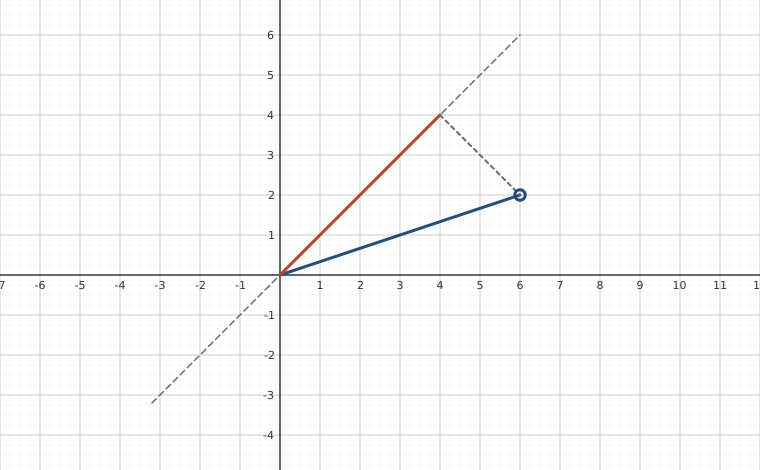
Interactive figureResolving w into components along and across vDrag the Component c of w (east-west) and Component d of w (north-south) sliders.
XYZ Graph · viewer build 5edf91b
The example's decomposition, live. The dashed line carries the direction of v = i + j; the blue vector is w = ci + dj with its components on sliders; the red vector is the part of w parallel to v, and the gray dashed connector from its tip to w's tip is the perpendicular part — at every setting the two add back to w, and the connector meets the dashed line at a right angle. At the starting values w = 6i + 2j, this is exactly the worked example: w = (4i + 4j) + (2i − 2j). The red part's length is the component of w in the direction of v — and its sign matters: slide w below the dashed line's perpendicular (make c + d negative, say w = i − 4j) and the red vector points backward along v, a negative component. At c + d = 0 — try w = 3i − 3j — w is perpendicular to v, the parallel part vanishes entirely, and w is all crosswise: the orthogonal case, where the dot product is zero.
The Dot Product
The expression , which we encountered above as part of the formula for , is quite useful and is given a name; it is called the dot product of the vectors and .
It is easy to remember the formula for the dot product if we think of adding the product of the -components and the product of the -components of the two vectors.
In the examples above, you can see that the dot product of two vectors is a scalar. For this reason, the dot product is also called the scalar product.
Compute the dot product of and .
We can now write the formula for using the dot product.
We have derived an alternate formula for a component of a vector.
Compute the component of in the direction of .
Geometric Meaning of the Dot Product
An even more important relationship, which gives geometric meaning to the dot product, follows from the formula for a component. We now have two ways to compute the component of in the direction of :
Equating these two expressions, we find
or . This is a geometric formula for the dot product.
The dot product is a way of multiplying two vectors that depends on the angle between them.
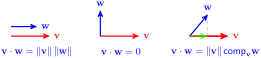
If , so that and point in the same direction, then and is just the product of their lengths, .
If and are perpendicular, then , so . (Two vectors and are said to be orthogonal if their dot product is zero.)
If is between and , the dot product multiplies the length of times the component of in the direction of .
Show that the vectors and are orthogonal.
Find a vector perpendicular to .
Using the dot product, we can find the angle between two vectors.
Find the angle between the vectors and .
Review the following skills you will need for this section.
Section 9.3 Summary
Vocabulary
Dot product
Scalar product
Orthogonal
Concepts
The dot product is a way of multiplying two vectors that depends on the angle between them.
The component of a vector in the direction of vector is the length of the vector projection of onto .
Two vectors and are orthogonal if
Study Questions
If and have the same direction, what is ?
If is perpendicular to , what is ?
What is the angle between and that makes their dot product as large as possible?
What does the dot product of two unit vectors tell you?
Skills
Find the component of in the direction of #1–6, 37–40
Compute the dot product #11–22, 27–36
Find the angle between two vectors #23–26
Resolve a vector into components in given directions #7–10, 41–42
Homework 9-3
For Problems 1–6, find the component of in the direction of .
For Problems 7–10,
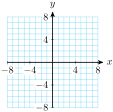
Resolve into two components, one parallel to and the other orthogonal to .
Sketch both vectors and the vector components.
For Problems 11–18, compute the dot product .
has magnitude 3 and direction , and has magnitude 8 and direction .
has magnitude and direction , and has magnitude and direction .
For Problems 19–22, decide whether the pair of vectors is orthogonal.
and
not orthogonal
and
and
orthogonal
and
For Problems 23–26, find the angle between the vectors.
and
and
and
and
For Problems 27–30, find a value of so that is orthogonal to .
For Problems 31–36, evaluate the expression for the vectors
Gary pulls a loaded wagon along a flat road. The handle of the wagon makes an angle of to the horizontal. If Gary pulls with a force of 60 pounds, find the component of the force in the direction of motion.
38.57 lbs
Wassily is trying to topple a statue by pulling on a rope tied to the statue's upraised arm. The rope is making a angle from horizontal. If Wassily is pulling on the rope with a force of 250 pounds, find the component of the force in the horizontal direction.
An SUV weighing 6200 pounds is parked on a hill with slope . Find the force needed to keep the SUV from rolling down the hill.
1289 lbs
Steve's boat is headed due north, and the sail points at an angle of east of north. The wind is blowing in the direction west of south, but because of the difference in air pressure between the front and back surfaces of the sail, the boat experiences a force of 400 pounds in the direction the sail is facing. Find the component of the force in the direction of the boat's motion.
Find unit vectors and in the directions of and .
Show that and are orthogonal.
Find the components of in the directions of and .
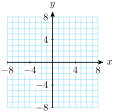
Sketch the vectors and , and show the components of .
and
Find unit vectors and in the directions of and .
Show that and are orthogonal.
Find the components of in the directions of and .
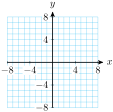
Sketch the vectors and , and show the components of .
For Problems 43–48, let and .
Show that .
If , show that .
Show that .
Prove the distributive law: .
Show that .
If , show that is perpendicular to .
Show that the component of in the direction of is , and the component of in the direction of is .
and
Show that the dot product gives the length of times the component of in the direction of .
Start from the geometric definition and show that and .
Use part (a) and Problems 45 and 46 to derive the coordinate definition of .
Both and because ;
Show that
Use part (a) to prove the triangle inequality:
Use the dot product to show that .
Use the figure at right to explain why part (a) proves the law of cosines.
Let , and
If is a unit vector, and the angle between and is , show that .
Suppose and are unit vectors, as shown in the figure at right. Use the dot product to prove that
Trigonometry by Katherine Yoshiwara (yoshiwarabooks.org), GNU Free Documentation License 1.2 or later. Adapted for the XYZ HTML edition with the authors' permission (recorded 2026-07-04). License: GFDL-1.2-or-later.
These eBooks are a prerelease and are not yet certified conformant with WCAG 2.1 AA or ADA Title II. Every page is built against an automated accessibility gate, and the published editions will meet ADA Title II requirements when they release in late September 2026. If something is unusable, please tell us.