In Section 9.1 we saw how to resolve a vector into horizontal and vertical components. Thus, every vector can be expressed as the sum of a horizontal vector and a vertical vector.
A vector has magnitude 2 and direction , where is in standard position. Express as the sum of a horizontal vector, , and a vertical vector, .
, where and points to the left; and points upward.
Unit Vectors
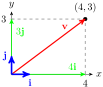
It is often useful to describe a vector by giving its horizontal and vertical components, instead of its magnitude and direction. To make the notation easier, we give names to the vectors of length 1 that point in the - and -directions. A vector of magnitude 1 is called a unit vector. We can have unit vectors in any direction, but the unit vector in the -direction is denoted by , and the unit vector in the -direction is called , as shown below.
By taking scalar multiples of and , we can describe any vector that lies in the directions of the coordinate axes. For example, represents the vector of magnitude 4 pointing in the -direction, and represents the vector of magnitude 3 pointing in the-direction. And by adding multiples of and , we can represent any vector we like. The vector is shown at right.
Because the components of the vector are chosen to align with the coordinate system, we call this the coordinate form of the vector.
The coordinate form of the vector in the previous example is .
State the coordinate form of the vector shown at right.
Converting Between Geometric and Coordinate Form
It is a simple matter to find the magnitude and direction of a vector given in coordinate form. The vector has magnitude
and direction . Thus, we can readily convert vectors from geometric form to coordinate form or vice versa.
Find the geometric form of the vector .
magnitude 10, direction
Scalar Multiples of Vectors in Coordinate Form
Scalar multiplication is easy to compute in coordinate form. This is really a consequence of the fact that the sides of similar triangles are proportional.
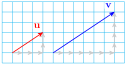
The figure at right shows the vectors and . The vector is twice as long as and points in the same direction as . You can see that each component of is twice the corresponding component of , so that .
In other words, to find a scalar multiple of a vector in coordinate form, we multiply each component by the scalar.
Find the coordinate form for the vector , where .
If we divide a non-zero vector by its own length, we create a unit vector that points in the same direction as . (Dividing a vector by a scalar is the same as multiplying the vector by .)
By computing its length, you can check that the vector found in the previous Example really is a unit vector.
Once we have a unit vector that points in a given direction, we can create a vector of any length in that direction, simply by scaling by the length we desire. For example, the vector of length 10 pointing in the same direction as in the previous example is
Find a unit vector and a vector of length 10 pointing in the same direction as .
,
Adding Vectors in Coordinate Form
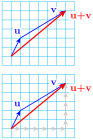
It is also easy to add vectors in coordinate form. The figure below shows the sum of and . Remember that we add two vectors by following the first vector by the second.
The vector sum describes the path
But we arrive at the same endpoint by traveling
The resultant vector has components that are just the sums of the components of the vectors and . To add two vectors in coordinate form, we add the corresponding components.
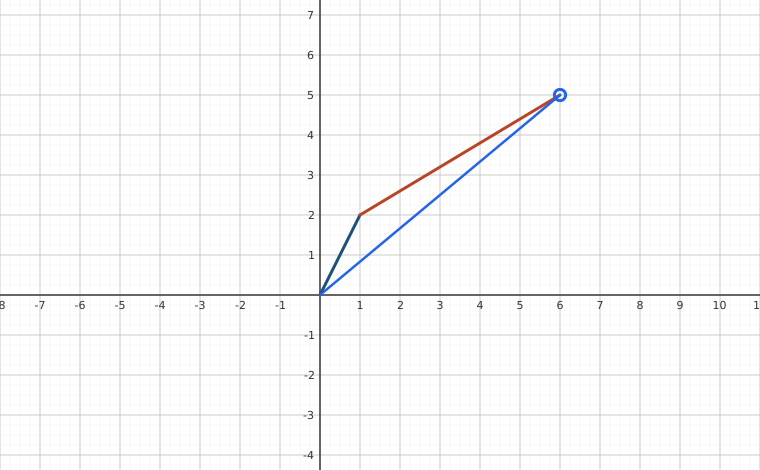
Interactive figureAdding vectors component by componentDrag the Component c of v (east-west) and Component d of v (north-south) sliders.
XYZ Graph · viewer build 5edf91b
The rule above, drawn tip-to-tail. The blue vector is fixed at u = i + 2j; the red vector v = ci + dj follows it, with its components c and d on the sliders; and the bright arrow from the origin is the resultant u + v, its endpoint marked with a dot. At the starting values v = 5i + 3j, this is exactly the book's figure: travel 1 right and 2 up, then 5 right and 3 up, and you arrive at (6, 5) — the components add. Slide c and d anywhere and the dot always lands at (1 + c, 2 + d). One setting deserves a special look: at v = −i − 2j, the exact opposite of u, the resultant collapses to the zero vector and the dot sits at the origin — the u + v = 0 case the section discusses.
Arianna's yacht heads west of north at a speed of 20 kilometers per hour relative to the water. However, the water is moving east of north at 4 kilometers per hour. What is Arianna's velocity relative to land?
21.1 kph, east of due north
The coordinate form is especially efficient if we want to add more than two vectors.
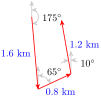
From your campsite you hike 1.6 km in the direction , then 0.8 km in the direction , and finally 1.2 km in the direction .
Draw a diagram for your hike, using vectors to represent each of the three segments.
Resolve each vector into components, and determine your location after your hike.
The three vectors describing the hike are , , and . Your final locations is .
Force
When you push or pull on something, you are exerting a force on the object. For example, the weight of an object is actually a force, the result of gravity pulling the object towards the earth. A force has magnitude (measured in pounds) and direction, so force is a vector quantity. A force applied to an object causes the object to accelerate in the direction of the force.
When two or more forces act simultaneously on an object, the object moves as if it were acted on by the sum of the individual force vectors. The sum of all the forces acting on an object is called the resultant force.
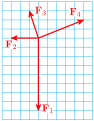
Two tugboats pull on a barge in the river with forces and , measured in thousands of pounds. In what direction will the barge move, and what is the magnitude of the force propelling it?
48.04 thousand lbs
If vectors and have the same magnitude but opposite directions, then has zero magnitude and is called the zero vector. A zero displacement vector means that the object started and ended in the same place; a zero velocity vector means that the object is not moving. We denote the zero vector by , so .
The vector that has the same magnitude as but the opposite direction is called the opposite of and denoted by . Then
If the sum of the forces acting on an object is , the forces are said to be in equilibrium, and the object will remain stationary.
Suppose that and that and What is the coordinate form of vector ?
Review the following skills you will need for this section.
Section 9.2 Summary
Vocabulary
Unit vector
Coordinate form
Geometric form
Zero vector
Concepts
A vector of magnitude 1 is called a unit vector. The unit vector in the direction of the -axis is denoted by . The unit vector in the direction of the -axis is called .
Study Questions
Is it easier to add vectors in geometric form or in coordinate form? Why?
To find a unit vector in the direction of , multiply the coordinates of
by ______.
To find a vector of length in the direction of , multiply the coordinates of
by ______.
Name two physical quantities that are represented by vectors.
Skills
Convert the coordinate form of a vector to geometric form #7–18
Convert the geometric form of a vector to coordinate form #19–22, 47–50
Compute sums and scalar multiples of vectors #1–8, 23–28, 47–50
Find a vector in a given direction with a given length #39–46
Solve problems with vectors #51–60
Homework 9-2
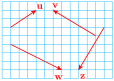
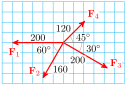
For Problems 1–4, give the coordinate form of each vector shown in the figure. Use the coordinate form to find the following.
For the vectors and above, calculate and .
Which of the following statements is true?
and
For the vectors and above, calculate and .
Which of the following statements is true?
For Problems 7–10,
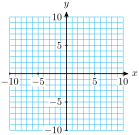
Sketch the vector and give its coordinate form.
Find the magnitude and direction of the vector.
The displacement vector from to .
The displacement vector from to .
The displacement vector from to .
The displacement vector from to .
Hermione is 12 meters east and 3 meters north of Harry. Ron is 6 meters east and 9 meters north of Hermione.
Calculate the displacement vector from Harry to Ron in coordinate form. Let point east and point north.
Find the magnitude and direction of the displacement vector.
Delbert and Francine are climbing a rock wall. Delbert is 8 feet to the right and and 23 feet above their starting point. Francine is 2 feet to the right and 7 feet above Delbert.
Calculate the displacement vector from the starting point to Francine in coordinate form. Let point right and point up.
Find the magnitude and direction of the displacement vector.
For Problems 13–18, find the magnitude and direction of the vector.
For Problems 19–22, find the coordinate form of the vector.
For Problems 23–26, sketch each vector and its components. Use the coordinate form to find the resultant vector , and sketch it.
For Problems 27–30, find the sum of the given vectors.
For Problems 31–38, find the coordinate form of the vector, where
For Problems 39–42, find a unit vector in the same direction as the given vector.
For Problems 43–46, find a vector in the same direction as , but with the given length.
For Problems 47–50,
Draw a diagram using arrows to represent the vectors.
Convert each vector to coordinate form.
Use the coordinate form to add or subtract the vectors.
Find , where has magnitude 2.6 and direction , has magnitude 5.8 and direction .
Find , where has magnitude 50 and direction , has magnitude 70 and direction .
Find , where has magnitude 35 and direction , has magnitude 60 and direction .
Find , where has magnitude 12.4 and direction , has magnitude 8.8 and direction .
For Problems 51–56,
Make a sketch using vectors to illustrate the problem.
Use the coordinate form of the vectors to solve problem.
The tornado displaced the trash bin to a spot 500 meters north and 800 meters east of its original position, and the flood later displaced the bin 2000 meters due south from there. How far and in what direction was the trash bin moved from it original position?
1700 m, east of south
A radio-controlled model plane pointed due west with an airspeed of 15 miles per hour, but there was a crosswind from the north at a speed of 8 miles per hour. How fast and in what direction is the plane moving relative to the ground?
Nimish flies 10 km in a direction north from east, then turns and flies an additional 12 km due west. How far and in what direction is Nimish's final position relative to his starting point?
21.98 km, north of west
Dena sails 500 yards due south, then turns and sails 350 yards in the direction from east. How far and in what direction is Dena's final position relative to her starting point?
After leaving the airport, Kelly flew 30 miles at a heading east of north, then 50 miles east of north, and finally 12 miles south of east. What is her current position relative to the airport?
83 mi, east of north
On a whale-watching trip, the SS Dolphin sailed 15 miles from port on a bearing of , then 8 miles on a bearing of , and then 4 miles on a bearing of . What is her current position relative to port?
For Problems 57–60,
Find the resultant force.
Find the additional force needed for the system to be in equilibrium.
Find the magnitude of the vector, and the magnitude of the vector , and verify that .
Let , and verify that , for .
Find the magnitude of the vector , and verify that the vector has magnitude 1.
Let , where and are not both , and verify that is a unit vector.
Trigonometry by Katherine Yoshiwara (yoshiwarabooks.org), GNU Free Documentation License 1.2 or later. Adapted for the XYZ HTML edition with the authors' permission (recorded 2026-07-04). License: GFDL-1.2-or-later.
These eBooks are a prerelease and are not yet certified conformant with WCAG 2.1 AA or ADA Title II. Every page is built against an automated accessibility gate, and the published editions will meet ADA Title II requirements when they release in late September 2026. If something is unusable, please tell us.