
8.4 Chapter Summary and Review
Key Concepts
- Identities are useful for changing from one form to another when solving equations, for simplifying expressions, and for finding exact values for trigonometric functions.
- it is not true in general that is equal to for all angles and , or that is equal to .
- Using one of the calculator keys , or performs the inverse operation for computing a sine, cosine or tangent.
- Two functions are called inverse functions if each "undoes" the results of the other function.
- If is a function, we can often find a formula for the inverse function by interchanging and in the formula for the function, and then solving for .
- The graphs of and are symmetric about the line .
- The domain of is the same as the range of , and the range of is the same as the domain of .
- A function has an inverse function if and only if is one-to-one.
- The inverse sine function is also called the arcsine function and denoted by . Similarly, the inverse cosine function is sometimes denoted by , and the inverse tangent function by .
- When simplifying expressions involving inverse trigonometric functions, it can often clarify the computations if we assign a name such as or to the inverse trig value.
- We can obtain graphs of the secant, cosecant, and cotangent functions as the reciprocals of the three basic functions.
- We can solve equations of the form , , and by taking the reciprocal of both sides.
- If we know one of the trigonometric ratios for an angle, we can use identities to find any of the others.
- We can often simplify trigonometric expressions by first converting all the trig ratios to sines and cosines.
Review Problems
For Problems 1–8, answer true or false.
False
True
False
False
If and find an exact value for .
If and find an exact value for .
If and find exact values for
If and find exact values for
If and find .
If and find .
For Problems 15-16, use the sum and difference formulas to expand each expression.
For Problems 17–18, use the figure to find the trigonometric ratios.

For Problems 19–24, use identities to simplify each expression.
For Problems 25–26,
- Use identities to rewrite the equation in terms of a single angle.
- Solve. Give exact solutions between and .
For Problems 27–28, graph the function and decide if it has an inverse function.
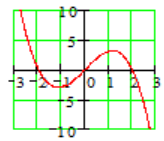
No
For Problems 29–30, give exact values in radians.
An IMAX movie screen is 52.8 feet high.
- If your line of sight is level with the bottom of the screen, write an expression for the angle subtended by the screen when you sit feet away.
- Evaluate your expression for feet and for feet.
Rembrandt's painting The Night Watch measures 13 feet high by 16 feet wide.
- Write an expression for the angle subtended by the width of the painting if you sit feet back from the center of the painting.
- Evaluate your expression for feet and for feet.
For Problems 33–34, solve for .
For Problems 35–36, find exact values without using a calculator.
For Problems 37–38, simplify the expression.
Explain why one of the expressions or must be undefined.
Because is undefined for . If , then either or . If , then is undefined.
Does ? Does ?
For Problems 41–42, evaluate. Round answers to 3 decimal places if necessary.
For Problems 43–50, find all six trigonometric ratios for the angle .

, , , , ,

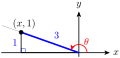
, , , , ,
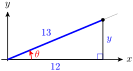
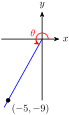
, , , , ,

,
, , , ,
is obtuse
For Problems 51–56, write algebraic expressions for the six trigonometric ratios of the angle.
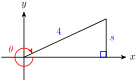
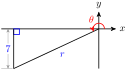
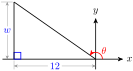
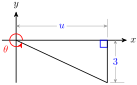
For Problems 57–58, find all six trigonometric ratios of the arc . Round to two places.
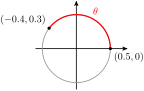
, , , , ,
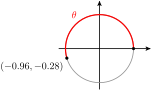
For Problems 59–62, evaluate exactly.
For Problems 63–64, find all solutions between and . Round your solutions to tenths.
For Problems 65–70, sketch a graph of each function. Then choose the function or functions described by each statement.
The graph has vertical asymptotes at multiples of .
or
The graph has a horizontal asymptote at .
The function values are the reciprocals of .
The function is defined only for -values between and , inclusive.
None of the function values lie between and .
or
The graph includes the origin.
For Problems 71–74,
- Graph the function on the interval , and use the graph to write the function in a simpler form.
- Verify your conjecture algebraically.
For Problems 75–78, simplify the expression.
For Problems 79–82, use the suggested substitution to simplify the expression.
This problem outlines a geometric proof of difference of angles formula for tangent.
- In the figure below left, and . Write expressions in terms of and for the sides and .
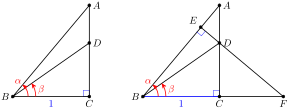
- In the figure above right, explain why is similar to .
- Explain why .
- Write an expression in terms of and for side .
- Explain why is similar to .
- Justify each equality in the statement
- They are right triangles that share .
- is the complement of and is the complement of .
- so
- They are right triangles with .
- so and are ratios of corresponding sides of similar triangles; by part (a), by part (d).
Let and be two lines with slopes and , respectively, and let be the acute angle formed between the two lines. Use an identity to show that
For Problems 85–86, use the fact that if is one angle of a triangle and is the length of the opposite side, then the diameter of the circumscribing circle is
Round your answers to the nearest hundredth.
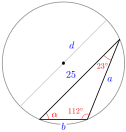
In the figure above, find the diameter of the circumscribing circle, the angle , and the sides and .
A triangle has one side of length 17cm and the angle opposite is . Find the diameter of the circle that circumscribes the triangle.
Trigonometry by Katherine Yoshiwara (yoshiwarabooks.org), GNU Free Documentation License 1.2 or later. Adapted for the XYZ HTML edition with the authors' permission (recorded 2026-07-04). License: GFDL-1.2-or-later.