
8.3 The Reciprocal Functions
Three More Functions
The three basic trigonometric functions occur so often as the denominator of a fraction that it is convenient to give names to their reciprocals. We define three new trigonometric functions as follows.
We can find exact values for all six trig functions at a given angle if we know the value of any one of them.
If , and , find exact values for the other five trig functions.
, , , ,
By comparing the definitions of secant, cosecant, and cotangent to the three basic trigonometric functions, we find the following relationships.
Calculators do not have keys for the secant, cosecant, and cotangent functions; instead, we calculate their values as reciprocals.
Use a calculator to approximate to three decimal places.
Of course, we can also evaluate the reciprocal trig functions for angles in radians, or for real numbers. Thus for example,
In particular, the exact values for the reciprocal trig functions of the special angles are easily obtained.
| Exact Values for the Special Angles | |||
|---|---|---|---|
| undefined | undefined | ||
| undefined | |||
Each of the reciprocal functions is undefined when its denominator is equal to zero. For example, the secant is undefined when , or when is an odd multiple of .
For what angles is the cotangent undefined? Give your answers in degrees and in radians.
Multiples of , or multiples of .
Application to Right Triangles
In Chapter 2 we defined three trigonometric ratios for an acute angle; namely, sine, cosine, and tangent. When we take the reciprocals of those ratios, we obtain expressions for the secant, cosecant, and cotangent.
Although we can express any relationship between the sides of a right triangle using sine, cosine, and tangent, sometimes it is more convenient to use one of the reciprocal functions.
The area of a regular polygon with sides having perimeter satisfies
Refer to the figure at right showing to prove this formula in the following steps.

- Find an expression for the angle in terms of .
- Find an expression for the base of the triangle shown.
- Find an expression for the height of the triangle.
- Write an expression for the area of the triangle, and then for the area of the entire polygon.
Graphs of the Reciprocal Functions
We can obtain graphs of the reciprocal trig functions by plotting points, as we did for the sine, cosine and tangent functions. However, it is more enlightening to construct these graphs as the reciprocals of the three basic functions.
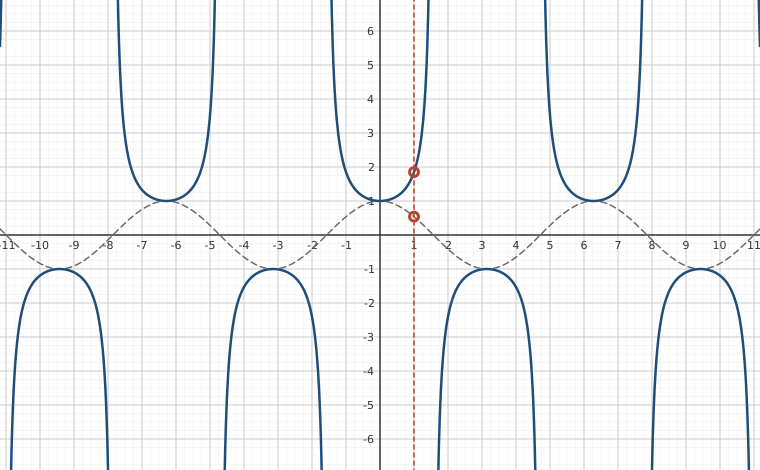
Use the graph of to sketch a graph of .
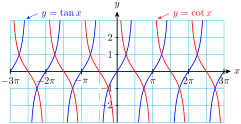
The graphs of the three new functions are shown below, with in radians. Note that the secant function is undefined at odd multiples of , the values at which . The cosecant is undefined where , namely at multiples of . The cotangent is also undefined at multiples of , because at those values.
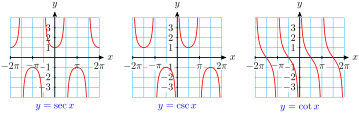
State the domain and range of the cosecant and cotangent functions.
Domain of cosecant: all real numbers except integer multiples of ; Range of cosecant:
Domain of cotangent: all real numbers except integer multiples of ; Range of cotangent: all real numbers
Solving Equations
From the graph of the secant function, we can see that the equation has two solutions between and if or , but no solution for . The same is true of the cosecant function: the equation has no solution for .
Solve for between and .
Using Identities
All six of the trigonometric ratios are related. If we know one of the ratios, we can use identities to find any of the others.
If , and , find an exact value for .
Identities are especially useful if the trig ratios are algebraic expressions, rather than numerical values. In the next example, we use the cotangent identity.
If and , find expressions for and .
,
We can often simplify trigonometric expressions by first converting all the trig ratios to sines and cosines.
In the previous example, you can verify that
by graphing the functions and to see that they are the same.
Show that .
There are two alternate versions of the Pythagorean identity which involve the reciprocal trig functions. These identities are useful when we know the value of or and want to find the other trig values.
You can memorize these identities, but they are easy to derive from the original Pythagorean identity, . We will prove them in the Homework problems.
If and lies in the second quadrant, find exact values for and .
,
Review the following skills you will need for this section.
Section 8.3 Summary
Vocabulary
- Reciprocal
- Secant
- Cosecant
- Cotangent
Concepts
- We can obtain graphs of the secant, cosecant, and cotangent functions as the reciprocals of the three basic functions.
- We can solve equations of the form , , and by taking the reciprocal of both sides.
- If we know one of the trigonometric ratios for an angle, we can use identities to find any of the others.
- We can often simplify trigonometric expressions by first converting all the trig ratios to sines and cosines.
Study Questions
- Delbert says that is just another way of writing , because . Is he correct? Explain your reasoning.
- Each of the following functions is related to the sine function in a different way. Explain how.
- Using Study Question #2 as an example, name three functions related to the tangent function, and explain how they are related.
- Why do the graphs of and have vertical asymptotes at the same -values?
Skills
- Evaluate the reciprocal trig functions for angles in degrees or radians #1–20
- Find values or expressions for the six trig ratios #21–28
- Evaluate the reciprocal trig functions in applications #29–32
- Given one trig ratio, find the others #33–46, 71–80
- Evaluate expressions exactly #47–52
- Graph the secant, cosecant, and cotangent functions #53–58
- Identify graphs of the reciprocal trig functions #59–64
- Solve equations in secant, cosecant, and cotangent #65–70
- Use identities to simplify or evaluate expressions #81–94
Homework 8-3
For Problems 1–8, evaluate. Round answers to 3 decimal places.
For Problems 9–16, evaluate. Give exact values.
For Problems 17–18, complete the tables with exact values.
| undefined | |||||||||
| undefined | undefined | ||||||||
| undefined | undefined |
Evaluate. Round answers to three decimal places.
Evaluate. Round answers to three decimal places.
For Problems 21–28, find exact values for the six trigonometric ratios of the angle .

, , , , ,


, , , , ,
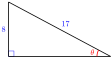
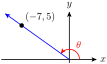
, , , , ,

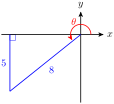
, , , , ,
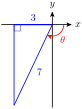
The distance that sunlight must travel to pass through a layer of Earth's atmosphere depends on both the thickness of the atmosphere and the angle of the sun.
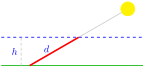
- Write an expression for the distance, , that sunlight travels through a layer of atmosphere of thickness .
- Find the distance (to the nearest mile) that sunlight travels through a 100-mile layer of atmosphere when the sun is above the horizon.
- 155.572 miles
In railroad design, the degree of curvature of a section of track is the angle subtended by a chord 100 feet long.
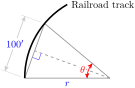
- Use the figure to write an expression for the radius, , of a curve whose degree of curvature is . (Hint: The bisector of the angle is perpendicular to the chord.)
- Find the radius of a curve whose degree of curvature is .
When a plane is tilted by an angle from the horizontal, the time required for a ball starting from rest to roll a horizontal distance of feet on the plane is
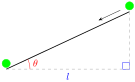
- How long, to the nearest 0.01 second, will it take the ball to roll 2 feet horizontally on a plane tilted by ?
- Solve the formula for in terms of and .
- 0.78 sec
After a heavy rainfall, the depth, , of the runoff flow at a distance feet from the watershed down a slope at angle is given by
where is a constant determined by the surface roughness and the intensity of the runoff.
- How deep, to the nearest 0.01 inch, is the runoff 100 feet down a slope of if ?
- Solve the formula for in terms of and .
For Problems 33–38, write algebraic expressions for the six trigonometric ratios of the angle .

, , , , ,


, , , , ,


, , , , ,

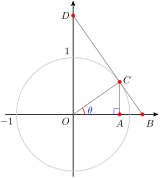
The diagram shows a unit circle. Find six line segments whose lengths are, respectively, and .
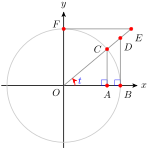
Use the figure in Problem 39 to find each area in terms of the angle .
- sector
For Problems 41–46, sketch the reference angle, and find exact values for all six trigonometric functions of the angle.
in Quadrant IV

, , , , ,
in Quadrant II
in Quadrant I

, , , , ,
in Quadrant IV
in Quadrant III

, , , , ,
in Quadrant I
For Problems 47–52, evaluate.
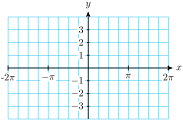
Complete the table and sketch a graph of .
| undefined | undefined |
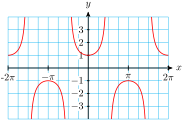
Complete the table and sketch a graph of .
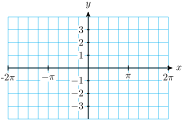
Use the graph of to sketch a graph of its reciprocal, .
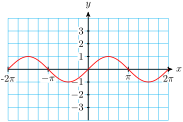
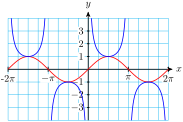
Use the graph of to sketch a graph of its reciprocal, .
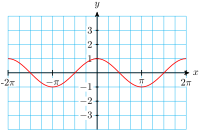
Complete the table and sketch a graph of .
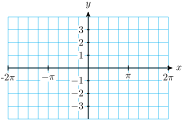
| undefined | undefined | undefined |
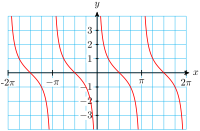
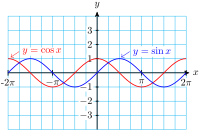
Use the graphs of and to sketch a graph of .
For Problems 59–64,
- Graph each function for , and write a simpler expression for the function.
- Show algebraically that your new expression is equivalent to the original one.
For Problems 65–70, find all solutions between and .
For Problems 71–76, use identities to find exact values or to write algebraic expressions.
If and , find .
If and , find .
If and , find .
If and , find .
If and , find .
If and , find .
For Problems 77–80, find exact values for and .
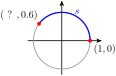
, ,
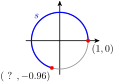

, ,

For Problems 81–88, write the expression in terms of sine and cosine, and simplify.
Prove the Pythagorean identity . (Hint: Start with the identity and divide both sides of the equation by .)
Prove the Pythagorean identity . (Hint: Start with the identity and divide both sides of the equation by .)
Suppose that and lies in the third quadrant.
- Use the Pythagorean identity to find the value of .
- Use identities to find the values of the other four trig functions of .
Suppose that and lies in the second quadrant.
- Use the Pythagorean identity to find the value of .
- Use identities to find the values of the other four trig functions of .
Write each of the other five trig functions in terms of only.
, , , ,
Write each of the other five trig functions in terms of only.
Show that if the angles of a triangle are and and the opposite sides are respectively and then
The figure shows a unit circle and an angle in standard position. Each of the six trigonometric ratios for is represented by the length of a line segment in the figure. Find the line segment for each ratio, and explain your choice.
Trigonometry by Katherine Yoshiwara (yoshiwarabooks.org), GNU Free Documentation License 1.2 or later. Adapted for the XYZ HTML edition with the authors' permission (recorded 2026-07-04). License: GFDL-1.2-or-later.