In Chapter 5 we studied identities that relate the three trigonometric functions sine, cosine, and tangent.
If we know one of the three trig values for an angle, we can find the other two by using these identities. Identities are useful for changing from one form to another when solving equations, and for finding exact values for trigonometric functions.
Are there identities relating the trig ratios of different angles?
For example, if we know the sine of , can we find the sine of without using a calculator? Or, if we know and , can we calculate ?
The Sum of Angles Identities
All of the identities that relate the trig ratios of different angles are derived from the sum and difference formulas. Let's see why we need these formulas.
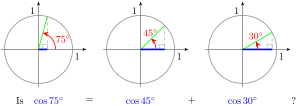
Is it true that
are equal for any values of and ? We can test this hypothesis by evaluating both expressions for some specific values of and , say and , as shown below.
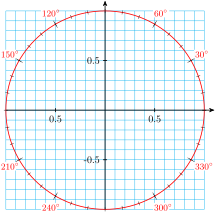
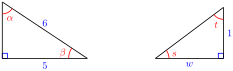
From the figure, you should be able to see that is in fact smaller than either or , so it cannot be true that is equal to .
Show that is not equal to .
, but
Notice that to find the sine or cosine of we must know (or be able to find) both trig ratios for both and .
The sum and difference formulas can be used to find exact values for trig ratios of various angles.
Find an exact value for .
Use the sum of angles identity for sine with and .
Of course, the sum formulas hold for angles in radians as well as degrees.
Suppose that and . Find an exact value for .
There are also identities for the negative of an angle, which you will discover in the next Activity.
The Difference of Angles Identities
The difference formulas for sine and cosine can be derived easily from the sum formulas, using the identities for negative angles. Note that the difference formulas are identical to the corresponding sum formulas, except for the signs.
Evaluate exactly.
As in the previous Example, use the fact that and apply the difference identity for sine to find
Sum and Difference Identities for Tangent
There are also sum and difference formulas for the tangent.
Evaluate exactly.
Use the fact that and apply the difference identity for tangent to find .
Double Angle Identities
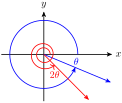
There are a number of other very useful identities that can be derived from the sum and difference formulas. In particular, if we set in the sum of angles identities (also called addition formulas), we obtain the double angle formulas. These identities are used frequently, so it is helpful to know them well.
You can also justify the identities to yourself by graphing both sides of the formula to see that the graphs are identical.
Find and for the angle shown in the previous Example.
We can use the double angle formulas for cosine and tangent to find and . (But also note that, once we know , we can calculate its cosine and tangent directly.)
We will often work with algebraic expressions instead of numerical values for the trig ratios.
For the triangle in the previous example, find expressions for and .
By using the Pythagorean identity, we can write the double angle formula for cosine in two alternate forms.
cos 2θ = 2cos²θ − 1, certified ✓ Computed · mojocas 0.1.0✓ Agrees with the text cos 2θ = 2cos²θ − 1, certified, computed exactly by mojocas 0.1.0, and confirmed to agree with the result stated in the text.The derivation above turns cos 2θ = cos²θ − sin²θ into the alternate form 2cos²θ − 1 by one application of the Pythagorean identity. The CAS re-certifies the alternate form directly — cos 2θ against 2cos²θ − 1, no intermediate steps — at build time, so the identity chain this chapter builds on the sum formulas is re-verified whenever the book is rebuilt.
Thus, we have three forms for the double angle formula for cosine, and we can use whichever form is most convenient for a particular problem.
Find an expression for if you know that .
Solving Equations
If a trigonometric equation involves more than one angle, we use identities to rewrite the equation in terms of a single angle.
Solve for .
First rewrite as to obtain the equation
Solving this equation by factoring gives us or , form which we find , and .
Review the following skills you will need for this section.
Section 8.1 Summary
Concepts
Identities are useful for changing from one form to another when solving equations, for simplifying expressions, and for finding exact values for trigonometric functions.
it is not true in general that is equal to for all angles and , or that is equal to .
Study Questions
Explain why is not a valid application of the distributive law.
Delbert says that . Is he correct? Explain.
Francine says that . Is she correct? Explain.
Provide an example to show that doubling an angle does not double its sine or cosine.
Skills
Find trig values for the negative of an angle #1–6
Verify or disprove possible formulas #7–12, 31–42, 73–76, 79–88
Find exact values for trigonometric functions #13–24, 55–62
Simplify or expand expressions #25–30, 43–54
Solve equations #63–72
Prove standard identities #77–78, 89–91
Homework 8-1
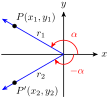
Sketch an angle in standard position, with . Also sketch the angle .
Choose a point on the terminal side of , and show that the negative angle identities
hold for .
, , and . Thus, , , and .
Sketch an angle in standard position, with . Also sketch the angle .
Choose a point on the terminal side of , and show that the negative angle identities
hold for .
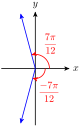
Given that , find . Sketch both angles.
Given that , find . Sketch both angles.
If and , find and .
,
If and , find and .
Show that is not equal to .
, but
Show that is not equal to .
Use your calculator to verify that is not equal to .
, but
Use your calculator to verify that is not equal to .
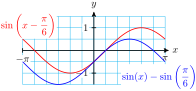
Use graphs to show that is not equivalent to .
The curves are different.
Use graphs to show that is not equivalent to .
For Problems 13–24, find exact values for the trig ratios. (Do not use a calculator!)
Suppose , and . Evaluate the following.
Suppose , and . Evaluate the following.
If and , find exact values for:
If and , find exact values for:
Suppose and , where and are in quadrant I. Evaluate the following.
Suppose , where is in quadrant IV, and , where is in quadrant II. Evaluate the following.
If , and , find exact values for:
Sketch the angles and .
If , and , find exact values for:
Sketch the angles and .
Find the exact values of and .
,
Find the exact values of and .
If and , find .
If and , find .
For Problems 25–30, use the sum and difference formulas to expand each expression.
For Problems 31–34, use the unit circle to estimate trig values. Then verify with your calculator.
Does ?
No
Does ?
Does ?
No
Does ?
For Problems 35–38, verify that each statement is true.
In Problems 39–42, is the statement true or false? Explain your answer.
If , then .
False, but
If , then , so .
If , then , so .
False, but
If , then .
For Problems 43–54, use the double angle identities to simplify the expression.
For Problems 55–58, use the figures to find the trigonometric ratios.
Suppose and . Compute exact values for:
Sketch the angles and .
Suppose and . Compute exact values for:
Sketch the angles and .
If and , find exact values for:
If and , find exact values for:
For Problems 63–72,
Use identities to rewrite the equation in terms of a single angle.
Solve. Give exact solutions between and .
, , ,
,
, , ,
,
, ,
Use the sum of angles formulas for sine and cosine to derive a formula for each expression. Then use graphs to verify your formula.
Use the sum of angles formulas for sine and cosine to derive a formula for each expression. Then use graphs to verify your formula.
Use the difference of angles formulas for sine and cosine to prove that:
Use the difference of angles formulas for sine and cosine to derive formulas for:
Prove the double angle identity . (Hint: Start with the sum of angles formula for sine and replace both and by .)
Prove the double angle identity . (Hint: Start with the sum of angles formula for sine and replace both and by .)
For Problems 79–88,
Use graphs to decide if the equation is an identity.
If the equation is not an identity, find a value of the variable that makes the equation false.
Not an identity.
(many answers possible)
Identity
Not an identity.
(many answers possible)
Identity
Identity
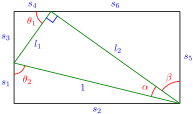
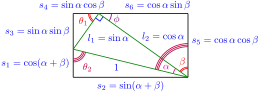
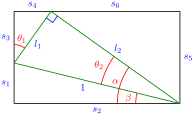
Problems 89 and 90 verify the addition and subtraction formulas for acute angles.
The figure below shows a right triangle inscribed in a rectangle.
Label the legs and of the right triangle with their lengths.
Explain why and . Label the diagram with these angles.
Label the legs and of the bottom triangle with their lengths.
Label the legs and of the top left triangle with their lengths.
Label the legs and of the top right triangle with their lengths.
Use the fact that the opposite sides of a rectangle are equal to state the addition formulas for sine and cosine.
and are both complements of ; and are alternate interior angles
,
,
,
,
The figure below shows a right triangle inscribed in a rectangle.
Label the legs and of the right triangle with their lengths.
Explain why and . Label the diagram with these angles.
Label the legs and of the bottom triangle with their lengths.
Label the legs and of the top left triangle with their lengths.
Label the legs and of the top right triangle with their lengths.
Use the fact that the opposite sides of a rectangle are equal to state the subtraction formulas for sine and cosine.
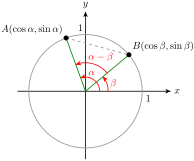
Follow the steps to prove the difference of angles formula for cosine,
Write an expression for , the square of the distance between the points and , using the Law of Cosines for .
Write another expression for using the distance formula and the coordinates of and .
Equate the two expressions for you obtained in (a) and (b). Simplify the equation to obtain .
Trigonometry by Katherine Yoshiwara (yoshiwarabooks.org), GNU Free Documentation License 1.2 or later. Adapted for the XYZ HTML edition with the authors' permission (recorded 2026-07-04). License: GFDL-1.2-or-later.
These eBooks are a prerelease and are not yet certified conformant with WCAG 2.1 AA or ADA Title II. Every page is built against an automated accessibility gate, and the published editions will meet ADA Title II requirements when they release in late September 2026. If something is unusable, please tell us.