
8.2 Inverse Trigonometric Functions
We have been using the calculator keys , , and to find approximate values of when we know either , or . For example, if we know that , then
In other words, we use the , , and keys to solve trigonometric equations, just as we use square roots to solve quadratic equations. Using one of these keys performs the inverse operation for computing a sine, cosine or tangent, just as extracting square roots is the inverse of squaring a number.
Many functions can be described as an operation or as a sequence of operations on the input value, and this leads us to the notion of an inverse function.
Inverse of a Function
Raising a number to the power and taking roots are an example of inverse operations. For example, if we first cube a number and then take the cube root of the result, we return to the original number.

We say that the two functions and are inverse functions. Each of the functions undoes the results of the other function. You can confirm this behavior by consulting the tables of values for the two functions.
Observe that the table of values for can be obtained from the table for by interchanging the values of and in each ordered pair. In fact, we can often find a formula for the inverse function by interchanging the input and output variables in the formula for the function, and then solving for the new output variable.
For our example, we start with the formula for the cubing function:
We use the notation to denote the inverse function. Thus, we have just shown that the inverse function for is .
Let . Find a formula for the inverse function.
In the examples above, note that , and .
The Graph of the Inverse
If we graph the function and its inverse on the same set of axes, we see that the graphs are related in an interesting way, as shown below.
The graphs are symmetric about the line , which means that if we were to place a mirror along the line each graph would be the reflection of the other.
This symmetry occurs because we interchanged the roles of and when we defined the inverse function.
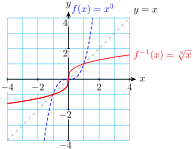
Note that, for this example, both graphs pass the vertical line test, so they are both graphs of functions.
Graph and its inverse function on the grid at right, and sketch in the line to show the symmetry.
- Find the domain and range of , and the domain and range of .
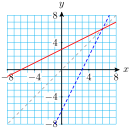
- The domain and range of and each include all real numbers
From the examples above, we see that the domain of is the same as the range of , and the range of is the same as the domain of . This should seem reasonable, because we obtain the inverse function by interchanging the values of the input and output variables.
Does Every Function Have an Inverse?
In the Examples above, the inverse of the function turned out to be a function as well. But this is not always the case. Consider the function . First we'll find a formula for the inverse. We interchange and and solve for :
The graphs of and its inverse are shown at right. You can see that although is a function, its inverse is not.
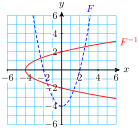
Is there some way to predict whether the inverse of a function will be a function, too? Yes! In order for the inverse to be a function, its graph must pass the vertical line test. (Recall that if a graph passes the vertical line test, there is only one -value for each value of .)
Now, we obtain the inverse by interchanging and in the formula for a function, so the inverse will be a function only if the original function passes the horizontal line test. A function that passes the horizontal line test is called one-to-one.
Which of the functions below are one-to-one?
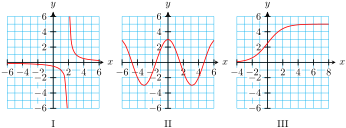
I and III
Restricting the Domain: The Inverse Sine Function
Sometimes it is so important that the inverse be a function that we are willing to sacrifice part of the original function to achieve this result.
Look again at the graph of . If we use only nonnegative -values for the domain, we create a new function,
The graph of this new function is shown as a dashed curve in the figure at right.
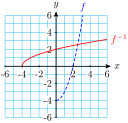
The new function is one-to-one, and its inverse, , is also a function. (We could also have used only negative -values for the domain, or some smaller interval, just as long as the resulting function is one-to-one.)
We say that we have restricted the domain of the original function, and we will use this technique to define inverse functions for the trigonometric functions.
The sine function is not one-to-one; there are many angles that have the same sine value. In order to define its inverse function, we must restrict the domain of the sine to an interval on which the -values do not repeat. But there are many candidates for such an interval; which one shall we choose?
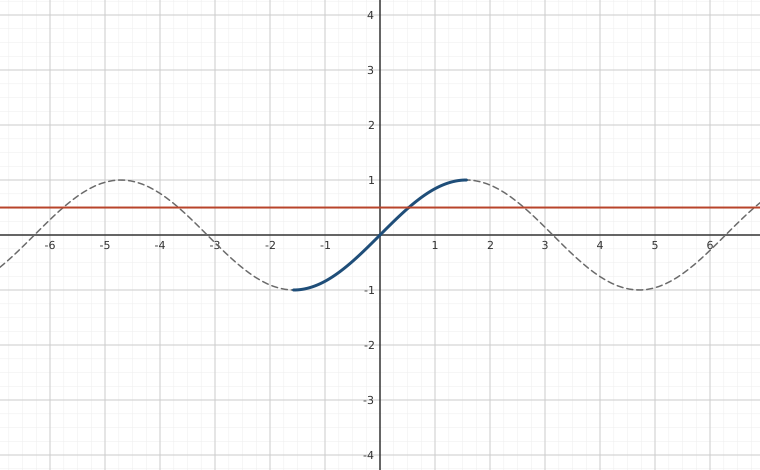
It turns out that the most useful interval is found by starting at and moving as far as we can in either direction until the -values begin to repeat. By doing so, we obtain the restricted domain , as shown below. This piece of the function includes all of the original range values, from to .
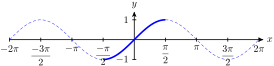
Because the sine function is one-to-one on this domain, its inverse is a function.
The graph of the inverse sine function, , is shown below. Its domain is the same as the range of the sine function, namely , and its range is our restricted domain for sine, .
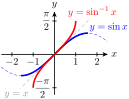
In other words, is the angle in radians, between and , whose sine is . There are many angles with a given sine value , but only one of these angles can be . This is why the calculator's key only gives outputs between and .
- If is positive, the inverse sine function delivers a first quadrant angle, .
- If is negative, the inverse sine function delivers a fourth quadrant angle, .
Simplify each expression without using a calculator.
The Inverse Cosine and Inverse Tangent Functions
The cosine and tangent functions are also periodic, so, just as with the sine function, to define their inverse functions we must restrict their domains to intervals where they are one-to-one. The graph of cosine is shown below.
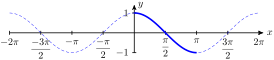
Once again the choice of these intervals is arbitrary. If we start at on the cosine graph, we can move in only one direction, either right or left, without encountering repeated -values.
We choose to move in the positive direction, to obtain the interval , as shown above. On this domain, the inverse of cosine is a function. Its graph is shown below.
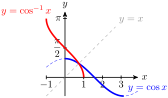
The range of the inverse cosine function is , so it delivers angles in the first and second quadrants. (Compare to the inverse sine, whose outputs are angles in the first or fourth quadrants.)
Simplify without using a calculator.
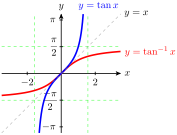
Finally, consider the graph of the tangent function. To choose a convenient interval on which the tangent is one-to-one, we start at and move as far as we can in either direction along the -axis. In this way we obtain one cycle of the graph, on the interval , as shown at right.
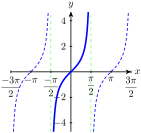
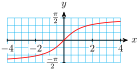
The range of the tangent on that interval includes all real numbers. Consequently, the domain of the inverse tangent function includes all real numbers, and its range is the interval . The graph of the inverse tangent function is shown below. Its outputs are angles in the first and fourth quadrants.
Simplify without using a calculator.
We summarize the content of the Caution above as follows.
Modeling with Inverse Functions
The inverse trig functions are used to model situations in which an angle is described in terms of one of its trigonometric ratios.
The tapestry from the previous example includes a 2-meter tall unicorn with its feet at the bottom of the tapestry.
- Express , the angle subtended vertically by the unicorn, as a function of , your distance to the tapestry.
- Express , the angle subtended by the portion of the tapestry above the unicorn, as a function of . (See the figure at right).

Alternate Notations
The inverse sine function, , is also called the arcsine function and denoted by arcsin . (This terminology reminds us that the output of the inverse sine function is an angle, or the arc on a unit circle determined by that angle, as shown at right.)

Similarly, the inverse cosine function is sometimes denoted by arccos , and the inverse tangent function by arctan . Some computer programs use the notation asin , accos , and atan .
Simplify each expression.
Simplifying Expressions
The key to simplifying expressions involving inverse trigonometric functions is to remember that the inverse sine, cosine, or tangent of a number can be treated as an angle. If we assign a name such as or to the inverse trig value, it can often clarify the computations.
Evaluate .
We can verify the results of the previous example using a calculator, but the same technique can be applied to simplify similar expressions involving variables.
Simplify , assuming that .
Review the following skills you will need for this section.
Section 8.2 Summary
Vocabulary
- Inverse function
- One-to-one
- Subtend
Concepts
- Using one of the calculator keys , or performs the inverse operation for computing a sine, cosine or tangent.
- Two functions are called inverse functions if each "undoes" the results of the other function.
- If is a function, we can often find a formula for the inverse function by interchanging and in the formula for the function, and then solving for .
- The graphs of and are symmetric about the line .
- The domain of is the same as the range of , and the range of is the same as the domain of .
- A function has an inverse function if and only if is one-to-one.
- The inverse sine function is also called the arcsine function and denoted by . Similarly, the inverse cosine function is sometimes denoted by , and the inverse tangent function by .
- When simplifying expressions involving inverse trigonometric functions, it can often clarify the computations if we assign a name such as or to the inverse trig value.
Study Questions
- Here is a table of values defining a function . Make a table of values for .
- What does it mean for a function to be one-to-one? Give an example.
- Why do we restrict the domains of the trig functions when we define their inverse functions?
- Which of the following expressions is undefined? Why?
- Write as a function of .
- Write as a function of .

- Write as a function of .
- Write as a function of .

Skills
- Decide whether a function has an inverse function #1–8
- Evaluate the inverse trig functions #9–20
- Model problems with inverse trig functions #21–24
- Solve formulas #25–30
- Simplify expressions involving the inverse trig functions #31–42, 51–68
- Graph the inverse trig functions #43–50, 69 and 70
Homework 8-2
In Problems 1–4, which functions have an inverse function? Explain your answer.

No inverse: Some horizontal lines intersect the curve in more than one point.


Inverse exists: The function is 1-1.

For Problems 5–8, graph the function and decide if it has an inverse function.
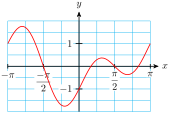
No inverse
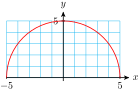
>
No inverse
For Problems 9–14, use a calculator to evaluate. Round your answers to the nearest tenth of a degree.
For Problems 15–20, give exact values in radians.
For Problems 21–26, sketch a figure to help you model each problem.
Delbert is watching the launch of a satellite at Cape Canaveral. The viewing area is 500 yards from the launch site. The angle of elevation, , of Delbert's line of sight increases as the booster rocket rises.
- Write a formula for the height, , of the rocket as a function of .
- Write a formula for as a function of .
- Evaluate the formula in part (b) for , and interpret the result.

- , so the angle of elevation is when the rocket is 1000 yd high.
Francine's house lies under the flight path from the city airport, and commercial airliners pass overhead at an altitude of 35,000 feet. As Francine watches an airplane recede, its angle of elevation, , decreases.
- Write a formula for the horizontal distance, , to the airplane as a function of .
- Write a formula for as a function of .
- Evaluate the formula in part (b) for , and interpret the result.
While driving along the interstate, you approach an enormous 50-foot-wide billboard that sits just beside the road. Your viewing angle, , increases as you get closer to the billboard.
- Write a formula for your distance, , from the billboard as a function of .
- Write a formula for as a function of .
- Evaluate the formula in part (b) for , and interpret the result.
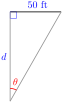
- ; the bilboard subtends an angle of at a distance of 200 ft.
Emma is walking along the bank of a straight river toward a 20-meter long bridge over the river. Let be the angle subtended horizontally by Emma's view of the bridge.
- Write a formula for Emma's distance from the bridge, , as a function of .
- Write a formula for as a function of .
- Evaluate the formula in part (b) for , and interpret the result.
Martin is viewing a 4-meter tall painting whose base is 1 meter above his eye level.
- Write a formula for , the angle subtended from Martin's eye level to the bottom of the painting, when he stands meters from the wall.
- Write a formula for , the angle subtended by the painting, in terms of .
- Evaluate the formula in part (b) for , and interpret the result.

- , so the painting subtends an angle of when Martin is 5 meters from the wall.
A 5-foot mirror is positioned so that its bottom is 1.5 feet below Jane's eye level.
- Write a formula for , the angle subtended by the section of mirror below Jane's eye level, when she stands feet from the mirror.
- Write a formula for , the angle subtended by the entire mirror, in terms of .
- Evaluate the formula in part (b) for , and interpret the result.
For Problems 27–32, solve the formula for the given variable.
, for
, for
, for
, for
for
, for
For Problems 33–38, find exact values without using a calculator.
For Problems 39–44, simplify the expression.
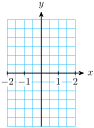
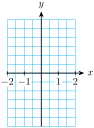
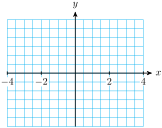
For Problems 45–47, complete the table of values and sketch the function.

Use a graphing calculator to answer each of the following questions. Then explain the results.
- Does ?
- Does ?
- Does ?
- Sketch a graph of , and label the scales on the axes.
- Use transformations to sketch graphs of and .
- Does ?
a–b.
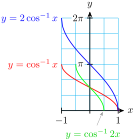
c. No
- Sketch a graph of , and label the scales on the axes.
- Use transformations to sketch graphs of and .
- Does ?
- Sketch a graph of , and label the scales on the axes.
- Use technology to graph on a suitable domain.
- Does ?
a.
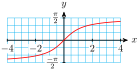
c. No
- Use technology to graph and for .
- Describe the similarities and differences in the two graphs.
Use the identities from Section 8.1 to help you find exact values for the expressions in Problems 53–58.
Let . Find exact values for the following.
Let . Find exact values for the following.
Find an exact value for .
Find an exact value for .
Express in terms of without trigonometric functions.
Express in terms of without trigonometric functions.
If , express and in terms of .
,
If , express and in terms of .
If , write in terms of .
If , write in terms of .
- For what values of is the function defined?
- Is for all where it is defined? If not, for what values of is the equation false?
- For what values of is the function defined?
- Is for all where it is defined? If not, for what values of is the equation false?
- Yes.
- All
- or
- For what values of is the function defined?
- Is for all where it is defined? If not, for what values of is the equation false?
- For what values of is the function defined?
- Is for all where it is defined? If not, for what values of is the equation false?
Use your calculator to graph .
- State the domain and range of the graph.
- Explain why the graph looks as it does.
- Domain: , range:
- Let . Then and . So .
Use your calculator to graph .
- State the domain and range of the graph.
- Explain why the graph looks as it does.
In Problems 73–74, we find a formula for the area under part of a semicircle.
Use the figure of a unit circle to answer the following.
- Write an expression for the area of the shaded sector in terms of .
- How are and related in the figure? (Hint: Write an expression for .)
- Combine your answers to (a) and (b) to write an expression for the area of the sector in terms of .

Use the figure of a unit circle to answer the following.
- Write an expression for the height of the shaded triangle in terms of . (Hint: Use the Pythagorean theorem.)
- Write an expression for the area of the triangle in terms of .
- Combine your answers to (b) and to Problem 73 to write an expression for the area bounded above by the upper semicircle, below by the -axis, on the left by the -axis, and on the right by , when .

Trigonometry by Katherine Yoshiwara (yoshiwarabooks.org), GNU Free Documentation License 1.2 or later. Adapted for the XYZ HTML edition with the authors' permission (recorded 2026-07-04). License: GFDL-1.2-or-later.