
11.3 The Law of Cosines
In Section 11.2, we developed the Law of Sines (Theorem 11.2) to enable us to solve triangles in the `Angle-Angle-Side' (AAS), the `Angle-Side-Angle' (ASA) and the ambiguous `Angle-Side-Side' (ASS) cases. In this section, we develop the Law of Cosines which handles solving triangles in the `Side-Angle-Side' (SAS) and `Side-Side-Side' (SSS) cases.1 We state and prove the theorem below.
To prove the theorem, we consider a generic triangle with the vertex of angle at the origin with side positioned along the positive -axis.
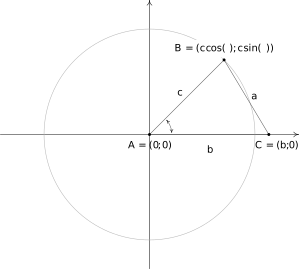
From this set-up, we immediately find that the coordinates of and are and . From Theorem 10.3, we know that since the point lies on a circle of radius , the coordinates of are . (This would be true even if were an obtuse or right angle so although we have drawn the case when is acute, the following computations hold for any angle drawn in standard position where .) We note that the distance between the points and is none other than the length of side . Using the distance formula, Equation 1.1, we get
The remaining formulas given in Theorem 11.5 can be shown by simply reorienting the triangle to place a different vertex at the origin. We leave these details to the reader. What's important about and in the above proof is that is an angle-side opposite pair and and are the sides adjacent to – the same can be said of any other angle-side opposite pair in the triangle. Notice that the proof of the Law of Cosines relies on the distance formula which has its roots in the Pythagorean Theorem. That being said, the Law of Cosines can be thought of as a generalization of the Pythagorean Theorem. If we have a triangle in which , then so we get the familiar relationship . What this means is that in the larger mathematical sense, the Law of Cosines and the Pythagorean Theorem amount to pretty much the same thing.2
We note that, depending on how many decimal places are carried through successive calculations, and depending on which approach is used to solve the problem, the approximate answers you obtain may differ slightly from those the authors obtain in the Examples and the Exercises. A great example of this is number in Example 11.3.1, where the approximate values we record for the measures of the angles sum to , which is geometrically impossible. Next, we have an application of the Law of Cosines.
In Section 11.2, we used the proof of the Law of Sines to develop Theorem 11.4 as an alternate formula for the area enclosed by a triangle. In this section, we use the Law of Cosines to derive another such formula - Heron's Formula.
We prove Theorem 11.6 using Theorem 11.4. Using the convention that the angle is opposite the side , we have from Theorem 11.4. In order to simplify computations, we start by manipulating the expression for .
The Law of Cosines tells us , so substituting this into our equation for gives
At this stage, we recognize the last factor as the semiperimeter, . To complete the proof, we note that
Similarly, we find and . Hence, we get
so that as required.
We close with an example of Heron's Formula.
Exercises
In Exercises -, use the Law of Cosines to find the remaining side(s) and angle(s) if possible.
In Exercises -, solve for the remaining side(s) and angle(s), if possible, using any appropriate technique.
- Find the area of the triangles given in Exercises, and above.
- The hour hand on my antique Seth Thomas schoolhouse clock in 4 inches long and the minute hand is 5.5 inches long. Find the distance between the ends of the hands when the clock reads four o'clock. Round your answer to the nearest hundredth of an inch.
- A geologist wants to measure the diameter of a crater. From her camp, it is 4 miles to the northern-most point of the crater and 2 miles to the southern-most point. If the angle between the two lines of sight is , what is the diameter of the crater? Round your answer to the nearest hundredth of a mile.
- From the Pedimaxus International Airport a tour helicopter can fly to Cliffs of Insanity Point by following a bearing of NE for 192 miles and it can fly to Bigfoot Falls by following a bearing of SE for 207 miles.6 Find the distance between Cliffs of Insanity Point and Bigfoot Falls. Round your answer to the nearest mile.
- Cliffs of Insanity Point and Bigfoot Falls from Exericse above both lie on a straight stretch of the Great Sasquatch Canyon. What bearing would the tour helicopter need to follow to go directly from Bigfoot Falls to Cliffs of Insanity Point? Round your angle to the nearest tenth of a degree.
- A naturalist sets off on a hike from a lodge on a bearing of SW. After 1.5 miles, she changes her bearing to SW and continues hiking for 3 miles. Find her distance from the lodge at this point. Round your answer to the nearest hundredth of a mile. What bearing should she follow to return to the lodge? Round your angle to the nearest degree.
- The HMS Sasquatch leaves port on a bearing of NE and travels for 5 miles. It then changes course and follows a heading of SE for 2 miles. How far is it from port? Round your answer to the nearest hundredth of a mile. What is its bearing to port? Round your angle to the nearest degree.
- The SS Bigfoot leaves a harbor bound for Nessie Island which is 300 miles away at a bearing of NE. A storm moves in and after 100 miles, the captain of the Bigfoot finds he has drifted off course. If his bearing to the harbor is now SW, how far is the SS Bigfoot from Nessie Island? Round your answer to the nearest hundredth of a mile. What course should the captain set to head to the island? Round your angle to the nearest tenth of a degree.
From a point 300 feet above level ground in a firetower, a ranger spots two fires in the Yeti National Forest. The angle of depression7 made by the line of sight from the ranger to the first fire is and the angle of depression made by line of sight from the ranger to the second fire is . The angle formed by the two lines of sight is . Find the distance between the two fires. Round your answer to the nearest foot. (Hint: In order to use the angle between the lines of sight, you will first need to use right angle Trigonometry to find the lengths of the lines of sight. This will give you a Side-Angle-Side case in which to apply the Law of Cosines.)
Figure 11.52 - If you apply the Law of Cosines to the ambiguous Angle-Side-Side (ASS) case, the result is a quadratic equation whose variable is that of the missing side. If the equation has no positive real zeros then the information given does not yield a triangle. If the equation has only one positive real zero then exactly one triangle is formed and if the equation has two distinct positive real zeros then two distinct triangles are formed. Apply the Law of Cosines to Exercises, and above in order to demonstrate this result.
- Discuss with your classmates why Heron's Formula yields an area in square units even though four lengths are being multiplied together.
Answers
Table 11.9 Information does not produce a triangle Table 11.10 Information does not produce a triangle - The area of the triangle given in Exercise is square units. The area of the triangle given in Exercise is square units. The area of the triangle given in Exercise is exactly square units.
- The distance between the ends of the hands at four o'clock is about inches.
- The diameter of the crater is about 5.22 miles.
- About 313 miles
- NW
- She is about 3.92 miles from the lodge and her bearing to the lodge is NE.
- It is about 4.50 miles from port and its heading to port is SW.
- It is about 229.61 miles from the island and the captain should set a course of NE to reach the island.
- The fires are about 17456 feet apart. (Try to avoid rounding errors.)
Adapted from Precalculus, 3rd corrected edition, by Carl Stitz and Jeff Zeager (stitz-zeager.com), licensed under CC BY-NC-SA 3.0. Changes were made: reformatted as an accessible XYZ web edition. License: CC-BY-NC-SA-3.0.