

5.1 Evaluating Algebraic Expressions
Evaluating Algebraic Expressions
A source-bound narrated opening with a worked example, an eight-second thinking pause, a checked result, English captions, and a transcript.
Read the transcriptDownload the videoNarration credits and licences
Evaluate Algebraic Expressions
Earlier, we simplified expressions using the order of operations. In this section, we’ll evaluate expressions—again following the order of operations.
To evaluate an algebraic expression means to find the value of the expression when the variable is replaced by a given number. To evaluate an expression, we substitute the given number for the variable in the expression and then simplify the expression using the order of operations.
Identify Terms, Coefficients, and Like Terms
Algebraic expressions are made up of terms. A term is a constant or the product of a constant and one or more variables. Some examples of terms are
The constant that multiplies the variable(s) in a term is called the coefficient. We can think of the coefficient as the number in front of the variable. The coefficient of the term is When we write the coefficient is since Table 5.1 gives the coefficients for each of the terms in the left column.
| Term | Coefficient |
|---|---|
An algebraic expression may consist of one or more terms added or subtracted. Here, we will only work with terms that are added together. Table 5.2 gives some examples of algebraic expressions with various numbers of terms. Notice that we include the operation before a term with it.
| Expression | Terms |
|---|---|
Some terms share common traits. Look at the following terms. Which ones seem to have traits in common?
Which of these terms are like terms?
- The terms and are both constant terms.
- The terms and are both terms with
- The terms and both have
Terms are called like terms if they have the same variables and exponents. All constant terms are also like terms. So among the terms
Simplify Expressions by Combining Like Terms
We can simplify an expression by combining the like terms. What do you think would simplify to? If you thought you would be right!
We can see why this works by writing both terms as addition problems.
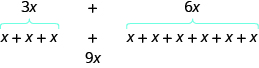
Add the coefficients and keep the same variable. It doesn’t matter what is. If you have of something and add more of the same thing, the result is of them. For example, oranges plus oranges is oranges. We will discuss the mathematical properties behind this later.
The expression has only two terms. When an expression contains more terms, it may be helpful to rearrange the terms so that like terms are together. The Commutative Property of Addition says that we can change the order of addends without changing the sum. So we could rearrange the following expression before combining like terms.
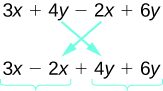
Now it is easier to see the like terms to be combined.
When any of the terms have negative coefficients, the procedure is the same, except that you have to subtract instead of adding to combine like terms.
Practice Makes Perfect
Evaluate Algebraic Expressions
In the following exercises, evaluate the expression for the given value.
Show solution
22
Show solution
26
Show solution
144
Show solution
32
Show solution
27
Show solution
21
Show solution
41
Show solution
9
Show solution
225
Show solution
73
Show solution
54
Identify Terms, Coefficients, and Like Terms
In the following exercises, list the terms in the given expression.
Show solution
15x2, 6x, 2
Show solution
10y3, y, 2
In the following exercises, identify the coefficient of the given term.
Show solution
8
Show solution
5
In the following exercises, identify all sets of like terms.
Show solution
x3 and 8x3; 14 and 5
Show solution
16ab and 4ab; 16b2 and 9b2
Simplify Expressions by Combining Like Terms
In the following exercises, simplify the given expression by combining like terms.
Show solution
13x
Show solution
26a
Show solution
7c
Show solution
12x + 8
Show solution
10u + 3
Show solution
12p + 10
Show solution
22a + 1
Show solution
17x2 + 20x + 16
Corequisite Skills for Introductory Statistics is a custom course edition compiled for Introductory Statistics corequisite courses from OpenStax Contemporary Mathematics, Elementary Algebra 2e, Intermediate Algebra 2e, Prealgebra 2e. Content by OpenStax is reproduced as published, apart from any corrections recorded for this edition. Sections are renumbered to follow the course outline. The course outline is adapted from Larry Green's Support Course for Elementary Statistics (LibreTexts, https://stats.libretexts.org/Bookshelves/Introductory_Statistics/Support_Course_for_Elementary_Statistics), used under CC BY 4.0 (https://creativecommons.org/licenses/by/4.0/). Lessons 2.4 and 6.7 are written for this edition by XYZ Homework. Every OpenStax lesson is abridged to the subsections and practice exercises this course uses. Lessons are headed with their course titles, not the source section titles. Access the complete originals free at openstax.org. License: CC-BY-NC-SA-4.0.