

5.2 The Distributive Property
The Distributive Property
A source-bound narrated opening with a worked example, an eight-second thinking pause, a checked result, English captions, and a transcript.
Read the transcriptDownload the videoNarration credits and licences
Simplify Expressions Using the Distributive Property
Suppose three friends are going to the movies. They each need that is, dollars and quarter. How much money do they need all together? You can think about the dollars separately from the quarters.
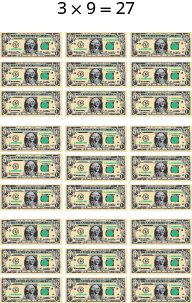
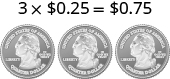
They need times so and times quarter, so cents. In total, they need
If you think about doing the math in this way, you are using the Distributive Property.
Back to our friends at the movies, we could show the math steps we take to find the total amount of money they need like this:
In algebra, we use the Distributive Property to remove parentheses as we simplify expressions. For example, if we are asked to simplify the expression the order of operations says to work in the parentheses first. But we cannot add and since they are not like terms. So we use the Distributive Property, as shown in Example 1.
Some students find it helpful to draw in arrows to remind them how to use the Distributive Property. Then the first step in Example 1 would look like this:


The distributive property can be used to simplify expressions that look slightly different from Here are two other forms.
In the next two examples, we multiply a fraction by a whole number.
Using the Distributive Property as shown in the next example will be very useful when we clear decimals from equations.
In the next example we’ll multiply by a variable.
The next example will use the ‘backwards’ form of the Distributive Property,
When you distribute a negative number, you need to be extra careful to get the signs correct.
In the next example, we will show how to use the Distributive Property to find the opposite of an expression. Remember,
Sometimes we need to use the Distributive Property as part of the order of operations. Start by looking at the parentheses. If the expression inside the parentheses cannot be simplified, the next step would be multiply using the distributive property, which removes the parentheses. The next two examples will illustrate this.
Practice Makes Perfect
Simplify Expressions Using the Distributive Property
In the following exercises, simplify using the distributive property.
Show solution
3a + 27
Show solution
27w + 63
Show solution
7y − 91
Show solution
35u − 20
Show solution
Show solution
Show solution
3x − 4
Show solution
2 + 9s
Show solution
uv − 10u
Show solution
ax + 7x
Show solution
−3a − 33
Show solution
−81a − 36
Show solution
−4q + 28
Show solution
−42x + 48
Show solution
−q − 11
Show solution
−5p + 4
Show solution
8u + 4
Show solution
−4x + 10
Show solution
−42n + 39
Show solution
−r + 15
Show solution
−c + 6
Show solution
3y + 1
Show solution
47u + 60
Show solution
24x + 4
Show solution
6n − 72
Show solution
17n + 76
Corequisite Skills for Introductory Statistics is a custom course edition compiled for Introductory Statistics corequisite courses from OpenStax Contemporary Mathematics, Elementary Algebra 2e, Intermediate Algebra 2e, Prealgebra 2e. Content by OpenStax is reproduced as published, apart from any corrections recorded for this edition. Sections are renumbered to follow the course outline. The course outline is adapted from Larry Green's Support Course for Elementary Statistics (LibreTexts, https://stats.libretexts.org/Bookshelves/Introductory_Statistics/Support_Course_for_Elementary_Statistics), used under CC BY 4.0 (https://creativecommons.org/licenses/by/4.0/). Lessons 2.4 and 6.7 are written for this edition by XYZ Homework. Every OpenStax lesson is abridged to the subsections and practice exercises this course uses. Lessons are headed with their course titles, not the source section titles. Access the complete originals free at openstax.org. License: CC-BY-NC-SA-4.0.