

1.5 Finding a Percent of a Total
Narrated lesson: Finding a Percent of a Total
Synthetic narration with English captions, a transcript, and time to think before checking the answer.
Read the transcriptDownload the videoNarration credits and licences
Translate and Solve Basic Percent Equations
We will solve percent equations using algebra. In the past, you may have solved percent problems by setting them up as proportions. That was the best method available when you did not have the tools of algebra. Now you can translate word sentences into algebraic equations, and then solve the equations.
We'll look at a common application of percent—tips to a server at a restaurant—to see how to set up a basic percent application.
When Aolani and her friends ate dinner at a restaurant, the bill came to They wanted to leave a tip. What amount would the tip be?
To solve this, we want to find what amount is of The is called the base. The amount of the tip would be or See Figure 1.11. To find the amount of the tip, we multiplied the percent by the base.
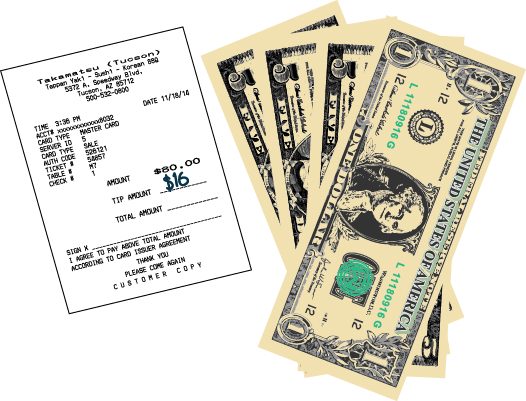
In the next examples, we will find the amount. We must be sure to change the given percent to a decimal when we translate the words into an equation.
In the next examples, we are asked to find the base.
In the next examples, we will solve for the percent.
Solve Applications of Percent
Many applications of percent occur in our daily lives, such as tips, sales tax, discount, and interest. To solve these applications we'll translate to a basic percent equation, just like those we solved in the previous examples in this section. Once you translate the sentence into a percent equation, you know how to solve it.
We will update the strategy we used in our earlier applications to include equations now. Notice that we will translate a sentence into an equation.
Now that we have the strategy to refer to, and have practiced solving basic percent equations, we are ready to solve percent applications. Be sure to ask yourself if your final answer makes sense—since many of the applications we'll solve involve everyday situations, you can rely on your own experience.
Practice Makes Perfect
Translate and Solve Basic Percent Equations
In the following exercises, translate and solve.
What number is of
Show solution
54
What number is of
What number is of
Show solution
26.88
What number is of
of is what number?
Show solution
162.5
of is what number?
of is what number?
Show solution
18,000
of is what number?
is of what number?
Show solution
112
is of what number?
is of what number?
Show solution
108
is of what number?
of what number is
Show solution
$35
of what number is
of what number is
Show solution
$940
of what number is
What percent of is
Show solution
30%
What percent of is
What percent of is
Show solution
36%
What percent of is
is what percent of
Show solution
150%
is what percent of
is what percent of
Show solution
175%
is what percent of
Solve Applications of Percents
In the following exercises, solve the applications of percents.
Geneva treated her parents to dinner at their favorite restaurant. The bill was She wants to leave of the total bill as a tip. How much should the tip be?
Show solution
$11.88
When Hiro and his co-workers had lunch at a restaurant the bill was They want to leave of the total bill as a tip. How much should the tip be?
Trong has of each paycheck automatically deposited to his savings account. His last paycheck was How much money was deposited to Trong's savings account?
Show solution
$259.80
Cherise deposits of each paycheck into her retirement account. Her last paycheck was How much did Cherise deposit into her retirement account?
One serving of oatmeal has grams of fiber, which is of the recommended daily amount. What is the total recommended daily amount of fiber? Round to the nearest tenth of a gram.
Show solution
24.2 grams
One serving of trail mix has grams of carbohydrates, which is of the recommended daily amount. What is the total recommended daily amount of carbohydrates?
A bacon cheeseburger at a popular fast food restaurant contains milligrams (mg) of sodium, which is of the recommended daily amount. What is the total recommended daily amount of sodium? Round to the nearest milligram.
Show solution
2,407 mg
A grilled chicken salad at a popular fast food restaurant contains milligrams (mg) of sodium, which is of the recommended daily amount. What is the total recommended daily amount of sodium?
The nutrition fact sheet at a fast food restaurant says the fish sandwich has calories, and calories are from fat. What percent of the total calories is from fat?
Show solution
45%
The nutrition fact sheet at a fast food restaurant says a small portion of chicken nuggets has calories, and calories are from fat. What percent of the total calories is from fat?
Emma gets paid per month. She pays a month for rent. What percent of her monthly pay goes to rent?
Show solution
25%
Dimple gets paid per month. She pays a month for rent. What percent of her monthly pay goes to rent?
Corequisite Skills for Introductory Statistics is a custom course edition compiled for Introductory Statistics corequisite courses from OpenStax Contemporary Mathematics, Elementary Algebra 2e, Intermediate Algebra 2e, Prealgebra 2e. Content by OpenStax is reproduced as published, apart from any corrections recorded for this edition. Sections are renumbered to follow the course outline. The course outline is adapted from Larry Green's Support Course for Elementary Statistics (LibreTexts, https://stats.libretexts.org/Bookshelves/Introductory_Statistics/Support_Course_for_Elementary_Statistics), used under CC BY 4.0 (https://creativecommons.org/licenses/by/4.0/). Lessons 2.4 and 6.7 are written for this edition by XYZ Homework. Every OpenStax lesson is abridged to the subsections and practice exercises this course uses. Lessons are headed with their course titles, not the source section titles. Access the complete originals free at openstax.org. License: CC-BY-NC-SA-4.0.