

1.2 Comparing Fractions and Decimals
Comparing Fractions and Decimals
A source-bound narrated opening with a worked example, an eight-second thinking pause, a checked result, English captions, and a transcript.
Read the transcriptDownload the videoNarration credits and licences
Convert Fractions to Decimals
Now we will convert fractions to decimals. Remember that the fraction bar indicates division. So can be written or This means that we can convert a fraction to a decimal by treating it as a division problem.
Repeating Decimals
So far, in all the examples converting fractions to decimals the division resulted in a remainder of zero. This is not always the case. Let’s see what happens when we convert the fraction to a decimal. First, notice that is an improper fraction. Its value is greater than The equivalent decimal will also be greater than
We divide by
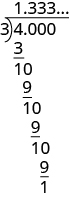
No matter how many more zeros we write, there will always be a remainder of and the threes in the quotient will go on forever. The number is called a repeating decimal. Remember that the “…” means that the pattern repeats.
How do you know how many ‘repeats’ to write? Instead of writing we use a shorthand notation by placing a line over the digits that repeat. The repeating decimal is written The line above the tells you that the repeats endlessly. So
For other decimals, two or more digits might repeat. Table 1.3 shows some more examples of repeating decimals.
| is the repeating digit | |
|---|---|
| is the repeating digit | |
| is the repeating block | |
| is the repeating block |
It is useful to convert between fractions and decimals when we need to add or subtract numbers in different forms. To add a fraction and a decimal, for example, we would need to either convert the fraction to a decimal or the decimal to a fraction.
Order Decimals and Fractions
Earlier, we compared two decimals and determined which was larger. To compare a decimal to a fraction, we will first convert the fraction to a decimal and then compare the decimals.
When ordering negative numbers, remember that larger numbers are to the right on the number line and any positive number is greater than any negative number.
Practice Makes Perfect
Convert Fractions to Decimals
In the following exercises, convert each fraction to a decimal.
Show solution
0.4
Show solution
−0.375
Show solution
0.85
Show solution
2.75
Show solution
−12.4
Show solution
Show solution
Show solution
In the following exercises, simplify the expression.
Show solution
7
Show solution
3.025
Show solution
10.58
Order Decimals and Fractions
In the following exercises, order each pair of numbers, using or
Show solution
<
Show solution
>
Show solution
<
Show solution
<
Show solution
>
Show solution
>
In the following exercises, write each set of numbers in order from least to greatest.
Show solution
Show solution
Show solution
Show solution
Corequisite Skills for Introductory Statistics is a custom course edition compiled for Introductory Statistics corequisite courses from OpenStax Contemporary Mathematics, Elementary Algebra 2e, Intermediate Algebra 2e, Prealgebra 2e. Content by OpenStax is reproduced as published, apart from any corrections recorded for this edition. Sections are renumbered to follow the course outline. The course outline is adapted from Larry Green's Support Course for Elementary Statistics (LibreTexts, https://stats.libretexts.org/Bookshelves/Introductory_Statistics/Support_Course_for_Elementary_Statistics), used under CC BY 4.0 (https://creativecommons.org/licenses/by/4.0/). Lessons 2.4 and 6.7 are written for this edition by XYZ Homework. Every OpenStax lesson is abridged to the subsections and practice exercises this course uses. Lessons are headed with their course titles, not the source section titles. Access the complete originals free at openstax.org. License: CC-BY-NC-SA-4.0.