

1.4 Scientific Notation
Scientific Notation
A source-bound narrated opening with a worked example, an eight-second thinking pause, a checked result, English captions, and a transcript.
Read the transcriptDownload the videoNarration credits and licences
The amount of information available on the Internet is simply incomprehensible. One estimate for the amount of data that will be on the Internet by 2025 is 175 Zettabytes. A single zettabyte is one billion trillion. Written out, it is 1,000,000,000,000,000,000,000. One estimate is that we’re producing 2.5 quintillion bytes of data per day. A quintillion is a billion billion, or, written out, 1,000,000,000,000,000,000. To determine how many days it takes to increase the amount of information that is on the Internet by 1 zettabyte, divide these two numbers, a zettabyte being 1,000,000,000,000,000,000,000, and 2.5 quintillion, being 2,500,000,000,000,000,000, shows it takes 400 days to generate 1 zettabyte of information. But doing that calculation is awkward with a calculator. Keeping track of the zeros can be tedious, and a mistake can easily be made.
On the other end of the scale, a human red blood cell has a diameter of 7.8 micrometers. One micrometer is one millionth of a meter. Written out, 7.8 micrometers is 0.0000078 meters. Smaller still is the diameter of a virus, which is about 100 nanometers in diameter, where a nanometer is a billionth of a meter. Written out, 100 nanometers is 0.0000001 meters. To compare that to engineered items, a single transistor in a computer chip can be 14 nanometers in size (0.000000014 meters). Smaller yet is the diameter of an atom, at between 0.1 and 0.5 nanometers.
Sometimes we have numbers that are incredibly big, and so have an incredibly large number of digits, or sometimes numbers are incredibly small, where they have a large number of digits after the decimal. But using those representations of the names of the sizes makes comparing and computing with these numbers problematic. That’s where scientific notation comes in.
Writing Numbers in Standard or Scientific Notation Form
When we say that a number is in scientific notation, we are specifying the form in which that number is written. That form begins with an integer with an absolute value between 1 and 9, then perhaps followed by the decimal point and then some more digits. This is then multiplied by 10 raised to some power. When the number only has one non-zero digit, the scientific notation form is the digit multiplied by 10 raised to an exponent. When the number has more than one non-zero digit, the scientific notation form is a single digit, followed by a decimal, which is then followed by the remaining digits, which is then multiplied by 10 to a power.
The following numbers are written in scientific notation:
The following numbers are not written in scientific notation:
because it isn't multiplied by 10 raised to a power
because the absolute value of −50.053 is not at least 1 and less than 10
because 41.7 is not at least 1 and less than 10
because 0.036 is not at least one and less than 10
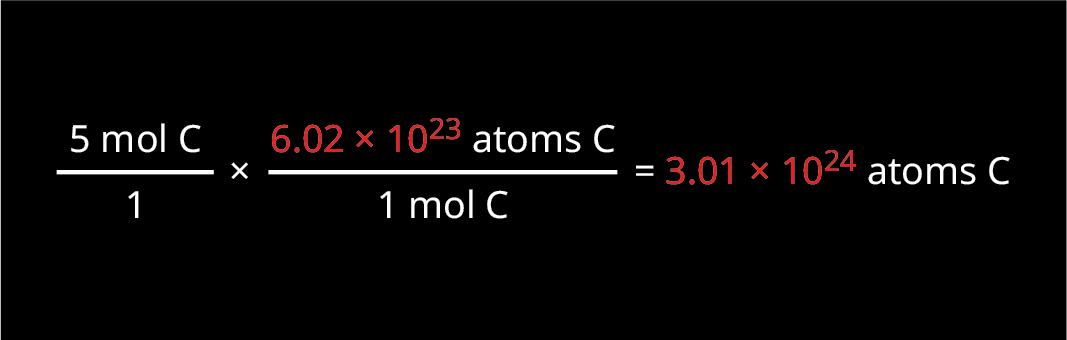
Some numbers are so large or so small that it is impractical to write them out fully. Avogadro’s number is important in chemistry. It represents the number of units in 1 mole of any substance. The substance may be electrons, atoms, molecules, or something else. Written out, the number is: 602,214,076,000,000,000,000,000. Another example of a number that is impractical to write out fully is the length of a light wave. The wavelength of the color blue is about 0.000000450 to 0.000000495 meters. Such numbers are awkward to work with, and so scientific notation is often used. We need to discuss how to convert numbers into scientific notation, and also out of scientific notation.
Recall that multiplying a number by 10 adds a 0 to the end of the number or moves the decimal one place to the right, as in or . And if you multiply by 100, it adds two zeros to the end of the number or moves the decimal two places to the right, and so on. For example, and . Multiplying a number by 1 followed by some number of zeros just adds that many zeros to the end of the number or moves the decimal place that many places to the right. Numbers written as 1 followed by some zeros are just powers of 10, as in , , , etc. Generally, .
We can use this to write very large numbers. For instance, Avogadro’s number is 602,214,076,000,000,000,000,000, which can be written as . The multiplication moves the decimal 23 places to the right.
Similarly, when we divide by 10, we move the decimal one place to the left, as in . If we divide by 100, we move the decimal two places to the left, as in . In general, when you divide a number by a 1 followed by zeros, you move the decimal places to the left, as in . This denominator could be written as . If we use that in the expression and allow for negative exponents, rewrite the number as . With this, we can write division by a 1 followed by zeros as multiplication by 10 raised to .
Using that information, we can demonstrate how to convert from a number in standard form into scientific notation form.
Case 1: The number is a single-digit integer.
In this case, the scientific notation form of the number is .
Case 2: The absolute value of the number is less than 1.
Follow the process below.
- Step 1: Count the number of zeros between the decimal and the first non-zero digit. Label this .
- Step 2: Starting with the first non-zero digit of the number, write the digits. If the number was negative, include the negative sign.
- Step 3: If there is more than one digit, place the decimal after the first digit from Step 2.
- Step 4: Multiply the number from Step 3 by .
Case 3: The absolute value of the number is 10 or larger.
Follow the process below.
- Step 1: Count the number of digits that are to the left of the decimal point. Label this .
- Step 2: Write the digits of the number without the decimal place, if one was present. If the number was negative, include the negative sign.
- Step 3: If there is more than one digit, place the decimal point after the first digit.
- Step 4: Multiply the number from Step 3 by .
When we write numbers in scientific notation form, we can manipulate the representation of the number by moving the decimal around, and making an appropriate change to the exponent of the 10. For instance, let’s look at . If we wanted to move the decimal one place to the left, we’d have to increase the power of 10, as shown here: . Since we moved the decimal one to the left, we balance that with moving the exponent up by one. Similarly, if we move the decimal one place to the right, we have to balance that by moving the exponent one to the left, or subtracting one from the exponent, as shown here: . Generally, for a number in the form :
- If you move the decimal to the left by digits, you increase the exponent by .
- If you move the decimal to the right by digits, you decrease the exponent by digits.
Converting Numbers from Scientific Notation to Standard Form
In the previous section, converting a number from standard form to scientific notation was explored. Now, we explore converting from scientific notation back into standard form. Doing so involves moving the decimal according to the power of the 10. The decimal is moved a number of steps equal to the exponent of the 10. As demonstrated previously, when the exponent of the 10 is negative, the decimal is moved to the left and when the exponent of the 10 is positive, the decimal is moved to the right.
Corequisite Skills for Introductory Statistics is a custom course edition compiled for Introductory Statistics corequisite courses from OpenStax Contemporary Mathematics, Elementary Algebra 2e, Intermediate Algebra 2e, Prealgebra 2e. Content by OpenStax is reproduced as published, apart from any corrections recorded for this edition. Sections are renumbered to follow the course outline. The course outline is adapted from Larry Green's Support Course for Elementary Statistics (LibreTexts, https://stats.libretexts.org/Bookshelves/Introductory_Statistics/Support_Course_for_Elementary_Statistics), used under CC BY 4.0 (https://creativecommons.org/licenses/by/4.0/). Lessons 2.4 and 6.7 are written for this edition by XYZ Homework. Every OpenStax lesson is abridged to the subsections and practice exercises this course uses. Lessons are headed with their course titles, not the source section titles. Access the complete originals free at openstax.org. License: CC-BY-NC-SA-4.0.