

1.1 Ordering and Rounding Decimals
Ordering and Rounding Decimals
A source-bound narrated opening with a worked example, an eight-second thinking pause, a checked result, English captions, and a transcript.
Read the transcriptDownload the videoNarration credits and licences
Name Decimals
You probably already know quite a bit about decimals based on your experience with money. Suppose you buy a sandwich and a bottle of water for lunch. If the sandwich costs , the bottle of water costs , and the total sales tax is , what is the total cost of your lunch?
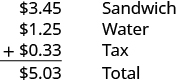
The total is Suppose you pay with a bill and pennies. Should you wait for change? No, and pennies is the same as
Because each penny is worth of a dollar. We write the value of one penny as since
Writing a number with a decimal is known as decimal notation. It is a way of showing parts of a whole when the whole is a power of ten. In other words, decimals are another way of writing fractions whose denominators are powers of ten. Just as the counting numbers are based on powers of ten, decimals are based on powers of ten. Table 1.1 shows the counting numbers.
| Counting number | Name |
|---|---|
| One | |
| Ten | |
| One hundred | |
| One thousand | |
| Ten thousand |
How are decimals related to fractions? Table 1.2 shows the relation.
| Decimal | Fraction | Name |
|---|---|---|
| One tenth | ||
| One hundredth | ||
| One thousandth | ||
| One ten-thousandth |
When we name a whole number, the name corresponds to the place value based on the powers of ten. For example, we read as ten thousand. Likewise, the names of the decimal places correspond to their fraction values. Notice how the place value names in Figure 1.1 relate to the names of the fractions from Table 1.2.
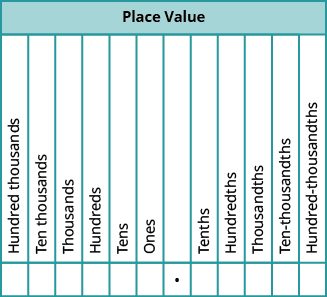
Notice two important facts shown in Figure 1.1.
- The “th” at the end of the name means the number is a fraction. “One thousand” is a number larger than one, but “one thousandth” is a number smaller than one.
- The tenths place is the first place to the right of the decimal, but the tens place is two places to the left of the decimal.
Remember that lunch? We read as five dollars and three cents. Naming decimals (those that don’t represent money) is done in a similar way. We read the number as five and three hundredths.
We sometimes need to translate a number written in decimal notation into words. As shown in Figure 1.2, we write the amount on a check in both words and numbers.
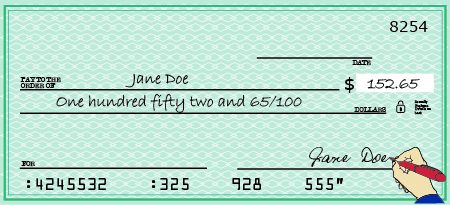
| Let’s try naming a decimal, such as 15.68. | |
|---|---|
| We start by naming the number to the left of the decimal. | fifteen______ |
| We use the word “and” to indicate the decimal point. | fifteen and_____ |
| Then we name the number to the right of the decimal point as if it were a whole number. | fifteen and sixty-eight_____ |
| Last, name the decimal place of the last digit. | fifteen and sixty-eight hundredths |
The number is read fifteen and sixty-eight hundredths.
Order Decimals
Which is larger, or
If you think of this as money, you know that (forty cents) is greater than (four cents). So,
We can also use the number line to order numbers.
Where are and located on the number line?

We see that is to the right of So we know
How does compare to This doesn’t translate into money to make the comparison easy. But if we convert and to fractions, we can tell which is larger.
| Convert to fractions. | ||
| We need a common denominator to compare them. |  | |
Because we know that Therefore,
Notice what we did in converting to a fraction—we started with the fraction and ended with the equivalent fraction Converting back to a decimal gives So is equivalent to Writing zeros at the end of a decimal does not change its value.
If two decimals have the same value, they are said to be equivalent decimals.
We say and are equivalent decimals.
Remember, writing zeros at the end of a decimal does not change its value.
When we order negative decimals, it helps to look first at negative integers. Larger numbers are to the right on the number line. For example, because lies to the right of on the number line, we know that Similarly, smaller numbers lie to the left on the number line. For example, because lies to the left of on the number line, we know that

If we zoomed in on the interval between and we would see in the same way that
Round Decimals
In the United States, gasoline prices are usually written with the decimal part as thousandths of a dollar. For example, a gas station might post the price of unleaded gas at per gallon. But if you were to buy exactly one gallon of gas at this price, you would pay , because the final price would be rounded to the nearest cent. We round numbers to get an approximate value when the exact value is not needed. Suppose we wanted to round to the nearest dollar. Is it closer to or to What if we wanted to round to the nearest ten cents; is it closer to or to The number lines in Figure 1.3 can help us answer those questions.

ⓑ We see that is closer to than So we say that rounded to the nearest tenth is
Can we round decimals without number lines? Yes! We use the method below.
Practice Makes Perfect
Name Decimals
In the following exercises, name each decimal.
Show solution
five and five tenths
Show solution
five and one hundredth
Show solution
eight and seventy-one hundredths
Show solution
two thousandths
Show solution
three hundred eighty-one thousandths
Show solution
negative seventeen and nine tenths
Order Decimals
In the following exercises, order each of the following pairs of numbers, using
Show solution
>
Show solution
<
Show solution
>
Show solution
>
Show solution
<
Show solution
<
Round Decimals
In the following exercises, round each number to the nearest tenth.
Show solution
0.7
Show solution
2.8
In the following exercises, round each number to the nearest hundredth.
Show solution
0.85
Show solution
5.79
Show solution
0.30
Show solution
4.10
In the following exercises, round each number to the nearest ⓐ hundredth ⓑ tenth ⓒ whole number.
Show solution
- ⓐ 5.78
- ⓑ 5.8
- ⓒ 6
Show solution
- ⓐ 63.48
- ⓑ 63.5
- ⓒ 63
Corequisite Skills for Introductory Statistics is a custom course edition compiled for Introductory Statistics corequisite courses from OpenStax Contemporary Mathematics, Elementary Algebra 2e, Intermediate Algebra 2e, Prealgebra 2e. Content by OpenStax is reproduced as published, apart from any corrections recorded for this edition. Sections are renumbered to follow the course outline. The course outline is adapted from Larry Green's Support Course for Elementary Statistics (LibreTexts, https://stats.libretexts.org/Bookshelves/Introductory_Statistics/Support_Course_for_Elementary_Statistics), used under CC BY 4.0 (https://creativecommons.org/licenses/by/4.0/). Lessons 2.4 and 6.7 are written for this edition by XYZ Homework. Every OpenStax lesson is abridged to the subsections and practice exercises this course uses. Lessons are headed with their course titles, not the source section titles. Access the complete originals free at openstax.org. License: CC-BY-NC-SA-4.0.