7.9 Conditional Probability and the Multiplication Rule
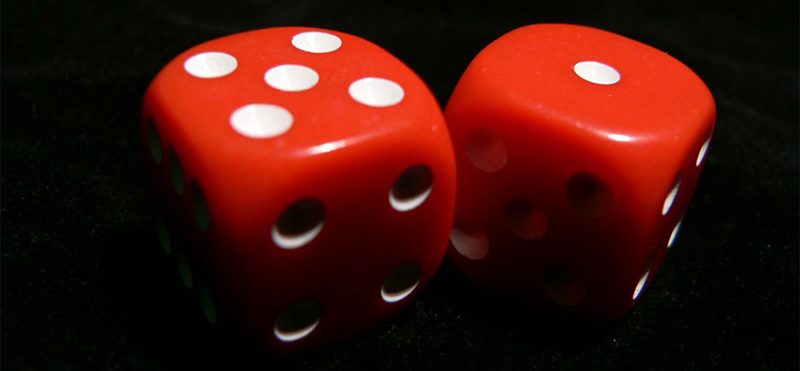
Figure 7.37If you roll two dice by throwing them one at a time, the face showing on the first die will affect the possible outcomes for the sum of the two dice.If you roll two dice by throwing them one at a time, the face showing on the first die will affect the possible outcomes for the sum of the two dice. (credit: “dice” by Ciarán Archer/Flickr, CC BY 2.0)
Learning Objectives
After completing this section, you should be able to:
Calculate conditional probabilities.
Apply the Multiplication Rule for Probability to compute probabilities.
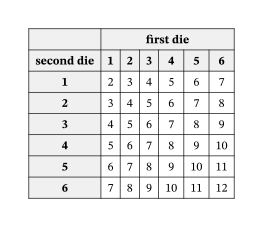
Back in Example 3 in Section 7.5, we constructed the following table (Figure 7.38) to help us find the probabilities associated with rolling two standard 6-sided dice:
Figure 7.38
For example, 3 of these 36 equally likely outcomes correspond to rolling a sum of 10, so the probability of rolling a 10 is . However, if you choose to roll the dice one at a time, the probability of rolling a 10 will change after the first die comes to rest. For example, if the first die shows a 5, then the probability of rolling a sum of 10 has jumped to —the event will occur if the second die also shows a 5, which is 1 of 6 equally likely outcomes for the second die. If instead the first die shows a 3, then the probability of rolling a sum of 10 drops to 0—there are no outcomes for the second die that will give us a sum of 10.
Understanding how probabilities can shift as we learn new information is critical in the analysis of our second type of compound events: those built with “and.” This section will explain how to compute probabilities of those compound events.
Conditional Probabilities
When we analyze experiments with multiple stages, we often update the probabilities of the possible final outcomes or the later stages of the experiment based on the results of one or more of the initial stages. These updated probabilities are called conditional probabilities.
In other words, if is a possible outcome of the first stage in a multistage experiment, then the probability of an event conditional on (denoted , read “the probability of given ”) is the updated probability of under the assumption that occurred.
In the example that opened this section, we might consider rolling two dice as a multistage experiment: rolling one, then the other. If we define to be the event “roll a sum of 10,” to be the event “first die shows 5,” and to be the event “first die shows 3,” then we computed , , and .
Compound Events Using “And” and the Multiplication Rule
For multistage experiments, the outcomes of the experiment as a whole are often stated in terms of the outcomes of the individual stages. Commonly, those statements are joined with “and.” For example, in the sock drawer example just above, one outcome might be “the left sock is black and the right sock is blue.” As with “or” compound events, these probabilities can be computed with basic arithmetic.
It is often useful to combine the rules we’ve seen so far with the techniques we used for finding sample spaces. In particular, trees can be helpful when we want to identify the probabilities of every possible outcome in a multistage experiment. The next example will illustrate this.
Key Terms
conditional probability
Key Concepts
Conditional probabilities are computed under the assumption that the condition has already occurred.
The Multiplication Rule for Probability is used to find the probability that two events occur in sequence.
Formulas
If and are events associated with the first and second stages of an experiment, then .
Adapted from Contemporary Mathematics by OpenStax (openstax.org), licensed under CC BY-NC-SA 4.0. Changes were made. License: CC-BY-NC-SA-4.0.