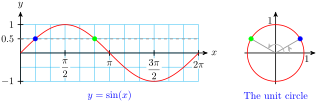
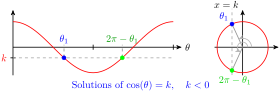
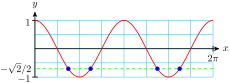
We have seen that an equation of the form (for ) always has two solutions between and . For example, the figure below illustrates that and are solutions of the equation . These two solutions correspond to the two points on the unit circle where .
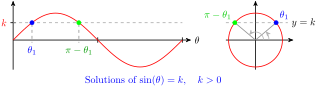
The calculator gives us only one of these solutions, but we can use reference angles to find the other solution. In fact, if we use a calculator to find one solution as , then the other solution is . You can see this by considering the symmetry of the sine graph, or of the unit circle, as shown below.
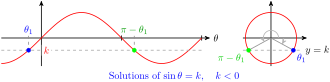
This relationship between the two solutions still holds if is negative, because the calculator returns a negative angle for . See the figure below.
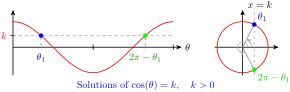
A similar method applies to equations of the form . The two solutions between and are and . Once again, you can see this by considering the symmetry of the cosine graph, or of the unit circle, as shown below.
The relationship between the two solutions still holds if is negative. See the figure below.
Solve for . Round your answers to four decimal places.
1.9391, 4.3441
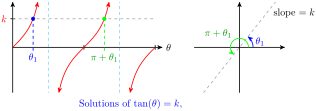
Equations of the form are generally easier to solve, because there is only one solution in each cycle of the graph. Each solution differs from the previous one by , as shown below.
For example, to solve the equation for , we first calculate
Because this angle is not between and , we add to find the next two solutions:
We summarize these observations for the three trigonometric functions as follows.
Multiple Solutions
If is an integer, what can we say about the solutions of the equation
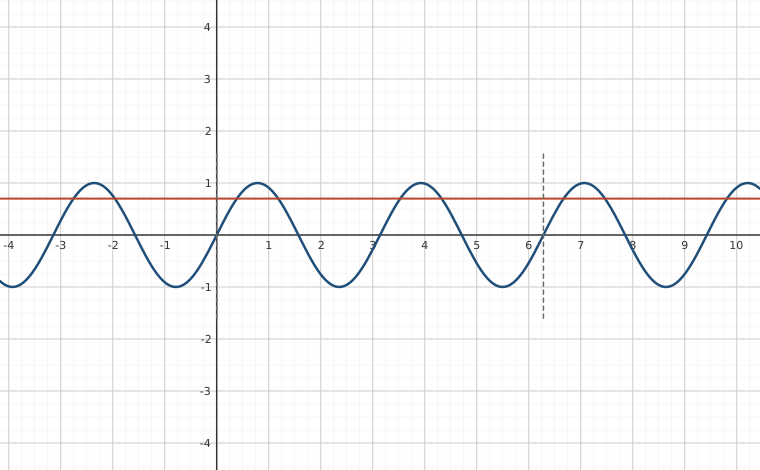
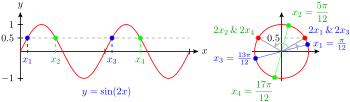
For example, how many solutions are there for the equation ? The figure below shows that this equation has four solutions between and . The graph of completes two cycles between and , and each cycle produces two solutions, for a total of four.
Interactive figureHow many solutions? sin(nx) = k between 0 and 2πDrag the Cycles n and Level k sliders.
XYZ Graph · viewer build 5edf91b
The section's counting argument as a picture you can change. The blue curve is y = sin(nx); the red line is y = k. Every crossing between the dashed markers at x = 0 and x = 2π is one solution of sin(nx) = k on that interval. With n = 2 and k = 0.7 (the section's equation) the graph completes two cycles and each cycle produces two solutions — four crossings. Slide n up: n cycles fit in [0, 2π], giving 2n solutions. Now slide k toward 1 and watch each pair of crossings merge into one as the line reaches the crests, then vanish entirely for k > 1 — the graphical face of “sin θ = k has no solution when |k| > 1.”
Sketch a graph of for .
Find exact values for all solutions of between and .
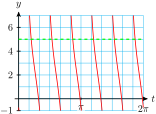
As we observed earlier, equations involving the tangent function are easier to solve, because there is only one solution in each cycle of the graph. Once we have found one solution, we can find all the others by adding multiples of the period.
Find all solutions of between and .
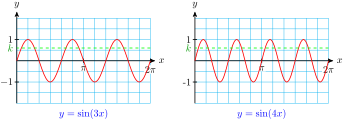
The larger the value of , the more cycles the graph completes between and , and the more solutions we find. Thus, for , there are six solutions of between and , eight solutions of , and so on. (See the figure below.)
Using a Calculator for Multiple Solutions
Of course, if is not one of the special values, we'll need a calculator to help us solve the equation.
Solve for . Round your answers to two decimal places.
Using a Substitution
For more complicated equations, it can be helpful to use a substitution, in order to reduce the equation to the form or or . We want our substitution to replace the input of the sine function by a single variable. For example, in the next example, we substitute for the angle , so that the equation becomes .
Use a substitution to solve for .
Here is our strategy for solving trigonometric equations by using a substitution.
Graph from to .
Find all solutions of
between and . Round your answers to two decimal places.
Applications
Trigonometric equations often arise in the study of periodic models.
A lever on an oil well is pumping vertically at a rate of 10 cycles per minute. The distance between its lowest position at the ground and its highest position is 1.8 meters.
Suppose the lever is at its midline position at and moving downwards. Find a formula for the sinusoidal function that gives the lever's height.
Find the first two times that lever is 1 meter above its lowest position.
0.0518 minute and 0.9823 minute
Review the following skills you will need for this section.
Section 7.3 Summary
Concepts
If is a positive integer, the equations and each have solutions between and , for .
The equation has one solution in each cycle of the graph.
For more complicated equations, it can be helpful to use a substitution to replace the input of the trig function by a single variable.
Study Questions
If is one solution of the equation , what is other? Illustrate on a unit circle.
If is one solution of the equation , what is the other? Illustrate on a unit circle.
If is one solution of the equation , what is the other?
Explain why the equation , has solutions between and .
Skills
Find exact solutions to equations of the form #1–10
Find all solutions between and #11–16
Use a substitution to solve trigonometric equations #17–28
Use a graph to estimate all solutions between and .
Give exact values for the solutions between and .
, , ,
, , , ,
, , , , ,
, , ,
, , , , ,
For Problems 11–20, find all solutions between and . Round your answers to three decimal places.
, , , , , , ,
, , , , ,
, , ,
, , , , , ,
For Problems 21–28, use a substitution to find exact values for all solutions between
and .
, , ,
, , , , ,
, , , , ,
For Problems 29–42, use a substitution to find all solutions between
and . Round your answers to hundredths.
, , , , ,
, , , , ,
, ,
, , , , ,
, ,
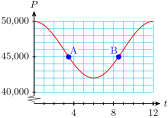
The population of deer in Marquette County over the course of a typical year can be approximated by a sinusoidal function. The population reached a maximum of 50,000 deer on September 1, and a minimum of 42,000 deer on March 1.
Write a formula for the function that gives the deer population on the first of each month, where is September 1.
When is the deer population 45,000? Give exact expressions and approximations rounded to two decimal places.
Graph your function over one period, and label the points that correspond to a deer population of 45,000. Is the population greater or less than 45,000 between the two solutions?
months (Dec) or months (June)
is less than 45,000 between and .
The percent of the moon visible from earth is a sinusoidal function ranging from 0% to 100%, with a period of 29.5 days.
Write a formula for the function that gives the percent of the moon that is visible, if a new moon (0% visible) occurs at days.
When is 25% of the moon visible? Give approximations rounded to two decimal places.
Graph your function over one period, and label the points that correspond to a quarter moon. Is more or less than 25% of the moon visible between the two solutions you found in part (b)?
A Ferris wheel has a diameter of 20 meters and completes one revolution every 60 seconds. Delbert is at the lowest position of the Ferris wheel, 1 meter above ground, when seconds.
Write a formula for the function that gives Delbert's altitude in meters after seconds.
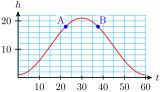
When is Delbert at an altitude of 18 meters during his first revolution? Give exact expressions and approximations rounded to two decimal places.
Graph your function over one period, labeling the points that correspond to an altitude of 18 meters. Is Delbert above or below 18 meters between the two solutions you found in part (b)?
sec or sec
Delbert is above 18 m between and .
High tides occur every 12.2 hours at Point Lookout. The depth of the water at the end of David's dock is 2.6 meters at high tide and 1.8 meters at low tide.
Write a formula for the function that gives the depth of the water hours after last night's high tide.
When is the water at the end of the dock 2 meters deep? Give approximations rounded to two decimal places.
Graph your function over one period, labeling the points that correspond to a depth of 2 meters. Is the water depth greater or less than 2 meters between the two solutions you found in part (b)?
Trigonometry by Katherine Yoshiwara (yoshiwarabooks.org), GNU Free Documentation License 1.2 or later. Adapted for the XYZ HTML edition with the authors' permission (recorded 2026-07-04). License: GFDL-1.2-or-later.
These eBooks are a prerelease and are not yet certified conformant with WCAG 2.1 AA or ADA Title II. Every page is built against an automated accessibility gate, and the published editions will meet ADA Title II requirements when they release in late September 2026. If something is unusable, please tell us.