
2.4 Chapter 2 Summary and Review
Key Concepts
- The longest side in a triangle is opposite the largest angle, and the shortest side is opposite the smallest angle
- Triangle Inequality: In any triangle, the sum of the lengths of any two sides is greater than the length of the third side.
- Pythagorean Theorem: In a right triangle with hypotenuse .
- If the sides of a triangle satisfy the relationship , then the triangle is a right triangle.
- By using similar triangles, we can find the unknown sides of a right triangle if we know only one side and one of the acute angles.
- The trigonometric ratio of an angle is the same for every right triangle containing the angle.
- If we know one of the sides of a right triangle and any one of the other four parts, we can use trigonometry to find all the other unknown parts.
- If we know one of the trigonometric ratios of an acute angle, we can find the angle using the inverse trig key on a calculator.
- The exact values of trigonometric ratios of the special angles are useful benchmarks.
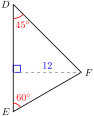
Trigonometric Ratios for the Special Angles Angle Sine Cosine Tangent - You can remember the trig values for the special angles if you memorize two triangles:
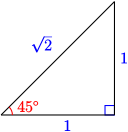
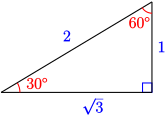
- For the trigonometric ratios of most angles, your calculator gives approximations, not exact values.
Chapter 2 Review Problems
For Problems 1–6, explain why the description of is impossible.
, and
If , then
, and
and
If , then
and
and
If , then
and
For Problems 7 and 8, sketch the triangle.
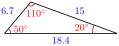
The three angles of a triangle are and the three sides are 15 cm, 6.7 cm, and 18.4 cm. Sketch and label the triangle.
Sketch and label an isosceles triangle with sides 5 in and 12 in, and one angle .
For Problems 9–12, find the unknown side of the right triangle.

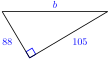
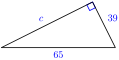
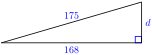
A triangle has sides of length 33, 56, and 65. Is it a right triangle?
Yes
A triangle has sides of length 22.5, 27.2, and 35.3. Is it a right triangle?
Find the angle between the diagonal of a cube and the diagonal of one of the sides. (See the figure at right.)

Find the angle between the diagonal of a cube and one edge. (See the figure at right.)

In the triangle shown, . Can we conclude that and ? Give two other possibilities for the values of and .

No. or
In the triangle shown, . Can we conclude that and ? Give two other possibilities for the values of and .
For Problems 19–22,
- Find the unknown side.
- Find the sine, cosine, and tangent of . Round your answers to four decimal places.
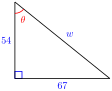
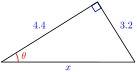
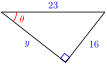

For Problems 23–28,find the unknown side of the triangle. Round your answer to hundredths.
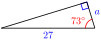


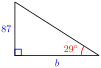

For Problems 29–32, solve the triangle. Give exact values.


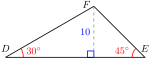
Find the diameter of a hex nut if one of the sides is 1.5 cm.

cm
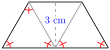
Find the long edge of the trapezoidal block of height 3 centimeters.
If a stop sign is 80 centimeters across, what is the radius of a circle that circumscribes the stop sign?

cm
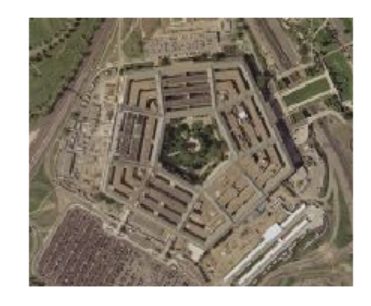
The Pentagon, which houses the U.S. Department of Defense, is in the shape of a regular pentagon. Each of the five outer walls is 921.6 feet long. What is the shortest distance from one of the outer walls to the opposite vertex of the pentagon?
A building casts a 12 meter shadow. At that moment, the sun is above the horizon. How tall is the building?
m
A ramp is rising at an angle from horizontal. What is the distance (along the ramp) from the base of the ramp to the point on the ramp that is 1 meter higher than the base of the ramp?
A baseball diamond is a square with sides 90 feet long. The corners are called (in clockwise order) first base, second base, third base, and home plate. The sides are called baselines. A runner is on the baseline between first and second base, 20 feet from second base. How far is the runner from home plate? What is the angle between the baseline from home plate to first base and the line from home plate to the runner?
ft,
A runner is on the baseline between second and third base, 10 feet from second base. How far is the runner from home plate? What is the angle between the baseline from home plate to third base and the line from home plate to the runner?
Let be the line that passes through the origin and the point . Let be the angle that makes with the positive -axis.
- Find the value of . Hint: Draw the triangle with vertices at the origin, , and , labeling the angle at the origin . What is ?)
- Let be any line parallel to . Find the measure of the acute angle that makes with the positive -axis.
- What is the slope of the line ? How is it related to ?
Let be the line that passes through the origin and the point , where and are positive numbers. Let be the angle that makes with the positive -axis.
- Find the value of . Hint: Draw the triangle with vertices at the origin, , and , labeling the angle at the origin . What is ?)
- What is the slope of the line ? How is it related to ?
- Let be any line parallel to . How is the slope of the line related to ?
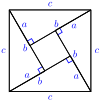
The figure illustrates the Pythagorean theorem.
- What is the area of the whole square?
- What is the side of the smaller interior square? What is its area?
- What is the area of one of the right triangles?
- Add the areas of the four triangles and the smaller square to obtain another expression for the area of the whole square.
The figure illustrates a proof of the Pythagorean theorem given by Euclid. It shows that the area of the square on the hypotenuse is the sum of the areas of the squares on legs and . We first draw a line segment from point perpendicular to the hypotenuse to meet the far side of the square on the hypotenuse. This segment meets at and the opposite side of the square at .
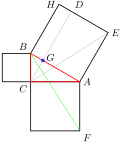
- How does the area of compare with the area of ? (Hint: Show that the triangles are congruent.)
- How does the area of compare with the area of the square on ? (Hint: Consider to be the base of the triangle. What is the height?)
- How does the area of compare with the area of the rectangle ? (Hint: Consider to be the base of the triangle. What is the height?)
- Explain why the area of the square on equals the area of the rectangle .
- An argument similar to parts (a)–(d) will show that the area of the square on equals the area of the rectangle . Explain how writing the area of the square on as the sum of the areas of two rectangles gives the Pythagorean theorem.
Trigonometry by Katherine Yoshiwara (yoshiwarabooks.org), GNU Free Documentation License 1.2 or later. Adapted for the XYZ HTML edition with the authors' permission (recorded 2026-07-04). License: GFDL-1.2-or-later.