
2.1 Side and Angle Relationships
Introduction
From geometry we know that the sum of the angles in a triangle is 180°. Are there any relationships between the angles of a triangle and its sides?
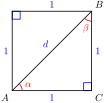
First of all, you have probably observed that the longest side in a triangle is always opposite the largest angle, and the shortest side is opposite the smallest angle, as illustrated below.
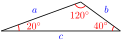

In isosceles triangle , the vertex angle . Which side is longer, or ?
Because the two base angles are each , is the largest angle, so is the longest side and is longer than .
The Triangle Inequality
It is also true that the sum of the lengths of any two sides of a triangle must be greater than the third side, or else the two sides will not meet to form a triangle. This fact is called the triangle inequality.
We cannot use the triangle inequality to find the exact lengths of the sides of a triangle, but when two sides are known, the triangle inequality allows us to find upper and lower bounds for the length of the third side.
Can you make a triangle with three wooden sticks of lengths 14 feet, 26 feet, and 10 feet? Sketch a picture, and explain why or why not.
No, is not greater than 26.
Right Triangles: The Pythagorean Theorem
In Chapter 1 we used the Pythagorean theorem to derive the distance formula. We can also use the Pythagorean theorem to find one side of a right triangle if we know the other two sides.
A baseball diamond is a square whose sides are 90 feet long. The catcher at home plate sees a runner on first trying to steal second base, and throws the ball to the second-baseman. Find the straight-line distance from home plate to second base.
Use the Pytthagorean theorem to find the diagonal of a square whose sides are 90 feet long.
, so feet
The sides of a triangle measure 15 inches, 25 inches, and 30 inches long. Is the triangle a right triangle?
No, .
The Pythagorean theorem relates the sides of right triangles. However, for information about the sides of other triangles, the best we can do (without trigonometry!) is the triangle inequality. Nor does the Pythagorean theorem help us find the angles in a triangle. In the next section we discover relationships between the angles and the sides of a right triangle.
Review the following skills you will need for this section.
Section 2.1 Summary
Vocabulary
- Converse
- Extraction of roots
- Inequality
Concepts
- The longest side in a triangle is opposite the largest angle, and the shortest side is opposite the smallest angle.
- Triangle Inequality: In any triangle, the sum of the lengths of any two sides is greater than the length of the third side.
- Pythagorean Theorem: In a right triangle with hypotenuse .
- If the sides of a triangle satisfy the relationship , then the triangle is a right triangle.
Study Questions
- Is it always true that the hypotenuse is the longest side in a right triangle? Why or why not?
- In , is it possible that and are both true? Explain your answer.
- In a right triangle with hypotenuse , we know that . Is it also true that ? Why or why not?
- The two shorter sides of an obtuse triangle are 3 in and 4 in. What are the possible lengths for the third side?
Skills
- Identify inconsistencies in figures #1-12
- Use the triangle inequality to put bounds on the lengths of sides #13-16
- Use the Pythagorean theorem to find the sides of a right triangle #17-26
- Use the Pythagorean theorem to identify right triangles #27-32
- Solve problems using the Pythagorean theorem #33-42
Homework 2.1
For Problems 1–12, explain why the measurements shown cannot be accurate.

The sum of the angles is not .


The exterior angle is not equal to the sum of the opposite interior angles.


The sum of the acute angles is not .


The largest side is not opposite the largest angle.


The Pythagorean theorem is not satisfied.


, but the angle opposite the side of length 13 is .

If two sides of a triangle are 6 feet and 10 feet long, what are the largest and smallest possible values for the length of the third side?
Two adjacent sides of a parallelogram are 3 cm and 4 cm long. What are the largest and smallest possible values for the length of the diagonal?
If one of the equal sides of an isosceles triangle is 8 millimeters long, what are the largest and smallest possible values for the length of the base?
The town of Madison is 15 miles from Newton, and 20 miles from Lewis. What are the possible values for the distance from Lewis to Newton?
For Problems 17–22,
- Make a sketch of the situation described, and label a right triangle.
- Use the Pythagorean Theorem to solve each problem.
The size of a TV screen is the length of its diagonal. If the width of a 35-inch TV screen is 28 inches, what is its height?
21 in
If a 30-meter pine tree casts a shadow of 30 meters, how far is the tip of the shadow from the top of the tree?
The diagonal of a square is 12 inches long. How long is the side of the square?
in
The length of a rectangle is twice its width, and its diagonal is meters long. Find the dimensions of the rectangle.
What size rectangle can be inscribed in a circle of radius 30 feet if the length of the rectangle must be three times its width?

The rectangle is inches by inches.
What size square can be inscribed inside a circle of radius 8 inches, so that its vertices just touch the circle?

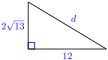
For Problems 23–26, find the unknown side of the triangle.

29


For Problems 27–32, decide whether a triangle with the given sides is a right triangle.
9 in, 16 in, 25 in
No
12 m, 16 m, 20 m
5 m, 12 m, 13 m
Yes
5 ft, 8 ft, 13 ft
ft, ft, ft
No
ft, ft, ft
Show that the triangle with vertices , and is an isosceles right triangle, that is, a right triangle with two sides of the same length.
The distance from to is , and the distance from to is also , so the triangle is isosceles. The distance from to is 6, and so the triangle is a right triangle.
Two opposite vertices of a square are and .
- Find the length of a diagonal of the square.
- Find the length of the side of the square.
A 24-foot flagpole is being raised by a rope and pulley, as shown in the figure. The loose end of the rope can be secured to a ring on the ground 7 feet from the base of the pole. From the ring to the top of the pulley, how long should the rope be when the flagpole is vertical?
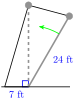
25 ft
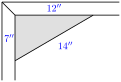
To check whether the corners of a frame are square, carpenters sometimes measure the sides of a triangle, with two sides meeting at the join of the boards. Is the corner shown in the figure square?
Find and .

Find and .
Find the diagonal of a cube of side 8 inches. Hint: Find the diagonal of the base first.
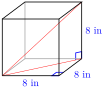
in
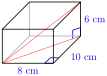
Find the diagonal of a rectangular box whose sides are 6 cm by 8 cm by 10 cm. Hint: Find the diagonal of the base first.
For Problems 41 and 42, make a sketch and solve.
- The back of Brian's pickup truck is five feet wide and seven feet long. He wants to bring home a 9-foot length of copper pipe. Will it lie flat on the floor of the truck?
- The shell on the pickup is 3 feet tall. Will a 9-foot copper pipe fit diagonally across the back of the truck?
- No
- Yes
What is the longest curtain rod that will fit inside a box 60 inches long by 10 inches wide by 4 inches tall?
In this problem, we'll show that any angle inscribed in a semi-circle must be a right angle. The figure shows a triangle inscribed in a unit circle, one side lying on the diameter of the circle and the opposite vertex at point on the circle.
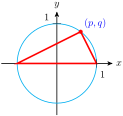
- What are the coordinates of the other two vertices of the triangle? What is the length of the side joining those vertices?
- Use the distance formula to compute the lengths of the other two sides of the triangle.
- Show that the sides of the triangle satisfy the Pythagorean theorem, .
- and ; 2
- and
There are many proofs of the Pythagorean theorem. Here is a simple visual argument.
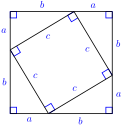
- What is the length of the side of the large square in the figure? Write an expression for its area.
- Write another expression for the area of the large square by adding the areas of the four right triangles and the smaller central square.
- Equate your two expressions for the area of the large square, and deduce the Pythagorean theorem.
Trigonometry by Katherine Yoshiwara (yoshiwarabooks.org), GNU Free Documentation License 1.2 or later. Adapted for the XYZ HTML edition with the authors' permission (recorded 2026-07-04). License: GFDL-1.2-or-later.