
2.2 Right Triangle Trigonometry
With the Pythagorean theorem we can find one side of a right triangle if we know the other two sides. By using what we know about similar triangles, we can find the unknown sides of a right triangle if we know only one side and one of the acute angles.


The Sine of an Angle
In Example 2 of Section 1.2, we saw that in a 30-60-90 right triangle, the ratio of the shortest side to the hypotenuse was , or 0.5. This ratio is the same for any two right triangles with a angle, because they are similar triangles, as shown at right.
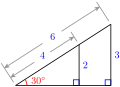
The ratio is given a name; it is called the "sine of ." We write
where sin is an abbreviation for sine. There is nothing special about angles; we can talk about the sine of any angle. The sine of an angle is the ratio of the side opposite the angle to the hypotenuse.
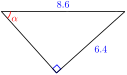
Find the sine of the labeled angle in the triangle at right. Round your answer to 4 decimal places.
Using a Calculator
Mathematicians have calculated the sines of any angle we like. The values of the sine were originally collected into tables, and are now available on scientific calculators. For example, let's find the sine of . First, consider some triangles, as shown below.
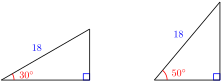
Do you expect the sine of to be larger or smaller than the sine of ? Do you expect the sine of to be larger or smaller than 1?
- Use your calculator to complete the table, rounding your answers to four decimal places.
- What do you notice about the values of as increases from to ? If you plot the values of against the values of , will the graph be a straight line? Why or why not?
- The values of increase from 0 to 1 as increases from to . The graph will not be a straight line because the slopes between successive points are not constant.
Using the Sine Ratio to Find an Unknown Side
In the next example we see how to use the sine ratio to find an unknown side in a right triangle, knowing only one other side and one angle.
Find the length of the hypotenuse in the triangle shown.

. Solve this equation to find , or, rounding to one decimal place, about 8.5 m
The Cosine and the Tangent
There are two more trigonometric ratios used for calculating the sides of right triangles, depending on which of the three sides is known and which are unknown. These ratios are called the cosine and the tangent.
Suppose we'd like to find the height of a tall cliff without actually climbing it. We can measure the distance to the base of the cliff, and we can use a surveying tool called a theodolite to measure the angle between the ground and our line of sight to the top of the cliff (this is called the angle of elevation).
These values give us two parts of a right triangle, as shown at right. The height we want is the side opposite the angle of elevation. The distance to the base of the cliff is the length of the side adjacent to the angle of elevation.
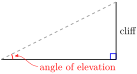
The ratio of the side opposite an angle to the side adjacent to the angle is called the tangent of the angle. The abbreviation for “tangent of theta” is tan ().
Just like the sine of an angle, the tangent ratio is always the same for a given angle, no matter what size triangle it occurs in. And just like , we can find the values of on a scientific calculator.
Use the tangent ratio to find in the triangle shown.
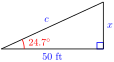
- Use the sine ratio to find the hypotenuse, , of the triangle.
- Use the Pythagorean theorem to find the hypotenuse of the triangle. Do you get the same answer with both methods? Can you explain why the calculations might give (slightly) different answers?
- , and solving this equation gives ft.
- , so ft.
- The answers agree when rounded to units. Rounding during calculation can cause the results to differ.
The third trigonometric ratio, called the cosine, is the ratio of the side adjacent to an angle and the hypotenuse of the triangle.
The Three Trigonometric Ratios
Here is a summary of the three trigonometric ratios we have discussed.
These three definitions are the foundation for all the rest of trigonometry. You should internalize them immediately!!
We must also be careful to apply these definitions of the trigonometric ratios only to right triangles. In the next example, we create a right triangle by drawing an extra line.
Another isosceles triangle has base angles of and equal sides of length 6.8 centimeters. Find the length of the base.
Let stand for half of the base. Then , so and the base is 4.2 cm.
Review the following skills you will need for this section.
Section 2.2 Summary
Vocabulary
- Sine
- Cosine
- Tangent
- Angle of elevation
- Adjacent side
- Irrational number
Concepts
- By using similar triangles, we can find the unknown sides of a right triangle if we know only one side and one of the acute angles.
- The trigonometric ratio of an angle is the same for every right triangle containing the angle.
Study Questions
- Sketch a figure that illustrates why is the same for every right triangle with a angle.
- Sketch a figure that illustrates why decreases as increases from to .
- Which trigonometric ratio would you use to find the hypotenuse of a right triangle if you knew one acute angle and the side opposite that angle?
- Does your calculator give you the exact decimal values for the trigonometric ratios of acute angles?
Skills
Practice each skill in the Homework Problems listed.
- Use measurements to calculate the trigonometric ratios for acute angles #1-10, 57-60
- Use trigonometric ratios to find unknown sides of right triangles #11-26
- Solve problems using trigonometric ratios #27-34, 41-46
- Use trig ratios to write equations relating the sides of a right triangle #35-40
- Use relationships among the trigonometric ratios #47-56, 61-68
Homework 2.2
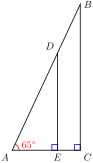
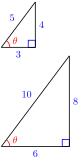
Here are two right triangles with a angle.
- Measure the sides and with a ruler. Use the lengths to estimate .
- Measure the sides and with a ruler. Use the lengths to estimate .
- Use your calculator to look up . Compare your answers. How close were your estimates?
- 0.91
- 0.91
- 0.9063
Use the figure in Problem 1 to calculate two estimates each for the cosine and tangent of . Compare your estimates to your calculator's values for and .
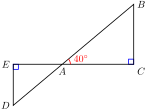
Here are two right triangles with a angle.
- Measure the sides and with a ruler. Use the lengths to estimate .
- Measure the sides and with a ruler. Use the lengths to estimate .
- Use your calculator to look up . Compare your answers. How close were your estimates?
- 0.77
- 0.77
- 0.7660
Use the figure in Problem 2 to calculate two estimates each for the cosine and tangent of . Compare your estimates to your calculator's values for and .
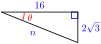
For the right triangles in Problems 5–10,
- Find the length of the unknown side.
- Find the sine, cosine, and tangent of . Round your answers to four decimal places.

>
- , ,


- , ,

- , ,

For Problems 11–16,
- Sketch and label the sides of a right triangle with angle .
- Sketch and label another right triangle with angle and longer sides.
(Answers may vary)

(Answers may vary)

(Answers may vary)
For Problems 17–22, use one of the three trigonometric ratios to find the unknown side of the triangle. Round your answer to hundredths.

14.41


37.86

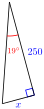
86.08

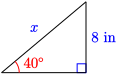
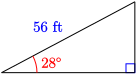
For Problems 23–26, sketch and label a right triangle with the given properties.
One angle is , the side opposite that angle is 8 inches
One angle is , the side adjacent to that angle is 30 yards
One angle is , the hypotenuse is 56 feet
One leg is 15 meters, the hypotenuse is 18 meters
For Problems 27–34,
- Sketch a right triangle that illustrates the situation. Label your sketch with the given information.
- Choose the appropriate trig ratio and write an equation, then solve the problem.
To measure the height of cloud cover, airport controllers fix a searchlight to shine a vertical beam on the clouds. The searchlight is 120 yards from the office. A technician in the office measures the angle of elevation to the light on the cloud cover at . What is the height of the cloud cover?

- , 170.1 yd
To measure the distance across a canyon, Evel first sights an interesting rock directly opposite on the other side. He then walks 200 yards down the rim of the canyon and sights the rock again, this time at an angle of from the canyon rim. What is the width of the canyon?
A salvage ship is searching for the wreck of a pirate vessel on the ocean floor. Using sonar, they locate the wreck at an angle of depression of . The depth of the ocean at their location is 260 feet. How far should they move so that they are directly above the wrecked vessel?

- , 355.2 ft
Ramps for wheelchairs should be no steeper than an angle of . How much horizontal distance should be allowed for a ramp that rises 5 feet in height?
The radio signal from a weather balloon indicates that it is 1500 meters from a meteorologist on the ground. The angle of elevation to the balloon is . What is the balloon's altitude?

- , 1114.7 m
According to Chinese legend, around 200 BC the general Han Xin used a kite to determine the distance from his location to an enemy palace. He then dug a secret tunnel which emerged inside the palace. When the kite was directly above the palace, its angle of elevation was and the string to the kite was 1850 feet long. How far did Han Xin's troops have to dig?
A cable car on a ski lift traverses a horizontal distance of 1800 meters at an angle of . How long is the cable?

- , 2284.2 m
Zelda is building the loft on her summer cottage. At its central point, the height of the loft is 8 feet, and the pitch of the roof should be . How long should the rafters be?
For Problems 35–40, use a trig ratio to write an equation for in terms of .


For Problems 41–44, find the altitude of the triangle. Round your answer to two decimal places.
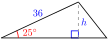

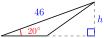
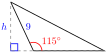
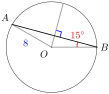
For Problems 45 and 46, find the length of the chord . Round your answer to two decimal places.
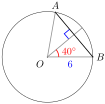
For Problems 47–50, fill in the table.


- In each of the figures for Problems 47-50, what is the relationship between the angles and ?
- Study the tables for Problems 47-50. What do you notice about the values of sine and cosine for the angles and ? Explain why this is true.
- and are complements.
- and . The side opposite is the side adjacent to , and vice versa.
There is a relationship between the tangent, the sine, and the cosine of any angle. Study the tables for Problems 47-50 to discover this relationship. Write your answer as an equation.
- Use the figure to explain what happens to as increases, and why.
- Use the figure to explain what happens to as increases, and why.
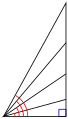
- As increases, increases also. The side opposite increases in length while the side adjacent to remains fixed.
- As increases, decreases. The side adjacent to remains fixed while the hypotenuse increases in length.
- Fill in the table for values of . Round your answers to four decimal places.
- Fill in the table for values of . Round your answers to three decimal places.
- What happens to as increases?
- What value does your calculator give for ? Why?
Explain why it makes sense that and . Use a figure to illustrate your explanation.
As decreases toward , the side opposite approaches a length of 0, so sin approaches 0. But as increases toward , the length of the side opposite approaches the length of the hypotenuse, so approaches 1.
Explain why it makes sense that and . Use a figure to illustrate your explanation
For Problems 57–60, explain why the trigonometric ratio is not correct.

The triangle is not a right tringle.


is the ratio of hypotenuse to the adjacent side, which is the reciprocal of .

For Problems 61–64, sketch and label a right triangle, then fill in the blank.
- If , then .
- If , then .
- If , then .
- If , then .
- 0.2358
- sine
- If , then .
- If , then ______.
- If , then .
- If , then .
- If and , then .
- If , and , then .
- If and , then .
- If and , then .
- If and , then .
- If , and , then .
- If and , then .
- If and , then .
Explain why the cosine of a angle is always the same, no matter what size triangle the angle is in. Illustrate your explanation with a sketch.
Although the triangles may differ in size, the ratio of the side adjacent to the angle to the hypotenuse of the triangle remains the same because the triangles would all be similar, and hence corresponding sides are proportional.
- Use your calculator to fill in a table of values for , rounded to hundredths.
- If you plotted the points in your table, would they lie on a straight line? Why or why not?
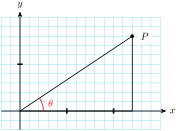
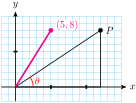
- What is the slope of the line through the origin and point ?
- What is the tangent of the angle ?
- On the same grid, sketch an angle whose tangent is
- Use your calculator to complete the table. Rounded your answers to hundredths.
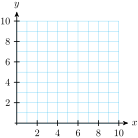
- Use the values of to sketch all the angles listed in the table. Locate the vertex of each angle at the origin, and the initial side along the positive -axis.
Trigonometry by Katherine Yoshiwara (yoshiwarabooks.org), GNU Free Documentation License 1.2 or later. Adapted for the XYZ HTML edition with the authors' permission (recorded 2026-07-04). License: GFDL-1.2-or-later.