
12.4 Magnetic Field of a Current Loop
The circular loop of Figure 12.11 has a radius R, carries a current I, and lies in the xz-plane. What is the magnetic field due to the current at an arbitrary point P along the axis of the loop?
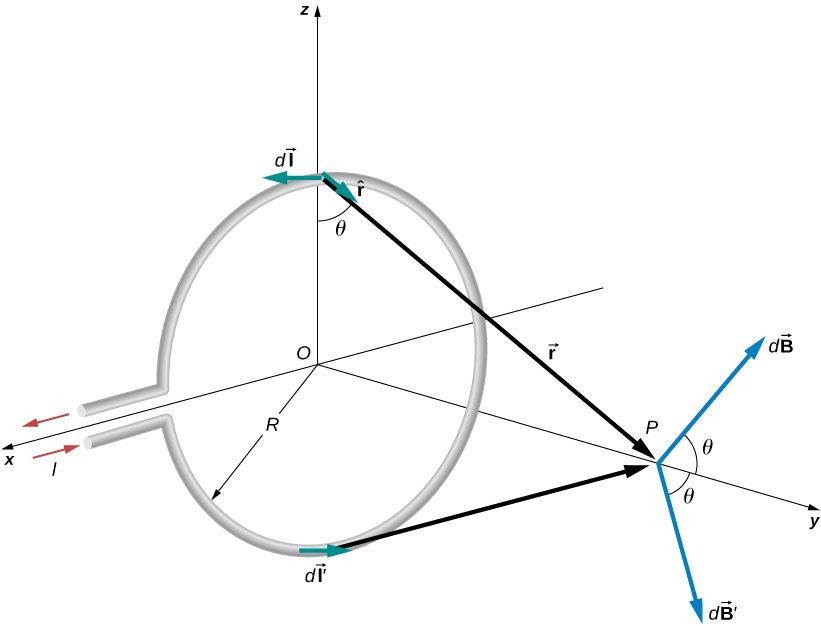
We can use the Biot-Savart law to find the magnetic field due to a current. We first consider arbitrary segments on opposite sides of the loop to qualitatively show by the vector results that the net magnetic field direction is along the central axis from the loop. From there, we can use the Biot-Savart law to derive the expression for magnetic field.
Let P be a distance y from the center of the loop. From the right-hand rule, the magnetic field at P, produced by the current element is directed at an angle above the y-axis as shown. Since is parallel along the x-axis and is in the yz-plane, the two vectors are perpendicular, so we have
where we have used
Now consider the magnetic field due to the current element which is directly opposite on the loop. The magnitude of is also given by Equation 12.13, but it is directed at an angle below the y-axis. The components of and perpendicular to the y-axis therefore cancel, and in calculating the net magnetic field, only the components along the y-axis need to be considered. The components perpendicular to the axis of the loop sum to zero in pairs. Hence at point P:
For all elements on the wire, y, R, and are constant and are related by
Now from Equation 12.14, the magnetic field at P is
where we have used As discussed in the previous chapter, the closed current loop is a magnetic dipole of moment For this example, and so the magnetic field at P can also be written as
By setting in Equation 12.15, we obtain the magnetic field at the center of the loop:
This equation becomes for a flat coil of N loops per length. It can also be expressed as
If we consider in Equation 12.16, the expression reduces to an expression known as the magnetic field from a dipole:
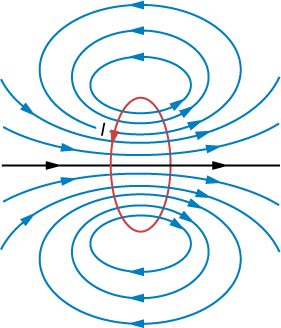
The calculation of the magnetic field due to the circular current loop at points off-axis requires rather complex mathematics, so we’ll just look at the results. The magnetic field lines are shaped as shown in Figure 12.12. Notice that one field line follows the axis of the loop. This is the field line we just found. Also, very close to the wire, the field lines are almost circular, like the lines of a long straight wire.
Summary
- The magnetic field strength at the center of a circular loop is given by where R is the radius of the loop. RHR-2 gives the direction of the field about the loop.
Conceptual Questions
Is the magnetic field of a current loop uniform?
What happens to the length of a suspended spring when a current passes through it?
The spring reduces in length since each coil will have a north pole-produced magnetic field next to a south pole of the next coil.
Two concentric circular wires with different diameters carry currents in the same direction. Describe the force on the inner wire.
Problems
When the current through a circular loop is 6.0 A, the magnetic field at its center is What is the radius of the loop?
0.019 m
How many turns must be wound on a flat, circular coil of radius 20 cm in order to produce a magnetic field of magnitude at the center of the coil when the current through it is 0.85 A?
A flat, circular loop has 20 turns. The radius of the loop is 10.0 cm and the current through the wire is 0.50 A. Determine the magnitude of the magnetic field at the center of the loop.
A circular loop of radius R carries a current I. At what distance along the axis of the loop is the magnetic field one-half its value at the center of the loop?
Two flat, circular coils, each with a radius R and wound with N turns, are mounted along the same axis so that they are parallel a distance d apart. What is the magnetic field at the midpoint of the common axis if a current I flows in the same direction through each coil?
For the coils in the preceding problem, what is the magnetic field at the center of either coil?
Adapted from University Physics Volume 2 by OpenStax (openstax.org), licensed under CC BY-NC-SA 4.0. Changes were made. License: CC-BY-NC-SA-4.0.