
12.3 Magnetic Force between Two Parallel Currents
You might expect that two current-carrying wires generate significant forces between them, since ordinary currents produce magnetic fields and these fields exert significant forces on ordinary currents. But you might not expect that the force between wires is used to define the ampere. It might also surprise you to learn that this force has something to do with why large circuit breakers burn up when they attempt to interrupt large currents.
The force between two long, straight, and parallel conductors separated by a distance r can be found by applying what we have developed in the preceding sections. Figure 12.9 shows the wires, their currents, the field created by one wire, and the consequent force the other wire experiences from the created field. Let us consider the field produced by wire 1 and the force it exerts on wire 2 (call the force ). The field due to at a distance r is
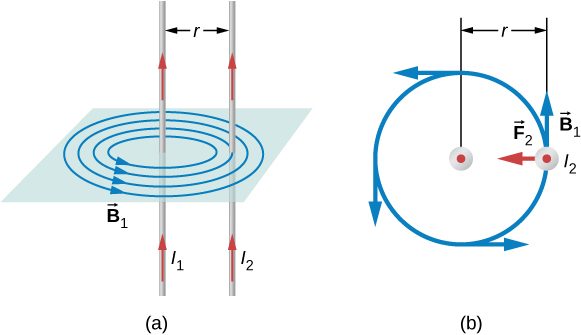
This field is uniform from the wire 1 and perpendicular to it, so the force it exerts on a length l of wire 2 is given by with
The forces on the wires are equal in magnitude, so we just write F for the magnitude of (Note that ) Since the wires are very long, it is convenient to think in terms of F/l, the force per unit length. Substituting the expression for into Equation 12.10 and rearranging terms gives
The ratio F/l is the force per unit length between two parallel currents and separated by a distance r. The force is attractive if the currents are in the same direction and repulsive if they are in opposite directions.
This force is responsible for the pinch effect in electric arcs and other plasmas. The force exists whether the currents are in wires or not. It is only apparent if the overall charge density is zero; otherwise, the Coulomb repulsion overwhelms the magnetic attraction. In an electric arc, where charges are moving parallel to one another, an attractive force squeezes currents into a smaller tube. In large circuit breakers, such as those used in neighborhood power distribution systems, the pinch effect can concentrate an arc between plates of a switch trying to break a large current, burn holes, and even ignite the equipment. Another example of the pinch effect is found in the solar plasma, where jets of ionized material, such as solar flares, are shaped by magnetic forces.
The definition of the ampere is based on the force between current-carrying wires. Note that for long, parallel wires separated by 1 meter with each carrying 1 ampere, the force per meter is
Since is exactly by definition, and because the force per meter is exactly This is the basis of the definition of the ampere.
Infinite-length wires are impractical, so in practice, a current balance is constructed with coils of wire separated by a few centimeters. Force is measured to determine current. This also provides us with a method for measuring the coulomb. We measure the charge that flows for a current of one ampere in one second. That is, For both the ampere and the coulomb, the method of measuring force between conductors is the most accurate in practice.
Summary
- The force between two parallel currents and separated by a distance r, has a magnitude per unit length given by
- The force is attractive if the currents are in the same direction, repulsive if they are in opposite directions.
Conceptual Questions
Compare and contrast the electric field of an infinite line of charge and the magnetic field of an infinite line of current.
Is constant in magnitude for points that lie on a magnetic field line?
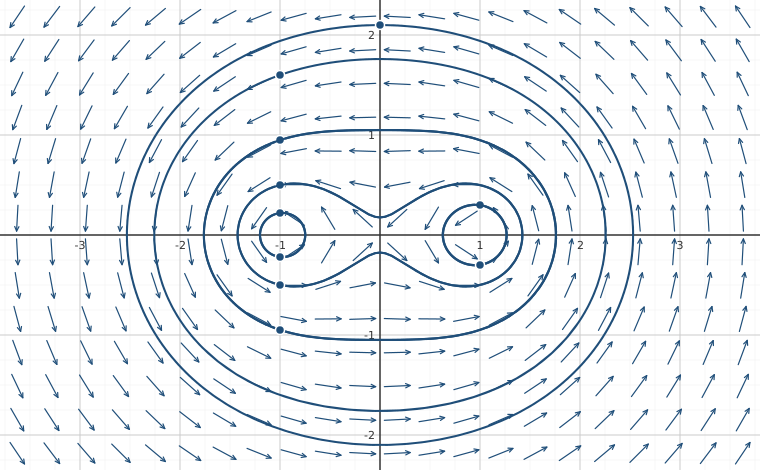
A magnetic field line gives the direction of the magnetic field at any point in space. The density of magnetic field lines indicates the strength of the magnetic field.
Problems
Two long, straight wires are parallel and 25 cm apart. (a) If each wire carries a current of 50 A in the same direction, what is the magnetic force per meter exerted on each wire? (b) Does the force pull the wires together or push them apart? (c) What happens if the currents flow in opposite directions?
Two long, straight wires are parallel and 10 cm apart. One carries a current of 2.0 A, the other a current of 5.0 A. (a) If the two currents flow in opposite directions, what is the magnitude and direction of the force per unit length of one wire on the other? (b) What is the magnitude and direction of the force per unit length if the currents flow in the same direction?
a. away from the other wire; b. toward the other wire
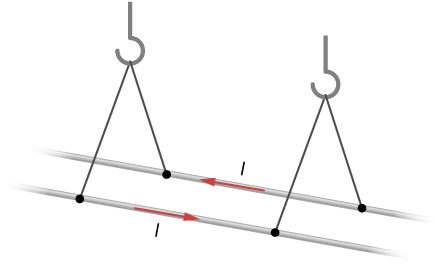
Two long, parallel wires are hung by cords of length 5.0 cm, as shown in the accompanying figure. Each wire has a mass per unit length of 30 g/m, and they carry the same current in opposite directions. What is the current if the cords hang at with respect to the vertical?
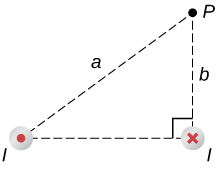
A circuit with current I has two long parallel wire sections that carry current in opposite directions. Find magnetic field at a point P near these wires that is a distance a from one wire and b from the other wire as shown in the figure.
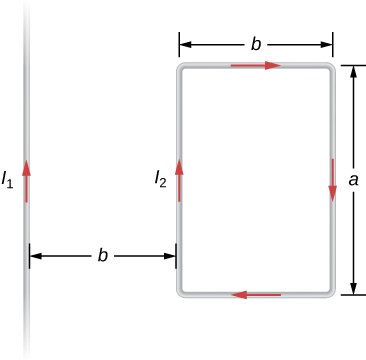
The infinite, straight wire shown in the accompanying figure carries a current The rectangular loop, whose long sides are parallel to the wire, carries a current What are the magnitude and direction of the force on the rectangular loop due to the magnetic field of the wire?
Adapted from University Physics Volume 2 by OpenStax (openstax.org), licensed under CC BY-NC-SA 4.0. Changes were made. License: CC-BY-NC-SA-4.0.