
12.2 Magnetic Field Due to a Thin Straight Wire
How much current is needed to produce a significant magnetic field, perhaps as strong as Earth’s field? Surveyors will tell you that overhead electric power lines create magnetic fields that interfere with their compass readings. Indeed, when Oersted discovered in 1820 that a current in a wire affected a compass needle, he was not dealing with extremely large currents. How does the shape of wires carrying current affect the shape of the magnetic field created? We noted in Magnetic Forces and Fields that a current loop created a magnetic field similar to that of a bar magnet, but what about a straight wire? We can use the Biot-Savart law to answer all of these questions, including determining the magnetic field of a long straight wire.
Figure 12.5 shows a section of an infinitely long, straight wire that carries a current I. What is the magnetic field at a point P, located a distance R from the wire?
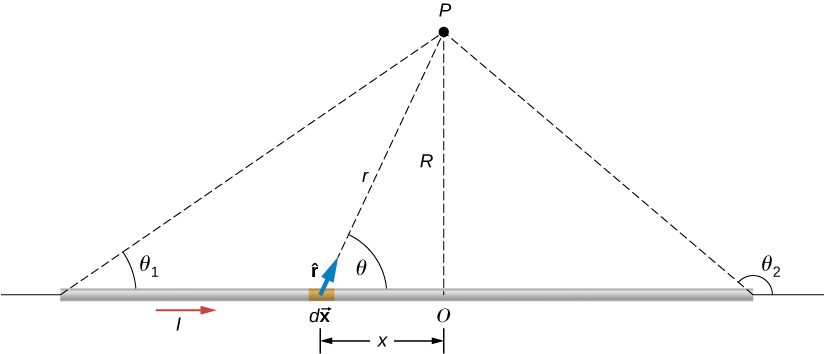
Let’s begin by considering the magnetic field due to the current element located at the position x. Using the right-hand rule 1 from the previous chapter, points out of the page for any element along the wire. At point P, therefore, the magnetic fields due to all current elements have the same direction. This means that we can calculate the net field there by evaluating the scalar sum of the contributions of the elements. With we have from the Biot-Savart law
The wire is symmetrical about point O, so we can set the limits of the integration from zero to infinity and double the answer, rather than integrate from negative infinity to positive infinity. Based on the picture and geometry, we can write expressions for r and in terms of x and R, namely:
Substituting these expressions into Equation 12.5, the magnetic field integration becomes
Evaluating the integral yields
Substituting the limits gives us the solution
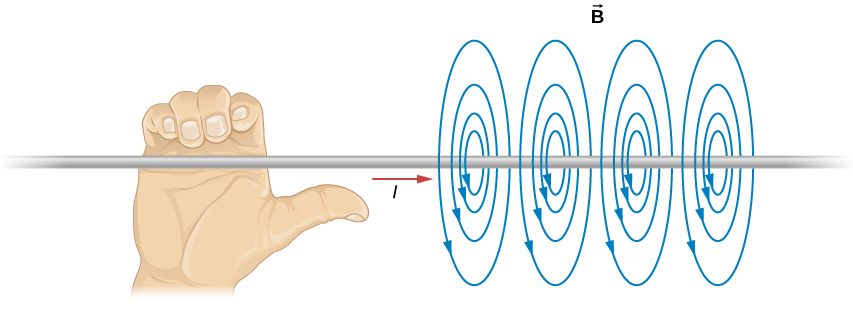
The magnetic field lines of the infinite wire are circular and centered at the wire (Figure 12.6), and they are identical in every plane perpendicular to the wire. Since the field decreases with distance from the wire, the spacing of the field lines must increase correspondingly with distance. The direction of this magnetic field may be found with a second form of the right-hand rule (illustrated in Figure 12.6). If you hold the wire with your right hand so that your thumb points along the current, then your fingers wrap around the wire in the same sense as
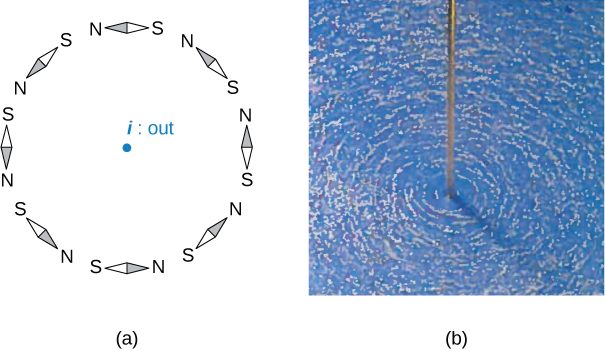
The direction of the field lines can be observed experimentally by placing several small compass needles on a circle near the wire, as illustrated in Figure 12.7. When there is no current in the wire, the needles align with Earth’s magnetic field. However, when a large current is sent through the wire, the compass needles all point tangent to the circle. Iron filings sprinkled on a horizontal surface also delineate the field lines, as shown in Figure 12.7.
Summary
- The strength of the magnetic field created by current in a long straight wire is given by (long straight wire) where I is the current, R is the shortest distance to the wire, and the constant is the permeability of free space.
- The direction of the magnetic field created by a long straight wire is given by right-hand rule 2 (RHR-2): Point the thumb of the right hand in the direction of current, and the fingers curl in the direction of the magnetic field loops created by it.
Conceptual Questions
How would you orient two long, straight, current-carrying wires so that there is no net magnetic force between them? (Hint: What orientation would lead to one wire not experiencing a magnetic field from the other?)
You would make sure the currents flow perpendicular to one another.
Problems
A typical current in a lightning bolt is A. Estimate the magnetic field 1 m from the bolt.
The magnitude of the magnetic field 50 cm from a long, thin, straight wire is What is the current through the long wire?
20 A
A transmission line strung 7.0 m above the ground carries a current of 500 A. What is the magnetic field on the ground directly below the wire? Compare your answer with the magnetic field of Earth.
A long, straight, horizontal wire carries a left-to-right current of 20 A. If the wire is placed in a uniform magnetic field of magnitude that is directed vertically downward, what is the resultant magnitude of the magnetic field 20 cm above the wire? 20 cm below the wire?
Both answers have the magnitude of magnetic field of
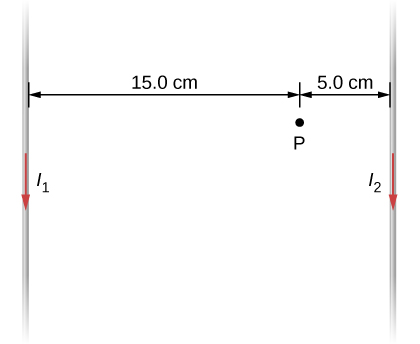
The two long, parallel wires shown in the accompanying figure carry currents in the same direction. If and what is the magnetic field at point P?
The accompanying figure shows two long, straight, horizontal wires that are parallel and a distance 2a apart. If both wires carry current I in the same direction, (a) what is the magnetic field at (b)
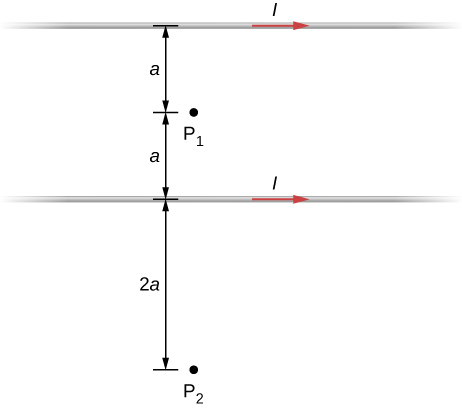
At P1, the net magnetic field is zero. At P2, into the page.
Repeat the calculations of the preceding problem with the direction of the current in the lower wire reversed.
Consider the area between the wires of the preceding problem. At what distance from the top wire is the net magnetic field a minimum? Assume that the currents are equal and flow in opposite directions.
The magnetic field is at a minimum at distance a from the top wire, or half-way between the wires.
Adapted from University Physics Volume 2 by OpenStax (openstax.org), licensed under CC BY-NC-SA 4.0. Changes were made. License: CC-BY-NC-SA-4.0.