
10.2 Rotation with Constant Angular Acceleration
In the preceding section, we defined the rotational variables of angular displacement, angular velocity, and angular acceleration. In this section, we work with these definitions to derive relationships among these variables and use these relationships to analyze rotational motion for a rigid body about a fixed axis under a constant angular acceleration. This analysis forms the basis for rotational kinematics. If the angular acceleration is constant, the equations of rotational kinematics simplify, similar to the equations of linear kinematics discussed in Motion along a Straight Line and Motion in Two and Three Dimensions. We can then use this simplified set of equations to describe many applications in physics and engineering where the angular acceleration of the system is constant. Rotational kinematics is also a prerequisite to the discussion of rotational dynamics later in this chapter.
Kinematics of Rotational Motion
Using our intuition, we can begin to see how the rotational quantities , and t are related to one another. For example, we saw in the preceding section that if a flywheel has an angular acceleration in the same direction as its angular velocity vector, its angular velocity increases with time and its angular displacement also increases. On the contrary, if the angular acceleration is opposite to the angular velocity vector, its angular velocity decreases with time. We can describe these physical situations and many others with a consistent set of rotational kinematic equations under a constant angular acceleration. The method to investigate rotational motion in this way is called kinematics of rotational motion.
To begin, we note that if the system is rotating under a constant acceleration, then the average angular velocity follows a simple relation because the angular velocity is increasing linearly with time. The average angular velocity is just half the sum of the initial and final values:
From the definition of the average angular velocity, we can find an equation that relates the angular position, average angular velocity, and time:
Solving for , we have
where we have set . This equation can be very useful if we know the average angular velocity of the system. Then we could find the angular displacement over a given time period. Next, we find an equation relating , , and t. To determine this equation, we start with the definition of angular acceleration:
We rearrange this to get and then we integrate both sides of this equation from initial values to final values, that is, from to t and . In uniform rotational motion, the angular acceleration is constant so it can be pulled out of the integral, yielding two definite integrals:
Setting , we have
We rearrange this to obtain
where is the initial angular velocity. Equation 10.11 is the rotational counterpart to the linear kinematics equation . With Equation 10.11, we can find the angular velocity of an object at any specified time t given the initial angular velocity and the angular acceleration.
Let’s now do a similar treatment starting with the equation . We rearrange it to obtain and integrate both sides from initial to final values again, noting that the angular acceleration is constant and does not have a time dependence. However, this time, the angular velocity is not constant (in general), so we substitute in what we derived above:
where we have set . Now we rearrange to obtain
Equation 10.12 is the rotational counterpart to the linear kinematics equation found in Motion Along a Straight Line for position as a function of time. This equation gives us the angular position of a rotating rigid body at any time t given the initial conditions (initial angular position and initial angular velocity) and the angular acceleration.
We can find an equation that is independent of time by solving for t in Equation 10.11 and substituting into Equation 10.12. Equation 10.12 becomes
or
Equation 10.10 through Equation 10.13 describe fixed-axis rotation for constant acceleration and are summarized in Table 10.1.
| Rotational Motion | Equation |
|---|---|
| Angular displacement from average angular velocity | |
| Angular velocity from angular acceleration | |
| Angular displacement from angular velocity and angular acceleration | |
| Angular velocity from angular displacement and angular acceleration |
Applying the Equations for Rotational Motion
Now we can apply the key kinematic relations for rotational motion to some simple examples to get a feel for how the equations can be applied to everyday situations.
In the preceding example, we considered a fishing reel with a positive angular acceleration. Now let us consider what happens with a negative angular acceleration.
Summary
- The kinematics of rotational motion describes the relationships among rotation angle (angular position), angular velocity, angular acceleration, and time.
- For a constant angular acceleration, the angular velocity varies linearly. Therefore, the average angular velocity is 1/2 the initial plus final angular velocity over a given time period:
- We used a graphical analysis to find solutions to fixed-axis rotation with constant angular acceleration. From the relation , we found that the area under an angular velocity-vs.-time curve gives the angular displacement, . The results of the graphical analysis were verified using the kinematic equations for constant angular acceleration. Similarly, since , the area under an angular acceleration-vs.-time graph gives the change in angular velocity: .
Conceptual Questions
If a rigid body has a constant angular acceleration, what is the functional form of the angular velocity in terms of the time variable?
straight line, linear in time variable
If a rigid body has a constant angular acceleration, what is the functional form of the angular position?
If the angular acceleration of a rigid body is zero, what is the functional form of the angular velocity?
constant
A massless tether with a masses tied to both ends rotates about a fixed axis through the center. Can the total acceleration of the tether/mass combination be zero if the angular velocity is constant?
Problems
A wheel has a constant angular acceleration of . Starting from rest, it turns through 300 rad. (a) What is its final angular velocity? (b) How much time elapses while it turns through the 300 radians?
a. ;
b.
During a 6.0-s time interval, a flywheel with a constant angular acceleration turns through 500 radians and acquires an angular velocity of 100 rad/s. (a) What is the angular velocity at the beginning of the 6.0 s? (b) What is the angular acceleration of the flywheel?
The angular velocity of a rotating rigid body increases from 500 to 1500 rev/min in 120 s. (a) What is the angular acceleration of the body? (b) Through what angle does it turn in this 120 s?
a. ;
b.
A flywheel slows from 600 to 400 rev/min while rotating through 40 revolutions. (a) What is the angular acceleration of the flywheel? (b) How much time elapses during the 40 revolutions?
A wheel 1.0 m in radius rotates with an angular acceleration of . (a) If the wheel’s initial angular velocity is 2.0 rad/s, what is its angular velocity after 10 s? (b) Through what angle does it rotate in the 10-s interval? (c) What are the tangential speed and acceleration of a point on the rim of the wheel at the end of the 10-s interval?
a. ;
b. ; c.
A vertical wheel with a diameter of 50 cm starts from rest and rotates with a constant angular acceleration of around a fixed axis through its center counterclockwise. (a) Where is the point that is initially at the bottom of the wheel at (b) What is the point’s linear acceleration at this instant?
A circular disk of radius 10 cm has a constant angular acceleration of ; at its angular velocity is 2.0 rad/s. (a) Determine the disk’s angular velocity at . (b) What is the angle it has rotated through during this time? (c) What is the tangential acceleration of a point on the disk at
a. ;
b. ; c.
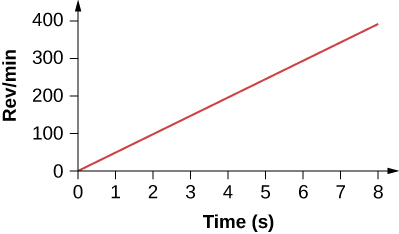
The angular velocity vs. time for a fan on a hovercraft is shown below. (a) What is the angle through which the fan blades rotate in the first 8 seconds? (b) Verify your result using the kinematic equations.
A rod of length 20 cm has two beads attached to its ends. The rod with beads starts rotating from rest. If the beads are to have a tangential speed of 20 m/s in 7 s, what is the angular acceleration of the rod to achieve this?
.
Adapted from University Physics Volume 1 by OpenStax (openstax.org), licensed under CC BY-NC-SA 4.0. Changes were made. License: CC-BY-NC-SA-4.0.