
10.1 Rotational Variables
So far in this text, we have mainly studied translational motion, including the variables that describe it: displacement, velocity, and acceleration. Now we expand our description of motion to rotation—specifically, rotational motion about a fixed axis. We will find that rotational motion is described by a set of related variables similar to those we used in translational motion.
Angular Velocity
Uniform circular motion (discussed previously in Motion in Two and Three Dimensions) is motion in a circle at constant speed. Although this is the simplest case of rotational motion, it is very useful for many situations, and we use it here to introduce rotational variables.
In Figure 10.2, we show a particle moving in a circle. The coordinate system is fixed and serves as a frame of reference to define the particle’s position. Its position vector from the origin of the circle to the particle sweeps out the angle , which increases in the counterclockwise direction as the particle moves along its circular path. The angle is called the angular position of the particle. As the particle moves in its circular path, it also traces an arc length s. The particle may complete more than one revolution around the circle, and so the angle may be greater than , and the arc length s may be greater than the circumference, .
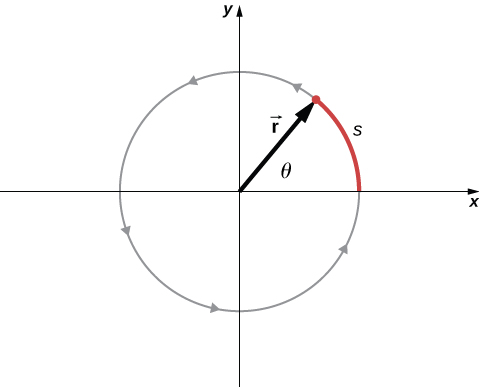
The angle is related to the radius of the circle and the arc length by
The angle , the angular position of the particle along its path, has units of radians (rad). There are radians in Note that the radian measure is a ratio of length measurements, and therefore is a dimensionless quantity. As the particle moves along its circular path, its angular position changes and it undergoes angular displacements
We can write infinitesimal displacement tangent to the circle using polar coordinates, as shown in Figure 10.3.
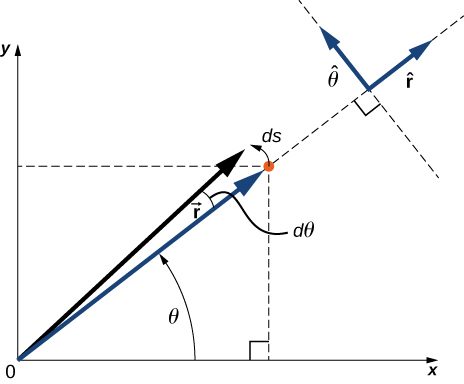
The magnitude of the angular velocity, denoted by , is the time rate of change of the angle as the particle moves in its circular path. The instantaneous angular velocity is defined as the limit in which in the average angular velocity :
where is the angle of rotation (Figure 10.2). The units of angular velocity are radians per second (rad/s). Angular velocity can also be referred to as the rotation rate in radians per second. In many situations, we are given the rotation rate in revolutions/s or cycles/s. To find the angular velocity, we must multiply revolutions/s by , since there are radians in one complete revolution. Since the direction of a positive angle in a circle is counterclockwise, we take counterclockwise rotations as being positive and clockwise rotations as negative.
We can see how angular velocity is related to the tangential speed of the particle by differentiating Equation 10.1 with respect to time. We rewrite Equation 10.1 as
Taking the derivative with respect to time and noting that the radius r is a constant, we have
where . Here is just the tangential speed of the particle in Figure 10.2. Thus, by using Equation 10.3, we arrive at
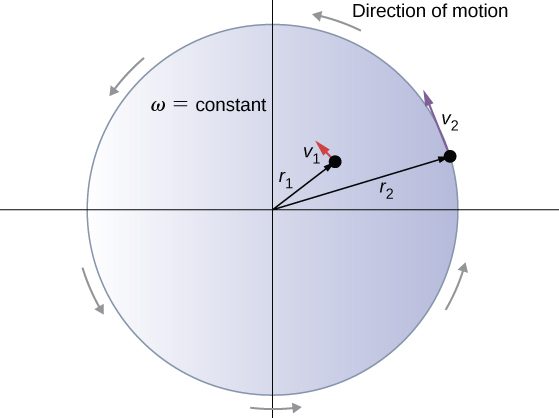
That is, the tangential speed of the particle is its angular velocity times the radius of the circle. From Equation 10.4, we see that the tangential speed of the particle increases with its distance from the axis of rotation for a constant angular velocity. This effect is shown in Figure 10.4. Two particles are placed at different radii on a rotating disk with a constant angular velocity. As the disk rotates, the tangential speed increases linearly with the radius from the axis of rotation. In Figure 10.4, we see that and . But the disk has a constant angular velocity, so . This means or . Thus, since , .
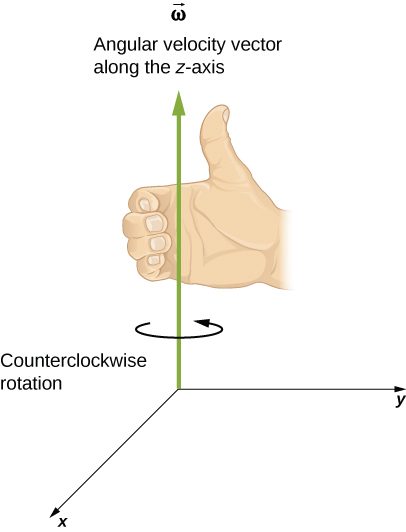
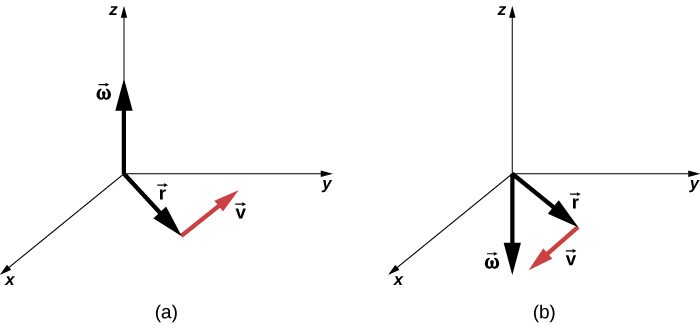
Up until now, we have discussed the magnitude of the angular velocity which is a scalar quantity—the change in angular position with respect to time. The vector is the vector associated with the angular velocity and points along the axis of rotation. This is useful because when a rigid body is rotating, we want to know both the axis of rotation and the direction that the body is rotating about the axis, clockwise or counterclockwise. The angular velocity gives us this information. The angular velocity has a direction determined by what is called the right-hand rule. The right-hand rule is such that if the fingers of your right hand wrap counterclockwise from the x-axis (the direction in which increases) toward the y-axis, your thumb points in the direction of the positive z-axis (Figure 10.5). An angular velocity that points along the positive z-axis therefore corresponds to a counterclockwise rotation, whereas an angular velocity that points along the negative z-axis corresponds to a clockwise rotation.
One can state a cross product relation to the vector of the tangential velocity as stated in Equation 10.4. Therefore, we have
That is, the tangential velocity is the cross product of the angular velocity and the position vector, as shown in Figure 10.6. From part (a) of this figure, we see that with the angular velocity in the positive z-direction, the rotation in the xy-plane is counterclockwise. In part (b), the angular velocity is in the negative z-direction, giving a clockwise rotation in the xy-plane.
Angular Acceleration
We have just discussed angular velocity for uniform circular motion, but not all motion is uniform. Envision an ice skater spinning with his arms outstretched—when he pulls his arms inward, his angular velocity increases. Or think about a computer’s hard disk slowing to a halt as the angular velocity decreases. We will explore these situations later, but we can already see a need to define an angular acceleration for describing situations where changes. The faster the change in , the greater the angular acceleration. We define the instantaneous angular acceleration as the derivative of angular velocity with respect to time:
where we have taken the limit of the average angular acceleration, as .
The units of angular acceleration are (rad/s)/s, or .
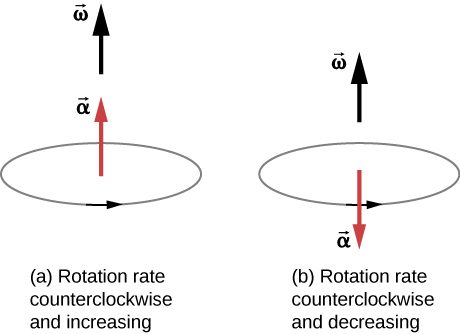
In the same way as we defined the vector associated with angular velocity , we can define , the vector associated with angular acceleration (Figure 10.7). If the angular velocity is along the positive z-axis, as in Figure 10.5, and is positive, then the angular acceleration is positive and points along the axis. Similarly, if the angular velocity is along the positive z-axis and is negative, then the angular acceleration is negative and points along the axis.
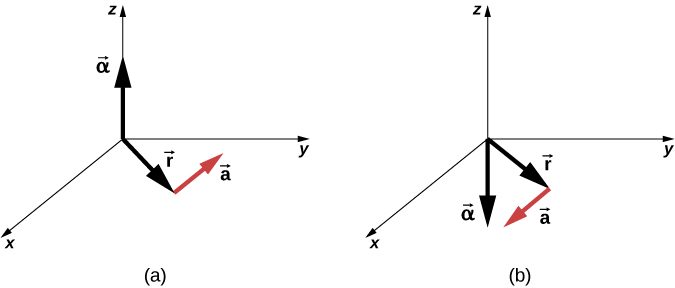
We can express the tangential acceleration vector as a cross product of the angular acceleration and the position vector. This expression can be found by taking the time derivative of and is left as an exercise:
The vector relationships for the angular acceleration and tangential acceleration are shown in Figure 10.8.
We can relate the tangential acceleration of a point on a rotating body at a distance from the axis of rotation in the same way that we related the tangential speed to the angular velocity. If we differentiate Equation 10.4 with respect to time, noting that the radius r is constant, we obtain
Thus, the tangential acceleration is the radius times the angular acceleration. Equation 10.4 and Equation 10.8 are important for the discussion of rolling motion (see Angular Momentum).
Let’s apply these ideas to the analysis of a few simple fixed-axis rotation scenarios. Before doing so, we present a problem-solving strategy that can be applied to rotational kinematics: the description of rotational motion.
Now let’s apply this problem-solving strategy to a few specific examples.
We now have a basic vocabulary for discussing fixed-axis rotational kinematics and relationships between rotational variables. We discuss more definitions and connections in the next section.
Summary
- The angular position of a rotating body is the angle the body has rotated through in a fixed coordinate system, which serves as a frame of reference.
- The angular velocity of a rotating body about a fixed axis is defined as , the rotational rate of the body in radians per second. The instantaneous angular velocity of a rotating body is the derivative with respect to time of the angular position , found by taking the limit in the average angular velocity . The angular velocity relates to the tangential speed of a point on the rotating body through the relation , where r is the radius to the point and is the tangential speed at the given point.
- The angular velocity is found using the right-hand rule. If the fingers curl in the direction of rotation about a fixed axis, the thumb points in the direction of (see Figure 10.5).
- If the system’s angular velocity is not constant, then the system has an angular acceleration. The average angular acceleration over a given time interval is the change in angular velocity over this time interval, . The instantaneous angular acceleration is the time derivative of angular velocity, . The angular acceleration is found by locating the angular velocity. If a rotation rate of a rotating body is decreasing, the angular acceleration is in the opposite direction to . If the rotation rate is increasing, the angular acceleration is in the same direction as .
- The tangential acceleration of a point at a radius from the axis of rotation is the angular acceleration times the radius to the point.
Conceptual Questions
A clock is mounted on the wall. As you look at it, what is the direction of the angular velocity vector of the second hand?
The second hand rotates clockwise, so by the right-hand rule, the angular velocity vector is into the wall.
What is the value of the angular acceleration of the second hand of the clock on the wall?
A baseball bat is swung. Do all points on the bat have the same angular velocity? The same tangential speed?
They have the same angular velocity. Points further out on the bat have greater tangential speeds.
The blades of a blender on a counter are rotating clockwise as you look into it from the top. If the blender is put to a greater speed what direction is the angular acceleration of the blades?
Problems
Calculate the angular velocity of Earth.
A track star runs a 400-m race on a 400-m circular track in 45 s. What is his angular velocity assuming a constant speed?
A wheel rotates at a constant rate of . (a) What is its angular velocity in radians per second? (b) Through what angle does it turn in 10 s? Express the solution in radians and degrees.
A particle moves 3.0 m along a circle of radius 1.5 m. (a) Through what angle does it rotate? (b) If the particle makes this trip in 1.0 s at a constant speed, what is its angular velocity? (c) What is its acceleration?
a. ; b. ; c.
A compact disc rotates at 500 rev/min. If the diameter of the disc is 120 mm, (a) what is the tangential speed of a point at the edge of the disc? (b) At a point halfway to the center of the disc?
Unreasonable results. The propeller of an aircraft is spinning at 10 rev/s when the pilot shuts off the engine. The propeller reduces its angular velocity at a constant for a time period of 40 s. What is the rotation rate of the propeller in 40 s? Is this a reasonable situation?
The propeller takes only to come to rest, when the propeller is at 0 rad/s, it would start rotating in the opposite direction. This would be impossible due to the magnitude of forces involved in getting the propeller to stop and start rotating in the opposite direction.
A gyroscope slows from an initial rate of 32.0 rad/s at a rate of . How long does it take to come to rest?
On takeoff, the propellers on a UAV (unmanned aerial vehicle) increase their angular velocity for 3.0 s from rest at a rate of where t is measured in seconds. (a) What is the instantaneous angular velocity of the propellers at ? (b) What is the angular acceleration?
a. ; b.
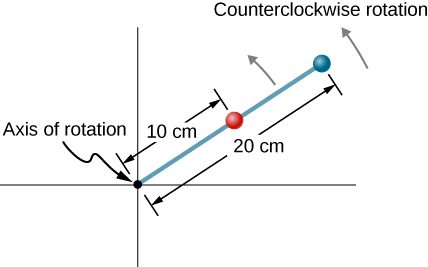
The angular position of a rod varies as radians from time . The rod has two beads on it as shown in the following figure, one at 10 cm from the rotation axis and the other at 20 cm from the rotation axis. (a) What is the instantaneous angular velocity of the rod at (b) What is the angular acceleration of the rod? (c) What are the tangential speeds of the beads at (d) What are the tangential accelerations of the beads at (e) What are the centripetal accelerations of the beads at
Adapted from University Physics Volume 1 by OpenStax (openstax.org), licensed under CC BY-NC-SA 4.0. Changes were made. License: CC-BY-NC-SA-4.0.