
9.6 Center of Mass
We have been avoiding an important issue up to now: When we say that an object moves (more correctly, accelerates) in a way that obeys Newton’s second law, we have been ignoring the fact that all objects are actually made of many constituent particles. A car has an engine, steering wheel, seats, passengers; a football is leather and rubber surrounding air; a brick is made of atoms. There are many different types of particles, and they are generally not distributed uniformly in the object. How do we include these facts into our calculations?
Then too, an extended object might change shape as it moves, such as a water balloon or a cat falling (Figure 9.27). This implies that the constituent particles are applying internal forces on each other, in addition to the external force that is acting on the object as a whole. We want to be able to handle this, as well.
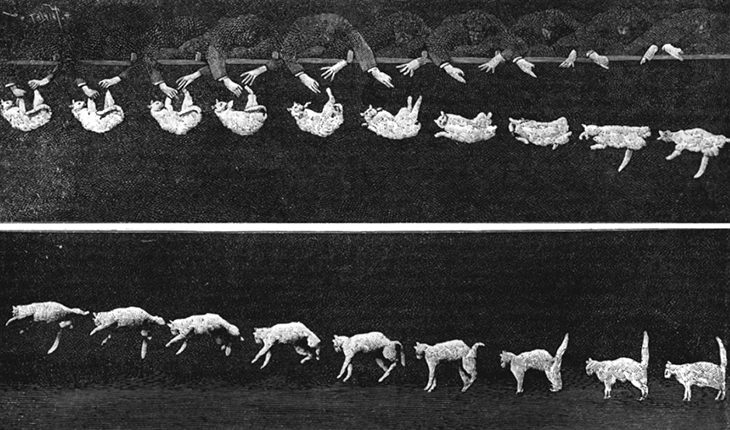
The problem before us, then, is to determine what part of an extended object is obeying Newton’s second law when an external force is applied and to determine how the motion of the object as a whole is affected by both the internal and external forces.
Be warned: To treat this new situation correctly, we must be rigorous and completely general. We won’t make any assumptions about the nature of the object, or of its constituent particles, or either the internal or external forces. Thus, the arguments will be complex.
Internal and External Forces
Suppose we have an extended object of mass M, made of N interacting particles. Let’s label their masses as , where . Note that
If we apply some net external force on the object, every particle experiences some “share” or some fraction of that external force. Let:
Notice that these fractions of the total force are not necessarily equal; indeed, they virtually never are. (They can be, but they usually aren’t.) In general, therefore,
Next, we assume that each of the particles making up our object can interact with (apply forces on) every other particle of the object. We won’t try to guess what kind of forces they are; but since these forces are the result of particles of the object acting on other particles of the same object, we refer to them as internal forces ; thus:
the net internal force that the jth particle experiences from all the other particles that make up the object.
Now, the net force, internal plus external, on the jth particle is the vector sum of these:
where again, this is for all N particles; .
As a result of this fractional force, the momentum of each particle gets changed:
The net force on the object is the vector sum of these forces:
This net force changes the momentum of the object as a whole, and the net change of momentum of the object must be the vector sum of all the individual changes of momentum of all of the particles:
Combining Equation 9.22 and Equation 9.23 gives
Let’s now think about these summations. First consider the internal forces term; remember that each is the force on the jth particle from the other particles in the object. But by Newton’s third law, for every one of these forces, there must be another force that has the same magnitude, but the opposite sign (points in the opposite direction). These forces do not cancel; however, that’s not what we’re doing in the summation. Rather, we’re simply mathematically adding up all the internal force vectors. That is, in general, the internal forces for any individual part of the object won’t cancel, but when all the internal forces are added up, the internal forces must cancel in pairs. It follows, therefore, that the sum of all the internal forces must be zero:
(This argument is subtle, but crucial; take plenty of time to completely understand it.)
For the external forces, this summation is simply the total external force that was applied to the whole object:
As a result,
This is an important result. Equation 9.25 tells us that the total change of momentum of the entire object (all N particles) is due only to the external forces; the internal forces do not change the momentum of the object as a whole. This is why you can’t lift yourself in the air by standing in a basket and pulling up on the handles: For the system of you + basket, your upward pulling force is an internal force.
Force and Momentum
Remember that our actual goal is to determine the equation of motion for the entire object (the entire system of particles). To that end, let’s define:
the total momentum of the system of N particles (the reason for the subscript will become clear shortly)
Then we have
and therefore Equation 9.25 can be written simply as
Since this change of momentum is caused by only the net external force, we have dropped the “ext” subscript.
This is Newton’s second law, but now for the entire extended object. If this feels a bit anticlimactic, remember what is hiding inside it: is the vector sum of the momentum of (in principle) hundreds of thousands of billions of billions of particles , all caused by one simple net external force—a force that you can calculate.
Center of Mass
Our next task is to determine what part of the extended object, if any, is obeying Equation 9.26.
It’s tempting to take the next step; does the following equation mean anything?
If it does mean something (acceleration of what, exactly?), then we could write
and thus
which follows because the derivative of a sum is equal to the sum of the derivatives.
Now, is the momentum of the jth particle. Defining the positions of the constituent particles (relative to some coordinate system) as , we thus have
Substituting back, we obtain
Dividing both sides by M (the total mass of the extended object) gives us
Thus, the point in the object that traces out the trajectory dictated by the applied force in Equation 9.27 is inside the parentheses in Equation 9.28.
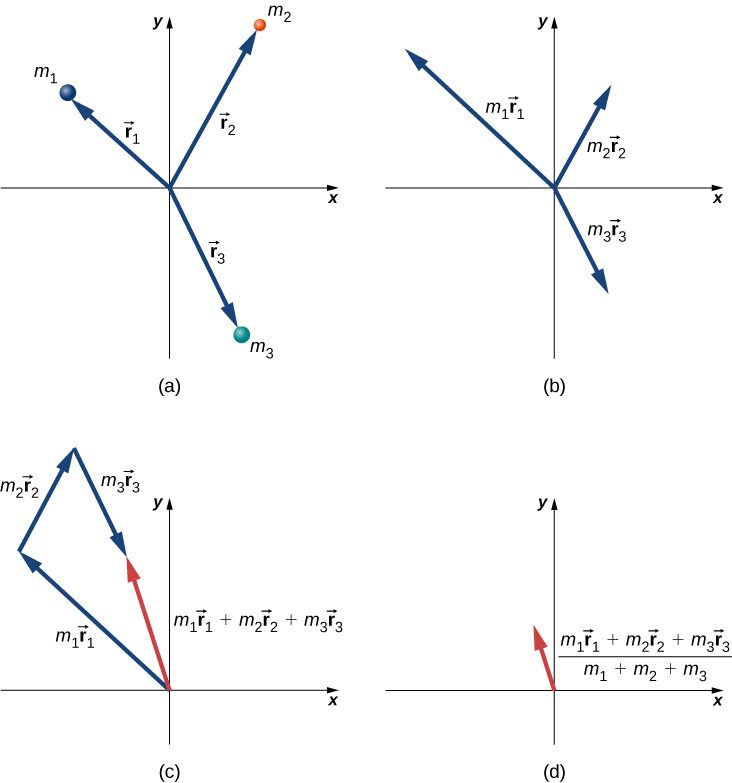
Looking at this calculation, notice that (inside the parentheses) we are calculating the product of each particle’s mass with its position, adding all N of these up, and dividing this sum by the total mass of particles we summed. This is reminiscent of an average; inspired by this, we’ll (loosely) interpret it to be the weighted average position of the mass of the extended object. It’s actually called the center of mass of the object. Notice that the position of the center of mass has units of meters; that suggests a definition:
So, the point that obeys Equation 9.26 (and therefore Equation 9.27 as well) is the center of mass of the object, which is located at the position vector .
It may surprise you to learn that there does not have to be any actual mass at the center of mass of an object. For example, a hollow steel sphere with a vacuum inside it is spherically symmetrical (meaning its mass is uniformly distributed about the center of the sphere); all of the sphere’s mass is out on its surface, with no mass inside. But it can be shown that the center of mass of the sphere is at its geometric center, which seems reasonable. Thus, there is no mass at the position of the center of mass of the sphere. (Another example is a doughnut.) The procedure to find the center of mass is illustrated in Figure 9.28.
Since , it follows that:
and thus
Therefore, you can calculate the components of the center of mass vector individually.
Finally, to complete the kinematics, the instantaneous velocity of the center of mass is calculated exactly as you might suspect:
and this, like the position, has x-, y-, and z-components.
To calculate the center of mass in actual situations, we recommend the following procedure:
Here are two examples that will give you a feel for what the center of mass is.
Two crucial concepts come out of these examples:
- As with all problems, you must define your coordinate system and origin. For center-of-mass calculations, it often makes sense to choose your origin to be located at one of the masses of your system. That choice automatically defines its distance in Equation 9.29 to be zero. However, you must still include the mass of the object at your origin in your calculation of M, the total mass Equation 9.19. In the Earth-moon system example, this means including the mass of Earth. If you hadn’t, you’d have ended up with the center of mass of the system being at the center of the moon, which is clearly wrong.
- In the second example (the salt crystal), notice that there is no mass at all at the location of the center of mass. This is an example of what we stated above, that there does not have to be any actual mass at the center of mass of an object.
Center of Mass of Continuous Objects
If the object in question has its mass distributed uniformly in space, rather than as a collection of discrete particles, then , and the summation becomes an integral:
In this context, r is a characteristic dimension of the object (the radius of a sphere, the length of a long rod). To generate an integrand that can actually be calculated, you need to express the differential mass element dm as a function of the mass density of the continuous object, and the dimension r. An example will clarify this.
Center of Mass and Conservation of Momentum
How does all this connect to conservation of momentum?
Suppose you have N objects with masses and initial velocities . The center of mass of the objects is
Its velocity is
and thus the initial momentum of the center of mass is
After these masses move and interact with each other, the momentum of the center of mass is
But conservation of momentum tells us that the right-hand side of both equations must be equal, which says
This result implies that conservation of momentum is expressed in terms of the center of mass of the system. Notice that as an object moves through space with no net external force acting on it, an individual particle of the object may accelerate in various directions, with various magnitudes, depending on the net internal force acting on that object at any time. (Remember, it is only the vector sum of all the internal forces that vanishes, not the internal force on a single particle.) Thus, such a particle’s momentum will not be constant—but the momentum of the entire extended object will be, in accord with Equation 9.36.
Equation 9.36 implies another important result: Since M represents the mass of the entire system of particles, it is necessarily constant. (If it isn’t, we don’t have a closed system, so we can’t expect the system’s momentum to be conserved.) As a result, Equation 9.36 implies that, for a closed system,
That is to say, in the absence of an external force, the velocity of the center of mass never changes.
You might be tempted to shrug and say, “Well yes, that’s just Newton’s first law,” but remember that Newton’s first law discusses the constant velocity of a particle, whereas Equation 9.37 applies to the center of mass of a (possibly vast) collection of interacting particles, and that there may not be any particle at the center of mass at all! So, this really is a remarkable result.
You may sometimes hear someone describe an explosion by saying something like, “the fragments of the exploded object always move in a way that makes sure that the center of mass continues to move on its original trajectory.” This makes it sound as if the process is somewhat magical: how can it be that, in every explosion, it always works out that the fragments move in just the right way so that the center of mass’ motion is unchanged? Phrased this way, it would be hard to believe no explosion ever does anything differently.
The explanation of this apparently astonishing coincidence is: We defined the center of mass precisely so this is exactly what we would get. Recall that first we defined the momentum of the system:
We then concluded that the net external force on the system (if any) changed this momentum:
and then—and here’s the point—we defined an acceleration that would obey Newton’s second law. That is, we demanded that we should be able to write
which requires that
where the quantity inside the parentheses is the center of mass of our system. So, it’s not astonishing that the center of mass obeys Newton’s second law; we defined it so that it would.
Summary
- An extended object (made up of many objects) has a defined position vector called the center of mass.
- The center of mass can be thought of, loosely, as the average location of the total mass of the object.
- The center of mass of an object traces out the trajectory dictated by Newton’s second law, due to the net external force.
- The internal forces within an extended object cannot alter the momentum of the extended object as a whole.
Conceptual Questions
Suppose a fireworks shell explodes, breaking into three large pieces for which air resistance is negligible. How does the explosion affect the motion of the center of mass? How would it be affected if the pieces experienced significantly more air resistance than the intact shell?
Problems
Three point masses are placed at the corners of a triangle as shown in the figure below.
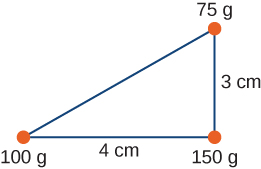
Find the center of mass of the three-mass system.
With the origin defined to be at the position of the 150-g mass, and
Two particles of masses and separated by a horizontal distance D are released from the same height h at the same time. Find the vertical position of the center of mass of these two particles at a time before the two particles strike the ground. Assume no air resistance.
Two particles of masses and separated by a horizontal distance D are let go from the same height h at different times. Particle 1 starts at , and particle 2 is let go at . Find the vertical position of the center of mass at a time before the first particle strikes the ground. Assume no air resistance.
Two particles of masses and move uniformly in different circles of radii and about origin in the x, y-plane. The x- and y-coordinates of the center of mass and that of particle 1 are given as follows (where length is in meters and t in seconds):
and:
- Find the radius of the circle in which particle 1 moves.
- Find the x- and y-coordinates of particle 2 and the radius of the circle this particle moves.
Two particles of masses and move uniformly in different circles of radii and about the origin in the x, y-plane. The coordinates of the two particles in meters are given as follows ( for both). Here t is in seconds:
- Find the radii of the circles of motion of both particles.
- Find the x- and y-coordinates of the center of mass.
- Decide if the center of mass moves in a circle by plotting its trajectory.
a. , ; b. ; c. yes, with
Find the center of mass of a one-meter long rod, made of 50 cm of iron (density ) and 50 cm of aluminum (density ).
Find the center of mass of a rod of length L whose mass density changes from one end to the other quadratically. That is, if the rod is laid out along the x-axis with one end at the origin and the other end at , the density is given by , where and are constant values.
Find the center of mass of a rectangular block of length a and width b that has a nonuniform density such that when the rectangle is placed in the x,y-plane with one corner at the origin and the block placed in the first quadrant with the two edges along the x- and y-axes, the density is given by, where is a constant.
Find the center of mass of a rectangular material of length a and width b made up of a material of nonuniform density. The density is such that when the rectangle is placed in the xy-plane, the density is given by .
A cube of side a is cut out of another cube of side b as shown in the figure below.
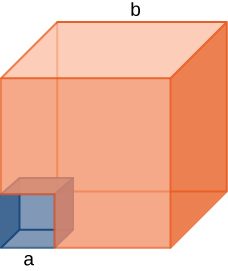
Find the location of the center of mass of the structure. (Hint: Think of the missing part as a negative mass overlapping a positive mass.)
Find the center of mass of a cone of uniform density that has a radius R at the base, height h, and mass M. Let the origin be at the center of the base of the cone and have +z going through the cone vertex.
Find the center of mass of a thin wire of mass m and length L bent in a semicircular shape. Let the origin be at the center of the semicircle and have the wire arc from the +x axis, cross the +y axis, and terminate at the −x axis.
Find the center of mass of a uniform thin semicircular plate of radius R. Let the origin be at the center of the semicircle, the plate arc from the +x axis to the −x axis, and the z axis be perpendicular to the plate.
Find the center of mass of a sphere of mass M and radius R and a cylinder of mass m, radius r, and height h arranged as shown below.
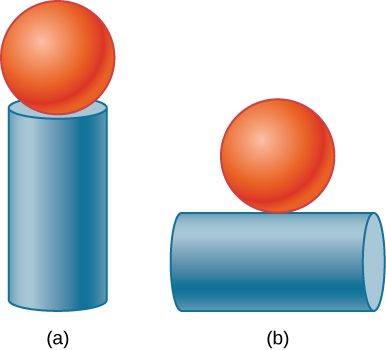
Express your answers in a coordinate system that has the origin at the center of the cylinder.
Adapted from University Physics Volume 1 by OpenStax (openstax.org), licensed under CC BY-NC-SA 4.0. Changes were made. License: CC-BY-NC-SA-4.0.