Recall Newton’s third law: When two objects of masses and interact (meaning that they apply forces on each other), the force that object 2 applies to object 1 is equal in magnitude and opposite in direction to the force that object 1 applies on object 2. Let:
the force on from
the force on from
Then, in symbols, Newton’s third law says
(Recall that these two forces do not cancel because they are applied to different objects. causes to accelerate, and causes to accelerate.)
Although the magnitudes of the forces on the objects are the same, the accelerations are not, simply because the masses (in general) are different. Therefore, the changes in velocity of each object are different:
However, the products of the mass and the change of velocity are equal (in magnitude):
It’s a good idea, at this point, to make sure you’re clear on the physical meaning of the derivatives in Equation 9.3. Because of the interaction, each object ends up getting its velocity changed, by an amount dv. Furthermore, the interaction occurs over a time interval dt, which means that the change of velocities also occurs over dt. This time interval is the same for each object.
Let‘s assume, for the moment, that the masses of the objects do not change during the interaction. (We’ll relax this restriction later.) In that case, we can pull the masses inside the derivatives:
(9.12)
and thus
This says that the rate at which momentum changes is the same for both objects. The masses are different, and the changes of velocity are different, but the rate of change of the product of m and are the same.
Physically, this means that during the interaction of the two objects (), both objects have their momentum changed; but those changes are identical in magnitude, though opposite in sign. For example, the momentum of object 1 might increase, which means that the momentum of object 2 decreases by exactly the same amount.
In light of this, let’s re-write Equation 9.12 in a more suggestive form:
This says that during the interaction, although object 1’s momentum changes, and object 2’s momentum also changes, these two changes cancel each other out, so that the total change of momentum of the two objects together is zero.
Since the total combined momentum of the two objects together never changes, then we could write
from which it follows that
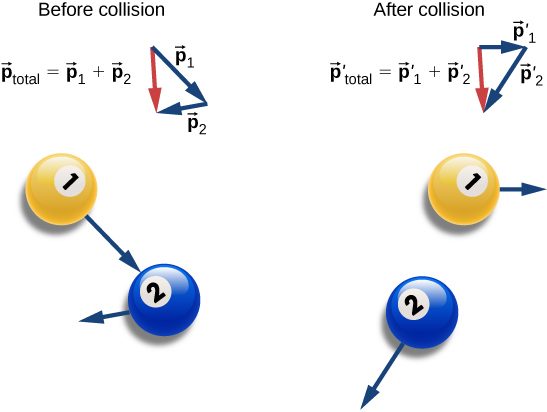
As shown in Figure 9.14, the total momentum of the system before and after the collision remains the same.
Figure 9.14Before the collision, the two billiard balls travel with momenta and . The total momentum of the system is the sum of these, as shown by the red vector labeled on the left. After the collision, the two billiard balls travel with different momenta and . The total momentum, however, has not changed, as shown by the red vector arrow on the right.
Generalizing this result to N objects, we obtain
(9.17)
Equation 9.17 is the definition of the total (or net) momentum of a system of N interacting objects, along with the statement that the total momentum of a system of objects is constant in time—or better, is conserved.
Requirements for Momentum Conservation
There is a complication, however. A system must meet two requirements for its momentum to be conserved:
The mass of the system must remain constant during the interaction.
As the objects interact (apply forces on each other), they may transfer mass from one to another; but any mass one object gains is balanced by the loss of that mass from another. The total mass of the system of objects, therefore, remains unchanged as time passes:
The net external force on the system must be zero.
As the objects collide, or explode, and move around, they exert forces on each other. However, all of these forces are internal to the system, and thus each of these internal forces is balanced by another internal force that is equal in magnitude and opposite in sign. As a result, the change in momentum caused by each internal force is cancelled by another momentum change that is equal in magnitude and opposite in direction. Therefore, internal forces cannot change the total momentum of a system because the changes sum to zero. However, if there is some external force that acts on all of the objects (gravity, for example, or friction), then this force changes the momentum of the system as a whole; that is to say, the momentum of the system is changed by the external force. Thus, for the momentum of the system to be conserved, we must have
A system of objects that meets these two requirements is said to be a closed system (also called an isolated system). Thus, the more compact way to express this is shown below.
This statement is called the Law of Conservation of Momentum. Along with the conservation of energy, it is one of the foundations upon which all of physics stands. All our experimental evidence supports this statement: from the motions of galactic clusters to the quarks that make up the proton and the neutron, and at every scale in between. In a closed system, the total momentum never changes.
Note that there absolutely can be external forces acting on the system; but for the system’s momentum to remain constant, these external forces have to cancel, so that the net external force is zero. Billiard balls on a table all have a weight force acting on them, but the weights are balanced (canceled) by the normal forces, so there is no net force.
The Meaning of ‘System’
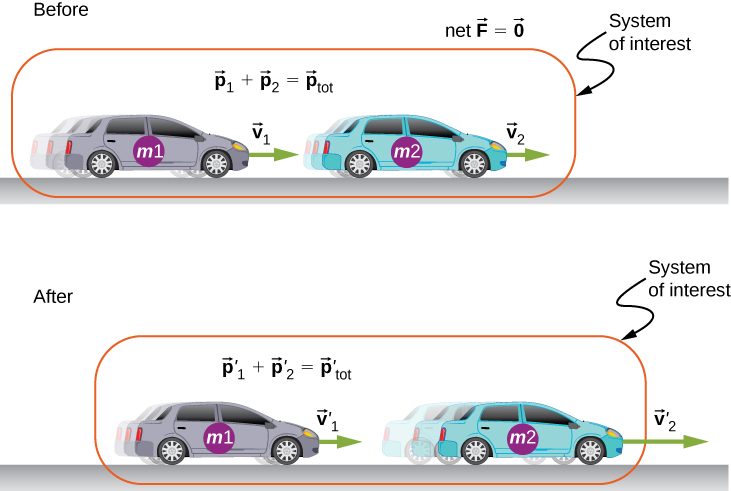
A system (mechanical) is the collection of objects in whose motion (kinematics and dynamics) you are interested. If you are analyzing the bounce of a ball on the ground, you are probably only interested in the motion of the ball, and not of Earth; thus, the ball is your system. If you are analyzing a car crash, the two cars together compose your system (Figure 9.15).
Figure 9.15The two cars together form the system that is to be analyzed. It is important to remember that the contents (the mass) of the system do not change before, during, or after the objects in the system interact.
Summary
The law of conservation of momentum says that the momentum of a closed system is constant in time (conserved).
A closed (or isolated) system is defined to be one for which the mass remains constant, and the net external force is zero.
The total momentum of a system is conserved only when the system is closed.
Conceptual Questions
Under what circumstances is momentum conserved?
Momentum is conserved when the mass of the system of interest remains constant during the interaction in question and when no net external force acts on the system during the interaction.
Can momentum be conserved for a system if there are external forces acting on the system? If so, under what conditions? If not, why not?
Explain in terms of momentum and Newton’s laws how a car’s air resistance is due in part to the fact that it pushes air in its direction of motion.
To accelerate air molecules in the direction of motion of the car, the car must exert a force on these molecules by Newton’s second law . By Newton’s third law, the air molecules exert a force of equal magnitude but in the opposite direction on the car. This force acts in the direction opposite the motion of the car and constitutes the force due to air resistance.
Can objects in a system have momentum while the momentum of the system is zero? Explain your answer.
A sprinter accelerates out of the starting blocks. Can you consider him as a closed system? Explain.
No, he is not a closed system because a net nonzero external force acts on him in the form of the starting blocks pushing on his feet.
A rocket in deep space (zero gravity) accelerates by firing hot gas out of its thrusters. Does the rocket constitute a closed system? Explain.
Problems
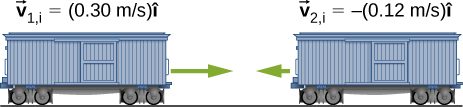
Train cars are coupled together by being bumped into one another. Suppose two loaded train cars are moving toward one another, the first having a mass of and a velocity of , and the second having a mass of and a velocity of . What is their final velocity?
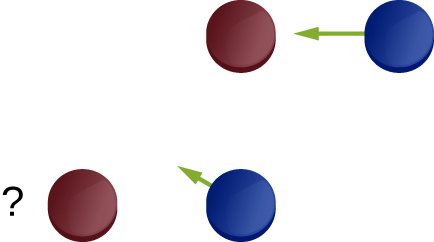
Two identical pucks collide elastically on an air hockey table. Puck 1 was originally at rest; puck 2 has an incoming speed of 6.00 m/s and scatters at an angle of with respect to its incoming direction. What is the velocity (magnitude and direction) of puck 1 after the collision?
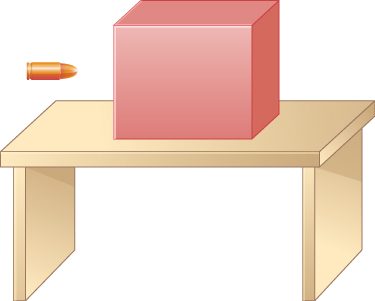
The figure below shows a bullet of mass 200 g traveling horizontally towards the east with speed 400 m/s, which strikes a block of mass 1.5 kg that is initially at rest on a frictionless table.
After striking the block, the bullet is embedded in the block and the block and the bullet move together as one unit.
What is the magnitude and direction of the velocity of the block/bullet combination immediately after the impact?
What is the magnitude and direction of the impulse by the block on the bullet?
What is the magnitude and direction of the impulse from the bullet on the block?
If it took 3 ms for the bullet to change the speed from 400 m/s to the final speed after impact, what is the average force between the block and the bullet during this time?
a. 47 m/s in the bullet to block direction; b., toward the bullet; c. , toward the block; d. magnitude is
A 20-kg child is coasting at 3.3 m/s over flat ground in a 4.0-kg wagon.
If the child drops a 1-kg ball out the back of the wagon, what is the final speed of the child and wagon?
If the child drops a 1-kg ball out the back of the wagon so that the ball is at rest relative to the ground, what is the final speed of the child and wagon?
A 4.5 kg puffer fish expands to 40% of its mass by taking in water. When the puffer fish is threatened, it releases the water toward the threat to move quickly forward. What is the ratio of the speed of the puffer fish forward to the speed of the expelled water backwards?
2:5
Explain why a cannon recoils when it fires a shell.
Two figure skaters are coasting in the same direction, with the leading skater moving at 5.5 m/s and the trailing skating moving at 6.2 m/s. When the trailing skater catches up with the leading skater, he picks her up without applying any horizontal forces on his skates. If the trailing skater is 50% heavier than the 50-kg leading skater, what is their speed after he picks her up?
5.9 m/s
A 2000-kg railway freight car coasts at 4.4 m/s underneath a grain terminal, which dumps grain directly down into the freight car. If the speed of the loaded freight car must not go below 3.0 m/s, what is the maximum mass of grain that it can accept?
Adapted from University Physics Volume 1 by OpenStax (openstax.org), licensed under CC BY-NC-SA 4.0. Changes were made. License: CC-BY-NC-SA-4.0.
These eBooks are a prerelease and are not yet certified conformant with WCAG 2.1 AA or ADA Title II. Every page is built against an automated accessibility gate, and the published editions will meet ADA Title II requirements when they release in late September 2026. If something is unusable, please tell us.