We have defined momentum to be the product of mass and velocity. Therefore, if an object’s velocity should change (due to the application of a force on the object), then necessarily, its momentum changes as well. This indicates a connection between momentum and force. The purpose of this section is to explore and describe that connection.
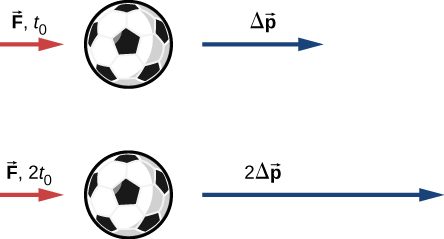
Suppose you apply a force on a free object for some amount of time. Clearly, the larger the force, the larger the object’s change of momentum will be. Alternatively, the more time you spend applying this force, again the larger the change of momentum will be, as depicted in Figure 9.5. The amount by which the object’s motion changes is therefore proportional to the magnitude of the force, and also to the time interval over which the force is applied.
Figure 9.5The change in momentum of an object is proportional to the length of time during which the force is applied. If a force is exerted on the lower ball for twice as long as on the upper ball, then the change in the momentum of the lower ball is twice that of the upper ball.
Mathematically, if a quantity is proportional to two (or more) things, then it is proportional to the product of those things. The product of a force and a time interval (over which that force acts) is called impulse, and is given the symbol
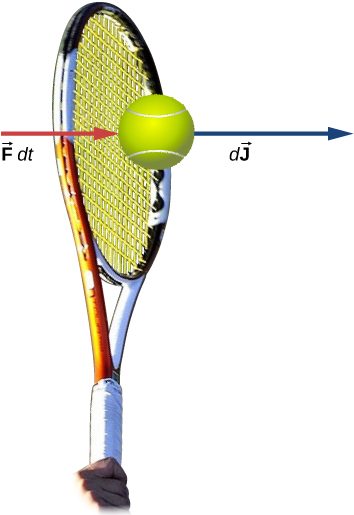
Figure 9.6A force applied by a tennis racquet to a tennis ball over a time interval generates an impulse acting on the ball.
The total impulse over the interval is
(9.3)
Equation 9.2 and Equation 9.3 together say that when a force is applied for an infinitesimal time interval dt, it causes an infinitesimal impulse , and the total impulse given to the object is defined to be the sum (integral) of all these infinitesimal impulses.
To calculate the impulse using Equation 9.3, we need to know the force function F(t), which we often don’t. However, a result from calculus is useful here: Recall that the average value of a function over some interval is calculated by
where . Applying this to the time-dependent force function, we obtain
The idea here is that you can calculate the impulse on the object even if you don’t know the details of the force as a function of time; you only need the average force. In fact, though, the process is usually reversed: You determine the impulse (by measurement or calculation) and then calculate the average force that caused that impulse.
To calculate the impulse, a useful result follows from writing the force in Equation 9.3 as :
For a constant force , this simplifies to
That is,
(9.6)
Note that the integral form, Equation 9.3, applies to constant forces as well; in that case, since the force is independent of time, it comes out of the integral, which can then be trivially evaluated.
Effect of Impulse
Since an impulse is a force acting for some amount of time, it causes an object’s motion to change. Recall Equation 9.6:
Because is the momentum of a system, is the change of momentum . This gives us the following relation, called the impulse-momentum theorem (or relation).
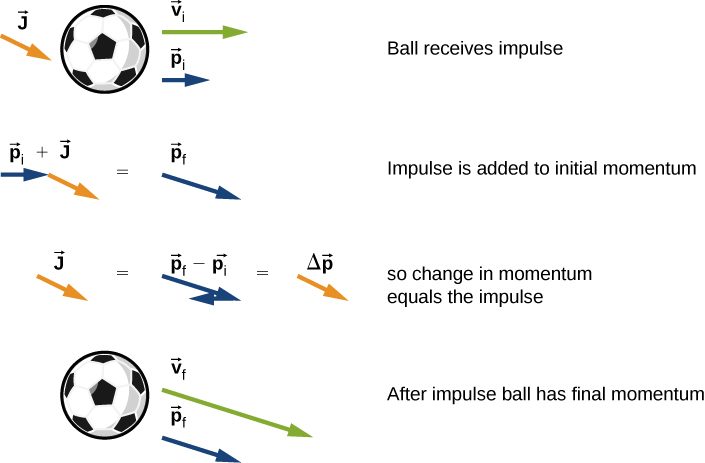
The impulse-momentum theorem is depicted graphically in Figure 9.10.
Figure 9.10Illustration of impulse-momentum theorem. (a) A ball with initial velocity and momentum receives an impulse . (b) This impulse is added vectorially to the initial momentum. (c) Thus, the impulse equals the change in momentum, . (d) After the impulse, the ball moves off with its new momentum
There are two crucial concepts in the impulse-momentum theorem:
Impulse is a vector quantity; an impulse of, say, is very different from an impulse of ; they cause completely opposite changes of momentum.
An impulse does not cause momentum; rather, it causes a change in the momentum of an object. Thus, you must subtract the initial momentum from the final momentum, and—since momentum is also a vector quantity—you must take careful account of the signs of the momentum vectors.
The most common questions asked in relation to impulse are to calculate the applied force, or the change of velocity that occurs as a result of applying an impulse. The general approach is the same.
Momentum and Force
In Example 3, we obtained an important relationship:
In words, the average force applied to an object is equal to the change of the momentum that the force causes, divided by the time interval over which this change of momentum occurs. This relationship is very useful in situations where the collision time is small, but measureable; typical values would be 1/10th of a second, or even one thousandth of a second. Car crashes, punting a football, or collisions of subatomic particles would meet this criterion.
For a continuously changing momentum—due to a continuously changing force—this becomes a powerful conceptual tool. In the limit , Equation 9.2 becomes
(9.9)
This says that the rate of change of the system’s momentum (implying that momentum is a function of time) is exactly equal to the net applied force (also, in general, a function of time). This is, in fact, Newton’s second law, written in terms of momentum rather than acceleration. This is the relationship Newton himself presented in his Principia Mathematica (although he called it “quantity of motion” rather than “momentum”).
If the mass of the system remains constant, Equation 9.3 reduces to the more familiar form of Newton’s second law. We can see this by substituting the definition of momentum:
The assumption of constant mass allowed us to pull m out of the derivative. If the mass is not constant, we cannot use this form of the second law, but instead must start from Equation 9.3. Thus, one advantage to expressing force in terms of changing momentum is that it allows for the mass of the system to change, as well as the velocity; this is a concept we’ll explore when we study the motion of rockets.
Although Equation 9.3 allows for changing mass, as we will see in Rocket Propulsion, the relationship between momentum and force remains useful when the mass of the system is constant, as in the following example.
Summary
When a force is applied on an object for some amount of time, the object experiences an impulse.
This impulse is equal to the object’s change of momentum.
Newton’s second law in terms of momentum states that the net force applied to a system equals the rate of change of the momentum that the force causes.
Conceptual Questions
Is it possible for a small force to produce a larger impulse on a given object than a large force? Explain.
Yes; impulse is the force applied multiplied by the time during which it is applied (), so if a small force acts for a long time, it may result in a larger impulse than a large force acting for a small time.
Why is a 10-m fall onto concrete far more dangerous than a 10-m fall onto water?
What external force is responsible for changing the momentum of a car moving along a horizontal road?
By friction, the road exerts a horizontal force on the tires of the car, which changes the momentum of the car.
A piece of putty and a tennis ball with the same mass are thrown against a wall with the same velocity. Which object experiences a greater force from the wall or are the forces equal? Explain.
Problems
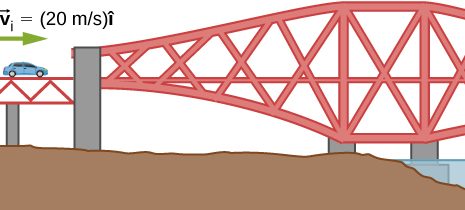
A 75.0-kg person is riding in a car moving at 20.0 m/s when the car runs into a bridge abutment (see the following figure).
Calculate the average force on the person if he is stopped by a padded dashboard that compresses an average of 1.00 cm.
Calculate the average force on the person if he is stopped by an air bag that compresses an average of 15.0 cm.
a. ; b.
One hazard of space travel is debris left by previous missions. There are several thousand objects orbiting Earth that are large enough to be detected by radar, but there are far greater numbers of very small objects, such as flakes of paint. Calculate the force exerted by a 0.100-mg chip of paint that strikes a spacecraft window at a relative speed of , given the collision lasts .
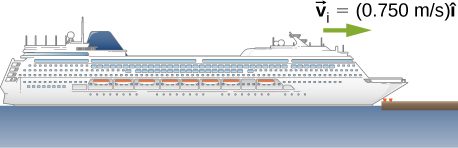
A cruise ship with a mass of strikes a pier at a speed of 0.750 m/s. It comes to rest after traveling 6.00 m, damaging the ship, the pier, and the tugboat captain’s finances. Calculate the average force exerted on the pier using the concept of impulse. (Hint: First calculate the time it took to bring the ship to rest, assuming a constant force.)
Calculate the final speed of a 110-kg rugby player who is initially running at 8.00 m/s but collides head-on with a padded goalpost and experiences a backward force of for .
Water from a fire hose is directed horizontally against a wall at a rate of 50.0 kg/s and a speed of 42.0 m/s. Calculate the force exerted on the wall, assuming the water’s horizontal momentum is reduced to zero.
A 0.450-kg hammer is moving horizontally at 7.00 m/s when it strikes a nail and comes to rest after driving the nail 1.00 cm into a board. Assume constant acceleration of the hammer-nail pair.
Calculate the duration of the impact.
What was the average force exerted on the nail?
What is the momentum (as a function of time) of a 5.0-kg particle moving with a velocity ? What is the net force acting on this particle?
;
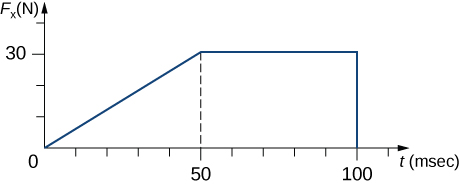
The x-component of a force on a 46-g golf ball by a 7-iron versus time is plotted in the following figure:
Find the x-component of the impulse during the intervals
[0, 50 ms], and
[50 ms, 100 ms]
Find the change in the x-component of the momentum during the intervals
[0, 50 ms], and
[50 ms, 100 ms]
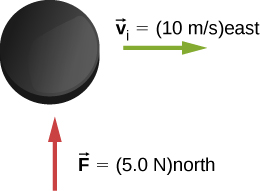
A hockey puck of mass 150 g is sliding due east on a frictionless table with a speed of 10 m/s. Suddenly, a constant force of magnitude 5 N and direction due north is applied to the puck for 1.5 s. Find the north and east components of the momentum at the end of the 1.5-s interval.
Let the positive x-axis be in the direction of the original momentum. Then and
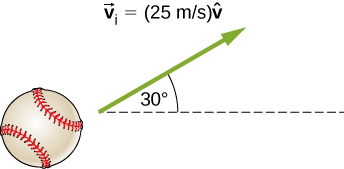
A ball of mass 250 g is thrown with an initial velocity of 25 m/s at an angle of with the horizontal direction. Ignore air resistance. What is the momentum of the ball after 0.2 s? (Do this problem by finding the components of the momentum first, and then constructing the magnitude and direction of the momentum vector from the components.)
Adapted from University Physics Volume 1 by OpenStax (openstax.org), licensed under CC BY-NC-SA 4.0. Changes were made. License: CC-BY-NC-SA-4.0.
These eBooks are a prerelease and are not yet certified conformant with WCAG 2.1 AA or ADA Title II. Every page is built against an automated accessibility gate, and the published editions will meet ADA Title II requirements when they release in late September 2026. If something is unusable, please tell us.