It is far more common for collisions to occur in two dimensions; that is, the angle between the initial velocity vectors is neither zero nor . Let’s see what complications arise from this.
The first idea we need is that momentum is a vector; like all vectors, it can be expressed as a sum of perpendicular components (usually, though not always, an x-component and a y-component, and a z-component if necessary). Thus, when we write down the statement of conservation of momentum for a problem, our momentum vectors can be, and usually will be, expressed in component form.
The second idea we need comes from the fact that momentum is related to force:
Expressing both the force and the momentum in component form,
Remember, these equations are simply Newton’s second law, in vector form and in component form. We know that Newton’s second law is true in each direction, independently of the others. It follows therefore (via Newton’s third law) that conservation of momentum is also true in each direction independently.
These two ideas motivate the solution to two-dimensional problems: We write down the expression for conservation of momentum twice: once in the x-direction and once in the y-direction.
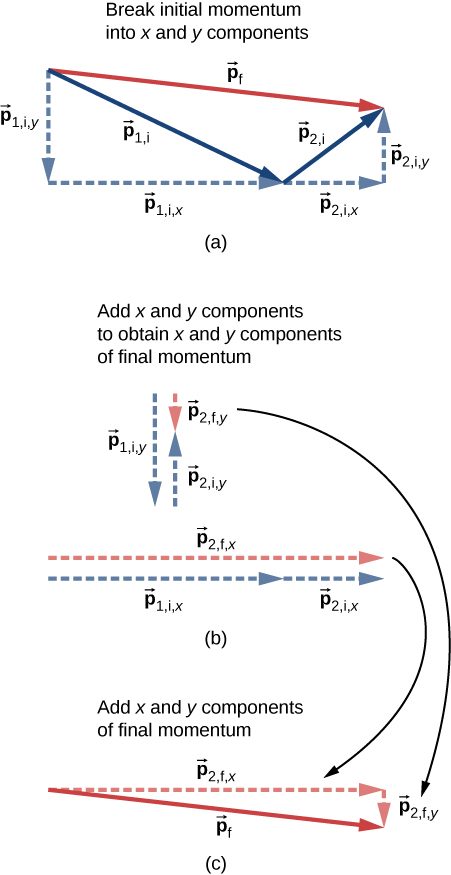
This procedure is shown graphically in Figure 9.22.
Figure 9.22(a) For two-dimensional momentum problems, break the initial momentum vectors into their x- and y-components. (b) Add the x- and y-components together separately. This gives you the x- and y-components of the final momentum, which are shown as red dashed vectors. (c) Adding these components together gives the final momentum.
We solve each of these two component equations independently to obtain the x- and y-components of the desired velocity vector:
(Here, m represents the total mass of the system.) Finally, combine these components using the Pythagorean theorem,
Summary
The approach to two-dimensional collisions is to choose a convenient coordinate system and break the motion into components along perpendicular axes.
Momentum is conserved in both directions simultaneously and independently.
The Pythagorean theorem gives the magnitude of the momentum vector using the x- and y-components, calculated using conservation of momentum in each direction.
Conceptual Questions
Momentum for a system can be conserved in one direction while not being conserved in another. What is the angle between the directions? Give an example.
The angle between the directions must be 90°. Any system that has zero net external force in one direction and nonzero net external force in a perpendicular direction will satisfy these conditions.
Problems
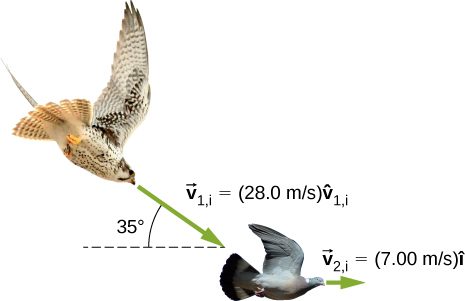
A 0.90-kg falcon is diving at 28.0 m/s at a downward angle of . It catches a 0.325-kg pigeon from behind in midair. What is their combined velocity after impact if the pigeon’s initial velocity was 7.00 m/s directed horizontally? Note that is a unit vector pointing in the direction in which the falcon is initially flying.
Figure 9.26(credit “falcon”: modification of work by “USFWS Mountain-Prairie”/Flickr; credit “pigeon”: modification of work by Jacob Spinks)
22.1 m/s at below the horizontal
A billiard ball, labeled 1, moving horizontally strikes another billiard ball, labeled 2, at rest. Before impact, ball 1 was moving at a speed of 3.00 m/s, and after impact it is moving at 0.50 m/s at 50° from the original direction. If the two balls have equal masses of 300 g, what is the velocity of the ball 2 after the impact?
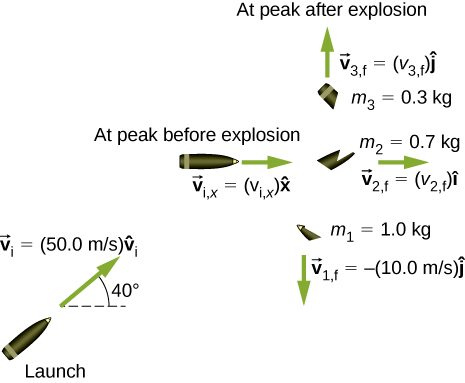
A projectile of mass 2.0 kg is fired in the air at an angle of 40.0 to the horizon at a speed of 50.0 m/s. At the highest point in its flight, the projectile breaks into three parts of mass 1.0 kg, 0.7 kg, and 0.3 kg. The 1.0-kg part falls straight down after breakup with an initial speed of 10.0 m/s, the 0.7-kg part moves in the original forward direction, and the 0.3-kg part goes straight up.
Find the speeds of the 0.3-kg and 0.7-kg pieces immediately after the break-up.
How high from the break-up point does the 0.3-kg piece go before coming to rest?
Where does the 0.7-kg piece land relative to where it was fired from?
a. 33 m/s and 110 m/s; b. 57 m; c. 480 m
Two asteroids collide and stick together. The first asteroid has mass of and is initially moving at 770 m/s. The second asteroid has mass of and is moving at 1020 m/s. Their initial velocities made an angle of 20° with respect to each other. What is the final speed and direction with respect to the velocity of the first asteroid?
A 200-kg rocket in deep space moves with a velocity of . Suddenly, it explodes into three pieces, with the first (78 kg) moving at and the second (56 kg) moving at . Find the velocity of the third piece.
A proton traveling at scatters elastically from an initially stationary alpha particle and is deflected at an angle of 85° with respect to its initial velocity. Given that the alpha particle has four times the mass of the proton, what percent of its initial kinetic energy does the proton retain after the collision?
Three 70-kg deer are standing on a flat 200-kg rock that is on an ice-covered pond. A gunshot goes off and the deer scatter, with deer A running at , deer B running at , and deer C running at . What is the velocity of the rock on which they were standing?
A family is skating. The father (75 kg) skates at 8.2 m/s and collides and sticks to the mother (50 kg), who was initially moving at 3.3 m/s and at 45° with respect to the father’s velocity. The pair then collides with their daughter (30 kg), who was stationary, and the three slide off together. What is their final velocity?
An oxygen atom (mass 16 u) moving at 733 m/s at 15.0° with respect to the direction collides and sticks to an oxygen molecule (mass 32 u) moving at 528 m/s at 128° with respect to the direction. The two stick together to form ozone. What is the final velocity of the ozone molecule?
341 m/s at 86.8° with respect to the axis.
Two cars of the same mass approach an extremely icy four-way perpendicular intersection. Car A travels northward at 30 m/s and car B is travelling eastward. They collide and stick together, traveling at 28° north of east. What was the initial velocity of car B?
Adapted from University Physics Volume 1 by OpenStax (openstax.org), licensed under CC BY-NC-SA 4.0. Changes were made. License: CC-BY-NC-SA-4.0.
These eBooks are a prerelease and are not yet certified conformant with WCAG 2.1 AA or ADA Title II. Every page is built against an automated accessibility gate, and the published editions will meet ADA Title II requirements when they release in late September 2026. If something is unusable, please tell us.