
4.4 Uniform and Nonuniform Circular Motion
Uniform circular motion is a specific type of motion in which an object travels in a circle with a constant speed. For example, any point on a propeller spinning at a constant rate is executing uniform circular motion. Other examples are the second, minute, and hour hands of a watch. It is remarkable that points on these rotating objects are actually accelerating, although the rotation rate is a constant. To see this, we must analyze the motion in terms of vectors.
Centripetal Acceleration
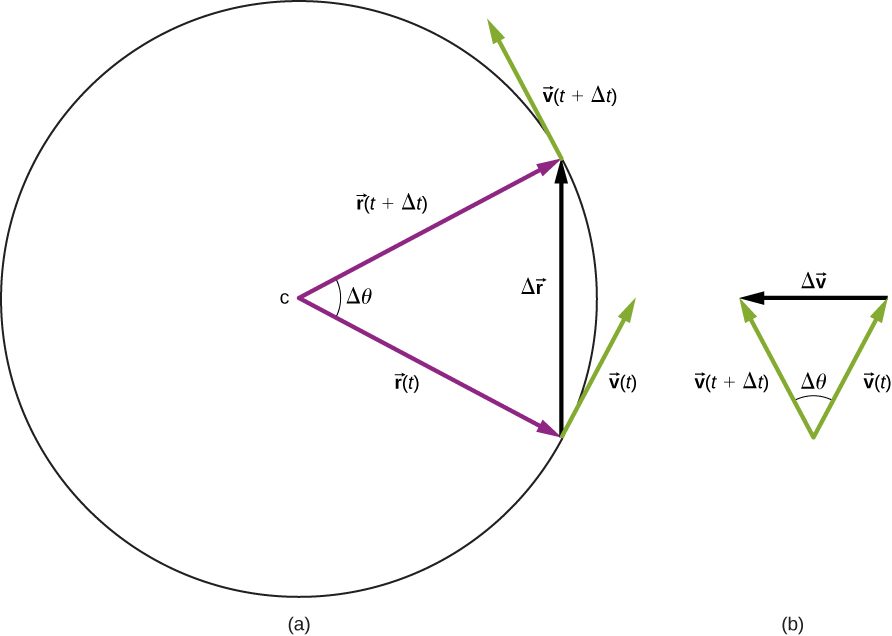
In one-dimensional kinematics, objects with a constant speed have zero acceleration. However, in two- and three-dimensional kinematics, even if the speed is a constant, a particle can have acceleration if it moves along a curved trajectory such as a circle. In this case the velocity vector is changing, or This is shown in Figure 4.18. As the particle moves counterclockwise in time on the circular path, its position vector moves from to The velocity vector has constant magnitude and is tangent to the path as it changes from to changing its direction only. Since the velocity vector is perpendicular to the position vector the triangles formed by the position vectors and and the velocity vectors and are similar. Furthermore, since and the two triangles are isosceles. From these facts we can make the assertion
or
We can find the magnitude of the acceleration from
The direction of the acceleration can also be found by noting that as and therefore approach zero, the vector approaches a direction perpendicular to In the limit is perpendicular to Since is tangent to the circle, the acceleration points toward the center of the circle. Summarizing, a particle moving in a circle at a constant speed has an acceleration with magnitude
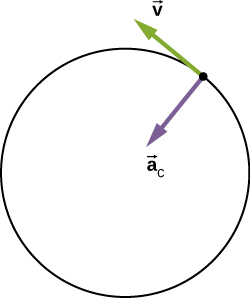
The direction of the acceleration vector is toward the center of the circle (Figure 4.19). This is a radial acceleration and is called the centripetal acceleration, which is why we give it the subscript c. The word centripetal comes from the Latin words centrum (meaning “center”) and petere (meaning “to seek”), and thus takes the meaning “center seeking.”
Let’s investigate some examples that illustrate the relative magnitudes of the velocity, radius, and centripetal acceleration.
Centripetal acceleration can have a wide range of values, depending on the speed and radius of curvature of the circular path. Typical centripetal accelerations are given in the following table.
| Object | Centripetal Acceleration (m/s2 or factors of g) |
|---|---|
| Earth around the Sun | |
| Moon around the Earth | |
| Satellite in geosynchronous orbit | 0.233 |
| Outer edge of a CD when playing | |
| Jet in a barrel roll | (2–3 g) |
| Roller coaster | (5 g) |
| Electron orbiting a proton in a simple Bohr model of the atom |
Equations of Motion for Uniform Circular Motion
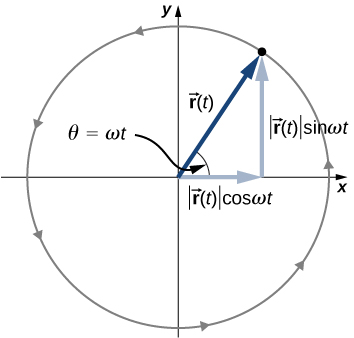
A particle executing circular motion can be described by its position vector Figure 4.20 shows a particle executing circular motion in a counterclockwise direction. As the particle moves on the circle, its position vector sweeps out the angle with the x-axis. Vector making an angle with the x-axis is shown with its components along the x- and y-axes. The magnitude of the position vector is and is also the radius of the circle, so that in terms of its components,
Here, is a constant called the angular frequency of the particle. The angular frequency has units of radians (rad) per second and is simply the number of radians of angular measure through which the particle passes per second. The angle that the position vector has at any particular time is .
If T is the period of motion, or the time to complete one revolution ( rad), then
Velocity and acceleration can be obtained from the position function by differentiation:
It can be shown from Figure 4.20 that the velocity vector is tangential to the circle at the location of the particle, with magnitude Similarly, the acceleration vector is found by differentiating the velocity:
From this equation we see that the acceleration vector has magnitude and is directed opposite the position vector, toward the origin, because
Nonuniform Circular Motion
Circular motion does not have to be at a constant speed. A particle can travel in a circle and speed up or slow down, showing an acceleration in the direction of the motion.
In uniform circular motion, the particle executing circular motion has a constant speed and the circle is at a fixed radius. If the speed of the particle is changing as well, then we introduce an additional acceleration in the direction tangential to the circle. Such accelerations occur at a point on a top that is changing its spin rate, or any accelerating rotor. In Displacement and Velocity Vectors we showed that centripetal acceleration is the time rate of change of the direction of the velocity vector. If the speed of the particle is changing, then it has a tangential acceleration that is the time rate of change of the magnitude of the velocity:
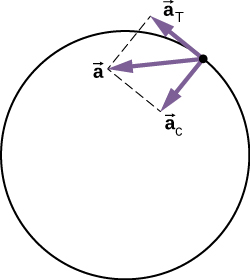
The direction of tangential acceleration is tangent to the circle whereas the direction of centripetal acceleration is radially inward toward the center of the circle. Thus, a particle in circular motion with a tangential acceleration has a total acceleration that is the vector sum of the centripetal and tangential accelerations:
The acceleration vectors are shown in Figure 4.22. Note that the two acceleration vectors and are perpendicular to each other, with in the radial direction and in the tangential direction. The total acceleration points at an angle between and
Summary
- Uniform circular motion is motion in a circle at constant speed.
- Centripetal acceleration is the acceleration a particle must have to follow a circular path. Centripetal acceleration always points toward the center of rotation and has magnitude
- Nonuniform circular motion occurs when there is tangential acceleration of an object executing circular motion such that the speed of the object is changing. This acceleration is called tangential acceleration The magnitude of tangential acceleration is the time rate of change of the magnitude of the velocity. The tangential acceleration vector is tangential to the circle, whereas the centripetal acceleration vector points radially inward toward the center of the circle. The total acceleration is the vector sum of tangential and centripetal accelerations.
- An object executing uniform circular motion can be described with equations of motion. The position vector of the object is where A is the magnitude which is also the radius of the circle, and is the angular frequency.
Conceptual Questions
Can centripetal acceleration change the speed of a particle undergoing circular motion?
Can tangential acceleration change the speed of a particle undergoing circular motion?
yes
Problems
A flywheel is rotating at 30 rev/s. What is the total angle, in radians, through which a point on the flywheel rotates in 40 s?
A particle travels in a circle of radius 10 m at a constant speed of 20 m/s. What is the magnitude of the acceleration?
Cam Newton of the Carolina Panthers throws a perfect football spiral at 8.0 rev/s. The radius of a pro football is 8.5 cm at the middle of the short side. What is the centripetal acceleration of the laces on the football?
A fairground ride spins its occupants inside a flying saucer-shaped container. If the horizontal circular path the riders follow has an 8.00-m radius, at how many revolutions per minute are the riders subjected to a centripetal acceleration equal to that of gravity?
which is
A runner taking part in the 200-m dash must run around the end of a track that has a circular arc with a radius of curvature of 30.0 m. The runner starts the race at a constant speed. If she completes the 200-m dash in 23.2 s and runs at constant speed throughout the race, what is her centripetal acceleration as she runs the curved portion of the track?
What is the acceleration of Venus toward the Sun, assuming a circular orbit?
Venus is 108.2 million km from the Sun and has an orbital period of 0.6152 y.
An experimental jet rocket travels around Earth along its equator just above its surface. At what speed must the jet travel if the magnitude of its acceleration is g?
A fan is rotating at a constant 360.0 rev/min. What is the magnitude of the acceleration of a point on one of its blades 10.0 cm from the axis of rotation?
A point located on the second hand of a large clock has a radial acceleration of How far is the point from the axis of rotation of the second hand?
Adapted from University Physics Volume 1 by OpenStax (openstax.org), licensed under CC BY-NC-SA 4.0. Changes were made. License: CC-BY-NC-SA-4.0.