
4.1 Displacement and Velocity Vectors
Displacement and velocity in two or three dimensions are straightforward extensions of the one-dimensional definitions. However, now they are vector quantities, so calculations with them have to follow the rules of vector algebra, not scalar algebra.
Displacement Vector
To describe motion in two and three dimensions, we must first establish a coordinate system and a convention for the axes. We generally use the coordinates x, y, and z to locate a particle at point P(x, y, z) in three dimensions. If the particle is moving, the variables x, y, and z are functions of time (t):
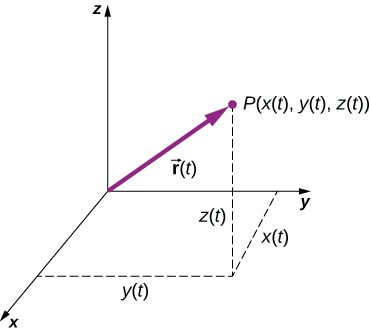
The position vector from the origin of the coordinate system to point P is In unit vector notation, introduced in Coordinate Systems and Components of a Vector, is
Figure 4.2 shows the coordinate system and the vector to point P, where a particle could be located at a particular time t. Note the orientation of the x, y, and z axes. This orientation is called a right-handed coordinate system (Coordinate Systems and Components of a Vector) and it is used throughout the chapter.
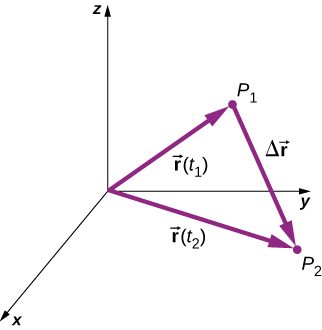
With our definition of the position of a particle in three-dimensional space, we can formulate the three-dimensional displacement. Figure 4.3 shows a particle at time located at with position vector At a later time the particle is located at with position vector . The displacement vector is found by subtracting from
Vector addition is discussed in Vectors. Note that this is the same operation we did in one dimension, but now the vectors are in three-dimensional space.
The following examples illustrate the concept of displacement in multiple dimensions.
Velocity Vector
In the previous chapter we found the instantaneous velocity by calculating the derivative of the position function with respect to time. We can do the same operation in two and three dimensions, but we use vectors. The instantaneous velocity vector is now
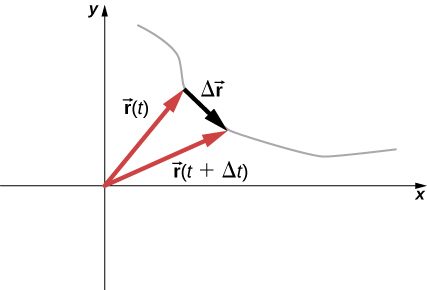
Let’s look at the relative orientation of the position vector and velocity vector graphically. In Figure 4.7 we show the vectors and which give the position of a particle moving along a path represented by the gray line. As goes to zero, the velocity vector, given by Equation 4.4, becomes tangent to the path of the particle at time t.
Equation 4.4 can also be written in terms of the components of Since
we can write
where
If only the average velocity is of concern, we have the vector equivalent of the one-dimensional average velocity for two and three dimensions:
The Independence of Perpendicular Motions
When we look at the three-dimensional equations for position and velocity written in unit vector notation, Equation 4.2 and Equation 4.5, we see the components of these equations are separate and unique functions of time that do not depend on one another. Motion along the x direction has no part of its motion along the y and z directions, and similarly for the other two coordinate axes. Thus, the motion of an object in two or three dimensions can be divided into separate, independent motions along the perpendicular axes of the coordinate system in which the motion takes place.
To illustrate this concept with respect to displacement, consider a woman walking from point A to point B in a city with square blocks. The woman taking the path from A to B may walk east for so many blocks and then north (two perpendicular directions) for another set of blocks to arrive at B. How far she walks east is affected only by her motion eastward. Similarly, how far she walks north is affected only by her motion northward.
An example illustrating the independence of vertical and horizontal motions is given by two baseballs. One baseball is dropped from rest. At the same instant, another is thrown horizontally from the same height and it follows a curved path. A stroboscope captures the positions of the balls at fixed time intervals as they fall (Figure 4.8).
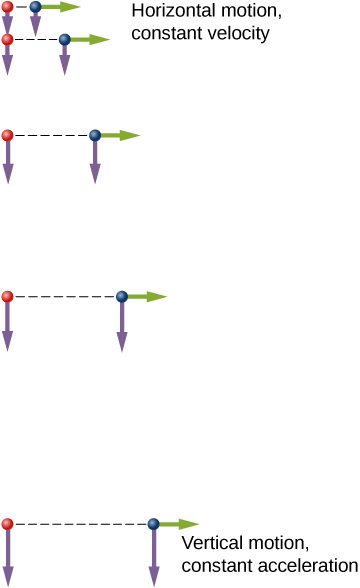
It is remarkable that for each flash of the strobe, the vertical positions of the two balls are the same. This similarity implies vertical motion is independent of whether the ball is moving horizontally. (Assuming no air resistance, the vertical motion of a falling object is influenced by gravity only, not by any horizontal forces.) Careful examination of the ball thrown horizontally shows it travels the same horizontal distance between flashes. This is because there are no additional forces on the ball in the horizontal direction after it is thrown. This result means horizontal velocity is constant and is affected neither by vertical motion nor by gravity (which is vertical). Note this case is true for ideal conditions only. In the real world, air resistance affects the speed of the balls in both directions.
The two-dimensional curved path of the horizontally thrown ball is composed of two independent one-dimensional motions (horizontal and vertical). The key to analyzing such motion, called projectile motion, is to resolve it into motions along perpendicular directions. Resolving two-dimensional motion into perpendicular components is possible because the components are independent.
Summary
- The position function gives the position as a function of time of a particle moving in two or three dimensions. Graphically, it is a vector from the origin of a chosen coordinate system to the point where the particle is located at a specific time.
- The displacement vector gives the shortest distance between any two points on the trajectory of a particle in two or three dimensions.
- Instantaneous velocity gives the speed and direction of a particle at a specific time on its trajectory in two or three dimensions, and is a vector in two and three dimensions.
- The velocity vector is tangent to the trajectory of the particle.
- Displacement can be written as a vector sum of the one-dimensional displacements along the x, y, and z directions.
- Velocity can be written as a vector sum of the one-dimensional velocities along the x, y, and z directions.
- Motion in any given direction is independent of motion in a perpendicular direction.
Conceptual Questions
What form does the trajectory of a particle have if the distance from any point A to point B is equal to the magnitude of the displacement from A to B?
straight line
Give an example of a trajectory in two or three dimensions caused by independent perpendicular motions.
If the instantaneous velocity is zero, what can be said about the slope of the position function?
The slope must be zero because the velocity vector is tangent to the graph of the position function.
Problems
The coordinates of a particle in a rectangular coordinate system are (1.0, –4.0, 6.0). What is the position vector of the particle?
The position of a particle changes from to What is the particle’s displacement?
The 18th hole at Pebble Beach Golf Course is a dogleg to the left of length 496.0 m. The fairway off the tee is taken to be the x direction. A golfer hits his tee shot a distance of 300.0 m, corresponding to a displacement and hits his second shot 189.0 m with a displacement What is the final displacement of the golf ball from where it started?
A bird flies straight northeast a distance of 95.0 km for 3.0 h. With the x-axis due east and the y-axis due north, what is the displacement in unit vector notation for the bird? What is the average velocity for the trip?
A cyclist rides 5.0 km due east, then 10.0 km west of north. From this point she rides 8.0 km due west. What is the final displacement from where the cyclist started?
New York Rangers defenseman Daniel Girardi stands at the goal and passes a hockey puck 20 m and from straight down the ice to left wing Chris Kreider waiting at the blue line. Kreider waits for Girardi to reach the blue line and passes the puck directly across the ice to him 10 m away. What is the final displacement of the puck? See the following figure.
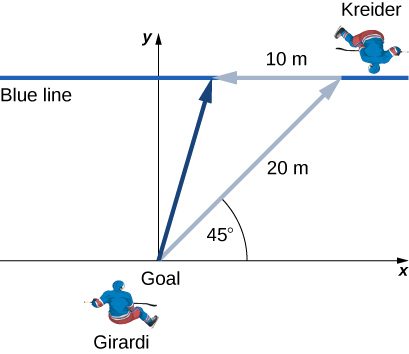
The position of a particle is (a) What is the velocity of the particle at 0 s and at s? (b) What is the average velocity between 0 s and s?
a. ,
b.
Clay Matthews, a linebacker for the Green Bay Packers, can reach a speed of 10.0 m/s. At the start of a play, Matthews runs downfield at with respect to the 50-yard line and covers 8.0 m in 1 s. He then runs straight down the field at with respect to the 50-yard line for 12 m, with an elapsed time of 1.2 s. (a) What is Matthews’ final displacement from the start of the play? (b) What is his average velocity?
The F-35B Lighting II is a short-takeoff and vertical landing fighter jet. If it does a vertical takeoff to 20.00-m height above the ground and then follows a flight path angled at with respect to the ground for 20.00 km, what is the final displacement?
Adapted from University Physics Volume 1 by OpenStax (openstax.org), licensed under CC BY-NC-SA 4.0. Changes were made. License: CC-BY-NC-SA-4.0.