
4.3 Projectile Motion
Projectile motion is the motion of an object thrown or projected into the air, subject only to acceleration as a result of gravity. The applications of projectile motion in physics and engineering are numerous. Some examples include meteors as they enter Earth’s atmosphere, fireworks, and the motion of any ball in sports. Such objects are called projectiles and their path is called a trajectory. The motion of falling objects as discussed in Motion Along a Straight Line is a simple one-dimensional type of projectile motion in which there is no horizontal movement. In this section, we consider two-dimensional projectile motion, and our treatment neglects the effects of air resistance.
The most important fact to remember here is that motions along perpendicular axes are independent and thus can be analyzed separately. We discussed this fact in Displacement and Velocity Vectors, where we saw that vertical and horizontal motions are independent. The key to analyzing two-dimensional projectile motion is to break it into two motions: one along the horizontal axis and the other along the vertical. (This choice of axes is the most sensible because acceleration resulting from gravity is vertical; thus, there is no acceleration along the horizontal axis when air resistance is negligible.) As is customary, we call the horizontal axis the x-axis and the vertical axis the y-axis. It is not required that we use this choice of axes; it is simply convenient in the case of gravitational acceleration. In other cases we may choose a different set of axes. Figure 4.11 illustrates the notation for displacement, where we define to be the total displacement, and and are its component vectors along the horizontal and vertical axes, respectively. The magnitudes of these vectors are s, x, and y.
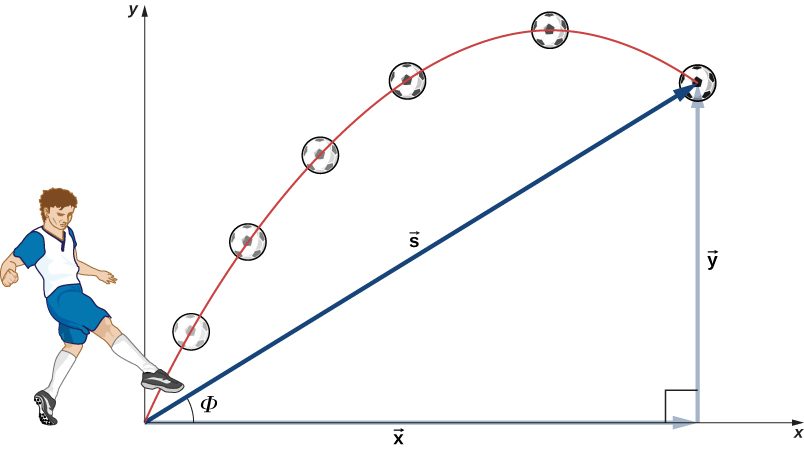
To describe projectile motion completely, we must include velocity and acceleration, as well as displacement. We must find their components along the x- and y-axes. Let’s assume all forces except gravity (such as air resistance and friction, for example) are negligible. Defining the positive direction to be upward, the components of acceleration are then very simple:
Because gravity is vertical, If this means the initial velocity in the x direction is equal to the final velocity in the x direction, or With these conditions on acceleration and velocity, we can write the kinematic Equation 4.11 through Equation 4.18 for motion in a uniform gravitational field, including the rest of the kinematic equations for a constant acceleration from Motion with Constant Acceleration. The kinematic equations for motion in a uniform gravitational field become kinematic equations with
Horizontal Motion
Vertical Motion
Using this set of equations, we can analyze projectile motion, keeping in mind some important points.
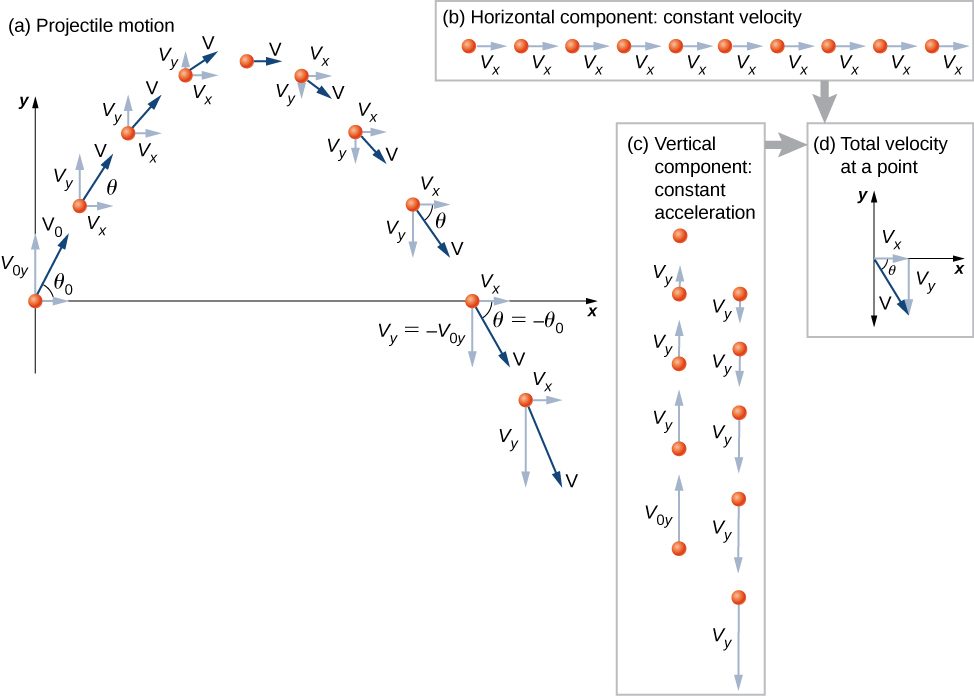
When solving Example 1(a), the expression we found for y is valid for any projectile motion when air resistance is negligible. Call the maximum height y = h. Then,
This equation defines the maximum height of a projectile above its launch position and it depends only on the vertical component of the initial velocity.
Time of Flight, Trajectory, and Range
Of interest are the time of flight, trajectory, and range for a projectile launched on a flat horizontal surface and impacting on the same surface. In this case, kinematic equations give useful expressions for these quantities, which are derived in the following sections.
Time of flight
We can solve for the time of flight of a projectile that is both launched and impacts on a flat horizontal surface by performing some manipulations of the kinematic equations. We note the position and displacement in y must be zero at launch and at impact on an even surface. Thus, we set the displacement in y equal to zero and find
Factoring, we have
Solving for t gives us
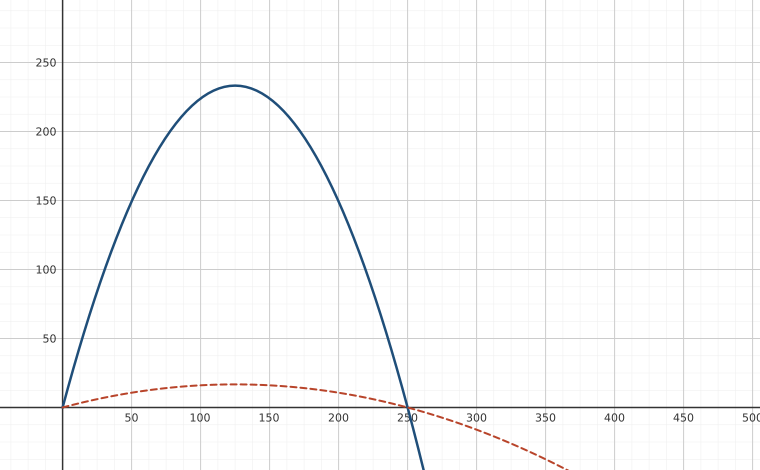
This is the time of flight for a projectile both launched and impacting on a flat horizontal surface. Equation 4.24 does not apply when the projectile lands at a different elevation than it was launched, as we saw in Example 2 of the tennis player hitting the ball into the stands. The other solution, t = 0, corresponds to the time at launch. The time of flight is linearly proportional to the initial velocity in the y direction and inversely proportional to g. Thus, on the Moon, where gravity is one-sixth that of Earth, a projectile launched with the same velocity as on Earth would be airborne six times as long.
Trajectory
The trajectory of a projectile can be found by eliminating the time variable t from the kinematic equations for arbitrary t and solving for y(x). We take so the projectile is launched from the origin. The kinematic equation for x gives
Substituting the expression for t into the equation for the position gives
Rearranging terms, we have
This trajectory equation is of the form which is an equation of a parabola with coefficients
Range
From the trajectory equation we can also find the range, or the horizontal distance traveled by the projectile. Factoring Equation 4.25, we have
The position y is zero for both the launch point and the impact point, since we are again considering only a flat horizontal surface. Setting y = 0 in this equation gives solutions x = 0, corresponding to the launch point, and
corresponding to the impact point. Using the trigonometric identity and setting x = R for range, we find
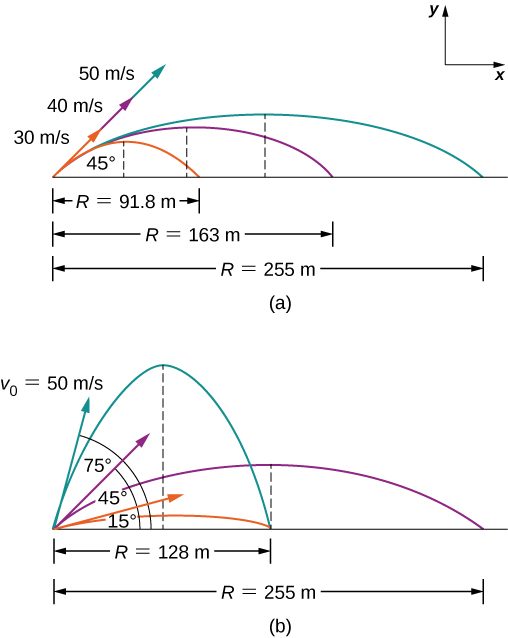
Note particularly that Equation 4.26 is valid only for launch and impact on a horizontal surface. We see the range is directly proportional to the square of the initial speed and , and it is inversely proportional to the acceleration of gravity. Thus, on the Moon, the range would be six times greater than on Earth for the same initial velocity. Furthermore, we see from the factor that the range is maximum at These results are shown in Figure 4.15. In (a) we see that the greater the initial velocity, the greater the range. In (b), we see that the range is maximum at This is true only for conditions neglecting air resistance. If air resistance is considered, the maximum angle is somewhat smaller. It is interesting that the same range is found for two initial launch angles that sum to The projectile launched with the smaller angle has a lower apex than the higher angle, but they both have the same range.
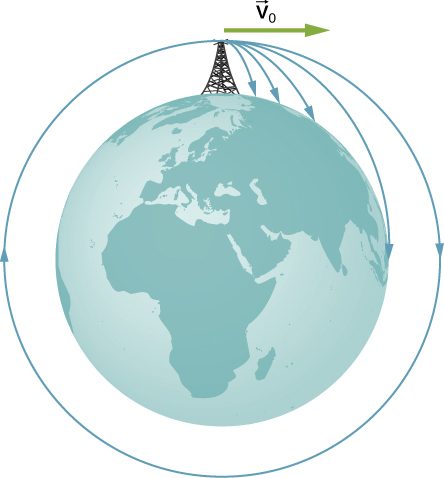
When we speak of the range of a projectile on level ground, we assume R is very small compared with the circumference of Earth. If, however, the range is large, Earth curves away below the projectile and the acceleration resulting from gravity changes direction along the path. The range is larger than predicted by the range equation given earlier because the projectile has farther to fall than it would on level ground, as shown in Figure 4.17, which is based on a drawing in Newton’s Principia. If the initial speed is great enough, the projectile goes into orbit. Earth’s surface drops 5 m every 8000 m. In 1 s an object falls 5 m without air resistance. Thus, if an object is given a horizontal velocity of 8000 m/s (or 18,000 mi/hr) near Earth’s surface, it will go into orbit around the planet because the surface continuously falls away from the object. This is roughly the speed of the Space Shuttle in a low Earth orbit when it was operational, or any satellite in a low Earth orbit. These and other aspects of orbital motion, such as Earth’s rotation, are covered in greater depth in Gravitation.
Summary
- Projectile motion is the motion of an object subject only to the acceleration of gravity, where the acceleration is constant, as near the surface of Earth.
- To solve projectile motion problems, we analyze the motion of the projectile in the horizontal and vertical directions using the one-dimensional kinematic equations for x and y.
- The time of flight of a projectile launched with initial vertical velocity on an even surface is given by This equation is valid only when the projectile lands at the same elevation from which it was launched.
- The maximum horizontal distance traveled by a projectile is called the range. Again, the equation for range is valid only when the projectile lands at the same elevation from which it was launched.
Conceptual Questions
Answer the following questions for projectile motion on level ground assuming negligible air resistance, with the initial angle being neither nor (a) Is the velocity ever zero? (b) When is the velocity a minimum? A maximum? (c) Can the velocity ever be the same as the initial velocity at a time other than at t = 0? (d) Can the speed ever be the same as the initial speed at a time other than at t = 0?
a. no; b. minimum at apex of trajectory and maximum at launch and impact; c. no, velocity is a vector; d. yes, where it lands
Answer the following questions for projectile motion on level ground assuming negligible air resistance, with the initial angle being neither nor (a) Is the acceleration ever zero? (b) Is the vector ever parallel or antiparallel to the vector ? (c) Is the vector v ever perpendicular to the vector a? If so, where is this located?
A dime is placed at the edge of a table so it hangs over slightly. A quarter is slid horizontally on the table surface perpendicular to the edge and hits the dime head on. Which coin hits the ground first?
They both hit the ground at the same time.
Problems
A bullet is shot horizontally from shoulder height (1.5 m) with an initial speed 200 m/s. (a) How much time elapses before the bullet hits the ground? (b) How far does the bullet travel horizontally?
a. , b.
A marble rolls off a tabletop 1.0 m high and hits the floor at a point 3.0 m away from the table’s edge in the horizontal direction. (a) How long is the marble in the air? (b) What is the speed of the marble when it leaves the table’s edge? (c) What is its speed when it hits the floor?
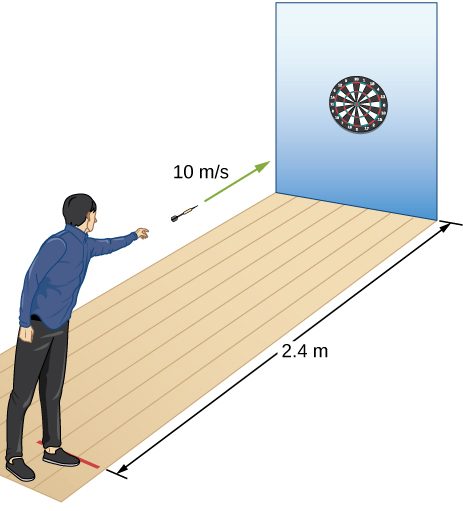
A dart is thrown horizontally at a speed of 10 m/s at the bull’s-eye of a dartboard 2.4 m away, as in the following figure. (a) How far below the intended target does the dart hit? (b) What does your answer tell you about how proficient dart players throw their darts?
a. , b. They aim high.
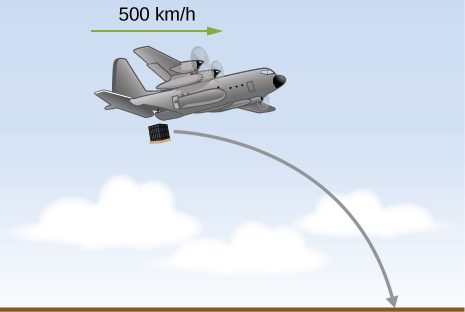
An airplane flying horizontally with a speed of 500 km/h at a height of 800 m drops a crate of supplies (see the following figure). If the parachute fails to open, how far in front of the release point does the crate hit the ground?
Suppose the airplane in the preceding problem fires a projectile horizontally in its direction of motion at a speed of 300 m/s relative to the plane. (a) How far in front of the release point does the projectile hit the ground? (b) What is its speed when it hits the ground?
a., b.
A fastball pitcher can throw a baseball at a speed of 40 m/s (90 mi/h). (a) Assuming the pitcher can release the ball 16.7 m from home plate so the ball is moving horizontally, how long does it take the ball to reach home plate? (b) How far does the ball drop between the pitcher’s hand and home plate?
A projectile is launched at an angle of and lands 20 s later at the same height as it was launched. (a) What is the initial speed of the projectile? (b) What is the maximum altitude? (c) What is the range? (d) Calculate the displacement from the point of launch to the position on its trajectory at 15 s.
a. ,
b.
c.
d.
A basketball player shoots toward a basket 6.1 m away and 3.0 m above the floor. If the ball is released 1.8 m above the floor at an angle of above the horizontal, what must the initial speed be if it were to go through the basket?
At a particular instant, a hot air balloon is 100 m in the air and descending at a constant speed of 2.0 m/s. At this exact instant, a girl throws a ball horizontally, relative to herself, with an initial speed of 20 m/s. When she lands, where will she find the ball? Ignore air resistance.
A man on a motorcycle traveling at a uniform speed of 10 m/s throws an empty can straight upward relative to himself with an initial speed of 3.0 m/s. Find the equation of the trajectory as seen by a police officer on the side of the road. Assume the initial position of the can is the point where it is thrown. Ignore air resistance.
An athlete can jump a distance of 8.0 m in the broad jump. What is the maximum distance the athlete can jump on the Moon, where the gravitational acceleration is one-sixth that of Earth?
The maximum horizontal distance a boy can throw a ball is 50 m. Assume he can throw with the same initial speed at all angles. How high does he throw the ball when he throws it straight upward?
A rock is thrown off a cliff at an angle of with respect to the horizontal. The cliff is 100 m high. The initial speed of the rock is 30 m/s. (a) How high above the edge of the cliff does the rock rise? (b) How far has it moved horizontally when it is at maximum altitude? (c) How long after the release does it hit the ground? (d) What is the range of the rock? (e) What are the horizontal and vertical positions of the rock relative to the edge of the cliff at t = 2.0 s, t = 4.0 s, and t = 6.0 s?
a. ,
b. ,
c. ,
d. ,
e.
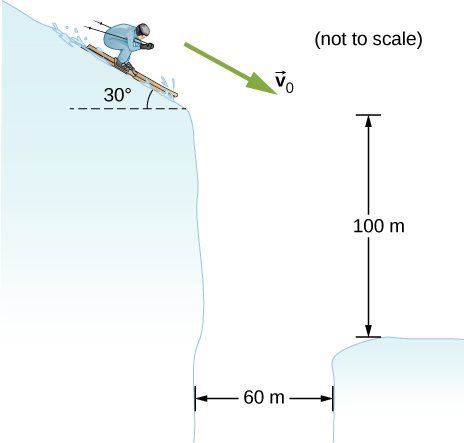
Trying to escape his pursuers, a secret agent skis off a slope inclined at below the horizontal at 60 km/h. To survive and land on the snow 100 m below, he must clear a gorge 60 m wide. Does he make it? Ignore air resistance.
A golfer on a fairway is 70 m away from the green, which sits below the level of the fairway by 20 m. If the golfer hits the ball at an angle of with an initial speed of 20 m/s, how close to the green does she come?
So the golfer’s shot lands 13.3 m short of the green.
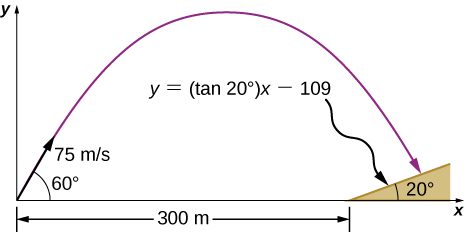
A projectile is shot at a hill, the base of which is 300 m away. The projectile is shot at above the horizontal with an initial speed of 75 m/s. The hill can be approximated by a plane sloped at to the horizontal. Relative to the coordinate system shown in the following figure, the equation of this straight line is Where on the hill does the projectile land?
An astronaut on Mars kicks a soccer ball at an angle of with an initial velocity of 15 m/s. If the acceleration of gravity on Mars is , (a) what is the range of the soccer kick on a flat surface? (b) What would be the range of the same kick on the Moon, where gravity is one-sixth that of Earth?
a. ,
b.
Mike Powell holds the record for the long jump of 8.95 m, established in 1991. If he left the ground at an angle of what was his initial speed?
MIT’s robot cheetah can jump over obstacles 46 cm high and has speed of 12.0 km/h. (a) If the robot launches itself at an angle of at this speed, what is its maximum height? (b) What would the launch angle have to be to reach a height of 46 cm?
a.
Mt. Asama, Japan, is an active volcano. In 2009, an eruption threw solid volcanic rocks that landed 1 km horizontally from the crater. If the volcanic rocks were launched at an angle of with respect to the horizontal and landed 900 m below the crater, (a) what would be their initial velocity and (b) what is their time of flight?
Drew Brees of the New Orleans Saints can throw a football 23.0 m/s (50 mph). If he angles the throw at from the horizontal, what distance does it go if it is to be caught at the same elevation as it was thrown?
The Lunar Roving Vehicle used in NASA’s late Apollo missions reached an unofficial lunar land speed of by astronaut Eugene Cernan. If the rover was moving at this speed on a flat lunar surface and hit a small bump that projected it off the surface at an angle of how long would it be “airborne” on the Moon?
A soccer goal is 2.44 m high. A player kicks the ball at a distance 10 m from the goal at an angle of The ball hits the crossbar at the top of the goal. What is the initial speed of the soccer ball?
Olympus Mons on Mars is the largest volcano in the solar system, at a height of 25 km and with a radius of 312 km. If you are standing on the summit, with what initial velocity would you have to fire a projectile from a cannon horizontally to clear the volcano and land on the surface of Mars? Note that Mars has an acceleration of gravity of
In 1999, Robbie Knievel was the first to jump the Grand Canyon on a motorcycle. At a narrow part of the canyon (69.0 m wide) and traveling 35.8 m/s off the takeoff ramp, he reached the other side. What was his launch angle?
You throw a baseball at an initial speed of 15.0 m/s at an angle of with respect to the horizontal. What would the ball’s initial speed have to be at on a planet that has twice the acceleration of gravity as Earth to achieve the same range? Consider launch and impact on a horizontal surface.
Aaron Rodgers throws a football at 20.0 m/s to his wide receiver, who is running straight down the field at 9.4 m/s. If Aaron throws the football when the wide receiver is 10.0 m in front of him, (a) at what angle does Aaron have to launch the ball so the ball will be at the same height as the receiver when the receiver makes it to 20.0 m in front of Aaron? (b) Will the receiver be able to catch the ball?
(a) It takes the wide receiver 1.1 s to cover the last 10 m of his run.
(b)
Therefore, the ball will be overthrown, and the receiver will not be able to catch it.
Adapted from University Physics Volume 1 by OpenStax (openstax.org), licensed under CC BY-NC-SA 4.0. Changes were made. License: CC-BY-NC-SA-4.0.