11.4 The Circular Functions: Tangent, Secant, Cosecant, and Cotangent
In section 11.2, we extended the notion of and from acute angles to any angles using the coordinate values of points on the Unit Circle. In total, there are six circular functions, as listed below.
While we left the history of the name `sine' as an interesting research project in Section 11.2,we take a slight detour here to explain the origin of the names `tangent' and `secant.'
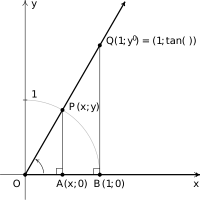
Consider the acute angle in standard position sketched in the diagram below.
Figure 11.134
As usual, denotes the point on the terminal side of which lies on the Unit Circle, but we also consider the point , the point on the terminal side of which lies on the vertical line .
The word `tangent' comes from the Latin meaning `to touch,' and for this reason, the line is called a tangent line to the Unit Circle since it intersects, or `touches', the circle at only one point, namely .
Dropping perpendiculars from and creates a pair of similar triangles and . Hence the corresponding sides are proportional. We get which gives .
We have just shown that for acute angles , is the -coordinate of the point on the terminal side of which lies on the line which is tangent to the Unit Circle.
The word `secant' means `to cut', so a secant line is any line that `cuts through' a circle at two points.1 The line containing the terminal side of (not just the terminal side itself) is one such secant line since it intersects the Unit Circle in Quadrants I and III.
With the point lying on the Unit Circle, the length of the hypotenuse of is . If we let denote the length of the hypotenuse of , we have from similar triangles that , or .
Hence for an acute angle , is the length of the line segment which lies on the secant line determined by the terminal side of and `cuts off' the tangent line .
As we mentioned in Definition 11.2, the `co' in `cosecant' and `cotangent' tie back to the concept of `co'mplementary angles and is explained in detail in Section 12.2.
Not only do these observations help explain the names of these functions, they serve as the basis for a fundamental inequality needed for Calculus which we'll explore in the Exercises.
Of the six circular functions, only sine and cosine are defined for all angles . Since and in Definition 11.4, it is customary to rephrase the remaining four circular functions Definition 11.4 in terms of sine and cosine.
We call the equations listed in Theorem 11.7
identities since they are relationships which are true regardless of the values of . This is in contrast to conditional equations such as which are true for only some values of . We will study identities more extensively in Sections 12.1 and 12.2.
While the Reciprocal and Quotient Identities presented in Theorem 11.7 allow us to always reduce problems involving secant, cosecant, tangent and cotangent to problems involving sine and cosine, it is not always convenient to do so.2 It is worth taking the time to memorize the tangent and cotangent values of the common angles summarized below.
Tangent and Cotangent Values of Common Angles
Coupling Theorem 11.7 with the Reference Angle Theorem, Theorem 11.1, we get the following.
It is high time for an example.
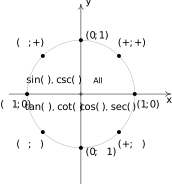
A few remarks about Example 11.4.1 are in order. First note that the signs () of secant and cosecant are the same as the signs of cosine and sine, respectively.
On the other hand, since tangent and cotangent are defined in terms of the ratios of coordinates and , tangent and cotangent are positive in Quadrants I and III (where both and have the same sign) and negative in Quadrants II and IV (where and have opposite signs.)
The diagram below on the left summarizes which circular functions are positive in which quadrants.
Figure 11.139Postive Circular FunctionsFigure 11.140The period of and is
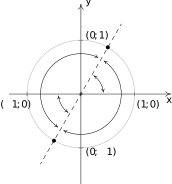
Also note it is no coincidence that both of our solutions to the equations involving tangent and cotangent in Example 11.4.1 could be simplified to just one list of angles differing by multiples of .
Indeed, any two angles that are units apart will not only have the same reference angle, but points on their terminal sides on the Unit Circle will be reflections through the origin, as illustrated above on the right.
It follows that the tangent and cotangent of such angles (if defined) will be the same, which means the period of these function is (at most) .
Using an argument similar to the one we used to establish the period of sine and cosine in Section 11.3, we note that if for all real numbers , then, in particular, . Hence, is a multiple of , and the smallest multiple of is itself.
Hence, the period of tangent (and cotangent) is , and we will see the consequences of this both when solving equations in this section and when graphing these functions in Section 11.5.
As with sine and cosine, the circular functions defined in Definition 11.4 agree with those put forth in Definitions B.1 and B.2 in Section B.2 for acute angles situated in right triangles. The argument is identical to the one given in Section 11.2 and is left to the reader.
Moreover, Definition 11.4 can be extended to circles of arbitrary radius using the same similarity arguments in Section 11.2.1 to generalize Definition 11.2 to Theorem 11.3 as summarized below.
We make good use of Theorem 11.9 in the following example.
As we did in Section 11.2.1, we may consider , , , and as functions real numbers by associating each real number with an angle measuring radians as discussed on page Section 11.2 and using Definition 11.4, or, more generally, Theorem 11.9.
Alternatively, we could define each of these four functions in terms of and as demonstrated in Theorem 11.7. For example, we could simply define
so long as .
Either way, we have the means to explore these functions in greater detail. Before doing so, we'll need practice with these additional four circular functions courtesy of the Exercises.
Exercises
In Exercises -, find the exact value or state that it is undefined.
In Exercises -, use the given the information to determine the quadrant in which the terminal side of the angle lies when plotted in standard position.
but .
but .
and .
but .
In Exercises -, use the given the information to find the exact values of the circular functions of .
with in Quadrant II
with in Quadrant III
with in Quadrant I
with in Quadrant IV
with in Quadrant III
with in Quadrant II
with in Quadrant IV.
with in Quadrant II.
with in Quadrant III.
with in Quadrant I.
with .
with .
with .
with .
In Exercises -, use your calculator to approximate the given value to three decimal places. Make sure your calculator is in the proper angle measurement mode!
In Exercises -, find all of the angles which satisfy the equation.
In Exercises -, solve the equation for . Give exact values.
In Exercises -, write the given function as a nontrivial decomposition of functions as directed.
For , find functions and so that .
For , find functions and so that .
For , find functions and so that .
For , find functions and so .
For , find functions and so .
For , find functions and so .
For , find functions and so .
For , find find functions , , and so .
Let and , , and . Explain why but .
HINT: Think about domains …
For each function listed below, compute the average rate of change over the indicated interval.5 What trends do you notice? Compare your answer with what you discovered in Section 11.2 number. Be sure your calculator is in radian mode!
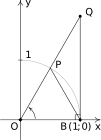
We wish to establish the inequality for Use the diagram from the beginning of the section, partially reproduced below, to answer the following.
Figure 11.145
Show that triangle has area and triangle has area .
Show that the circular sector with central angle has area .
Comparing areas, show that for
Use the inequality to show that for
Use the inequality to show that for Combine this with the previous part to complete the proof.
Show that also holds for .
Use the results from Exercises and along with the Squeeze Theorem,6 to prove
.
Answers
is undefined
is undefined
is undefined
is undefined
Quadrant II.
Quadrant III.
Quadrant I.
Quadrant IV.
when for any integer
when or for any integer
when for any integer .
when for any integer
when for any integer
when for any integer
when or for any integer .
when for any integer
when for any integer
never happens
never happens
when for any integer
when for any integer
when or for any integer
when for any integer
when for any integer
when for any integer
when or for any integer
never happens
when for any integer
when for any integer
when or for any integer
when or for any integer
One solution is and .
One solution is and .
One solution is and .
One solution is and .
One solution is and .
Since , one solution is and .
One solution is and .
One solution is , , and .
As we zoom in towards , the average rate of change of approaches . This is the same trend we observed for in Section 11.2 number.
Adapted from Precalculus with Integrated Calculus, edition 4i, by Carl Stitz and Jeff Zeager (stitz-zeager.com), licensed under CC BY-NC-SA 3.0. Changes were made: reformatted as an accessible XYZ web edition. License: CC-BY-NC-SA-3.0.
These eBooks are a prerelease and are not yet certified conformant with WCAG 2.1 AA or any other accessibility standard. Every page is built against an automated accessibility gate, and our target for the published editions is WCAG 2.2 Level AA. If something is unusable, please tell us.