In Section 5.2, we saw how the arithmetic of real numbers carried over into an arithmetic of functions. In this section, we discuss another way to combine functions which is unique to functions and isn't shared with real numbers - function composition.
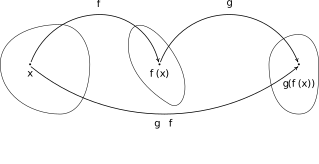
To compute , we use the formula given in Defintion 5.2: . However, from a procedural viewpoint, Defintion 5.2 tells us the output from is found by taking the output from , , and then making that the input to . From this perspective, we see as a two step process taking an input and first applying the procedure then applying the procedure . Abstractly, we have
Figure 5.40
In the expression , the function is often called the `inside' function while is often called the `outside' function. When evaluating composite function values we present two methods in the example below: the `inside out' and `outside in' methods.
As previously mentioned, it should be clear from Example 5.3.1 that, in general, , in other words, function composition is not commutative. However, numbers and demonstrate the associative property of function composition. That is, when composing three (or more) functions, as long as we keep the order the same, it doesn't matter which two functions we compose first. We summarize the important properties of function composition in the theorem below.
By repeated applications of Definition 5.2, we find . Similarly, . This establishes that the formulas for the two functions are the same. We leave it to the reader to think about why the domains of these two functions are identical, too. These two facts establish the equality . A consequence of the associativity of function composition is that there is no need for parentheses when we write . The second property can also be verified using Definition 5.2. Recall that the function is called the identity function and was introduced in Exercise in Section 1.2. If we compose the function with a function , then we have , and a similar computation shows . This establishes that we have an identity for function composition much in the same way the function is an identity for function multiplication.
As we know, not all functions are described by formulas, and, moreover, not all functions are described by just one formula. The next example applies the concept of function composition to functions represented in various and sundry ways.
A useful skill in Calculus is to be able to take a complicated function and break it down into a composition of easier functions which our last example illustrates. As with Example 5.2.2, we want to avoid trivial decompositions, which, when it comes to function composition, are those involving the identity function as described in Theorem 5.4.
We close this section of a real-world application of function composition.
Related Rates
In Section 5.2.1, we studied the difference operator, and showed how average rates of change operate with the basic function arithmetic. In this section, we explore how rates of change of composite functions are related to the rates of change of their constituent functions. As in that section, we'll use the formulation:
adjusting the names of functions and independent variables as needed.
As a motivational example, we revisit the scenario in Example 5.3.4.
Example 5.3.5 verifies a property of rates we formalize below.
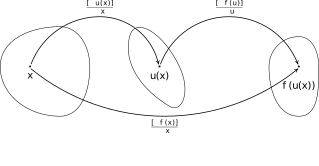
If we think of as being an `intermediary' variable, Theorem 5.5 allows us to determine the rate of change of with respect to by multiplying the rate of change of with respect to this `intermediary' by the rate of change of the `intermediary' with respect to . That is, we are looking for rate information on how depends on by decomposing the rate into two rates as visualized below.
Figure 5.46
We close the section with one last example.
Note that we never needed to know explicitly how the speed, , directly depended on time in order to answer the question posed in Example 5.3.6. All we needed was the rate.
Exercises
In Exercises -, use the given pair of functions to find the following values if they exist.
,
,
,
,
,
,
,
,
,
,
,
,
In Exercises -, use the given pair of functions to find and simplify expressions for the following functions and state the domain of each using interval notation.
,
,
,
,
,
,
,
,
,
,
,
,
In Exercises -, use , and to find and simplify expressions for the following functions and state the domain of each using interval notation.
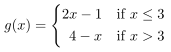
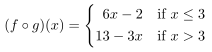
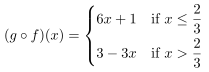
In Exercises -, let be the function defined by
and let be the function defined by
Find the following, if it exists.
Find the domain and range of and .
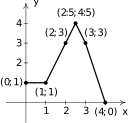
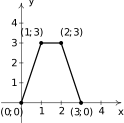
In Exercises -, use the graphs of and below to find the following if it exists.
Figure 5.47Figure 5.48
Find the domain and range of and .
In Exercises -, write the given function as a composition of two or more non-identity functions. (There are several correct answers, so check your answer using function composition.)
Write the function as a composition of three or more non-identity functions.
Let and . In what order must these functions be composed with to create ?
What linear functions could be used to transform into ? What is the proper order of composition?
Let and let
. Find expressions for and .
The volume of a cube is a function of its side length . Let's assume that is also a function of time , where is measured in inches and is measured in minutes. Find a formula for as a function of .
Suppose a local vendor charges per hot dog and that the number of hot dogs sold per hour is given by , where is the number of hours since AM, .
Find an expression for the revenue per hour as a function of .
The book in Example 5.3.6 plunges into a lake and generates a circular wave pattern. If the waves are tracked as traveling at a constant meters per second , use Theorem 5.5 to find the rate at which the area of the disturbance is changing with respect to time as the radius changes from to meters (m). Be sure to include units on your answer.
HINT: Recall the area, , enclosed by a circle of radius is given by . Here, .
Perfectly fine precalculus textbooks which have no Calculus content are being fed into a shredder at a rate of 2 books per minute in order to make room for precalculus textbooks with Calculus content. The shredder creates a pile of debris which is in the shape of a right circular cone whose height is twice its width.
Assume the volume of the conical pile, , is given by where is the radius of the base of the pile and is the height of the pile. Given the pile is twice as tall as it is wide, show we can write .
Assuming a typical precalculus textbook is cubic feet , use Theorem 5.5 to find the rate of change of the radius of the pile with respect to time as the radius changes from to feet. Be sure to include units on your answer.
Discuss with your classmates how `real-world' processes such as filling out federal income tax forms or computing your final course grade could be viewed as a use of function composition. Find a process for which composition with itself (iteration) makes sense.
Answers
For and ,
For and ,
For and ,
For and ,
For and ,
is not real
is not real
For and ,
For and ,
For and ,
For and ,
is undefined
For and ,
For and ,
is not real
For and ,
is not real
is not real
For and
, domain:
, domain:
, domain:
For and
, domain:
, domain:
, domain:
For and
, domain:
, domain:
, domain:
For and
, domain:
, domain:
, domain:
For and
, domain:
, domain:
, domain:
For and
, domain:
, domain:
, domain:
For and
, domain:
, domain:
, domain:
For and
, domain:
, domain:
, domain:
For and
, domain:
, domain:
, domain:
For and
, domain:
, domain:
, domain:
For and
, domain:
, domain:
, domain:
For and
, domain:
, domain:
, domain:
, domain:
, domain:
, domain:
, domain:
, domain:
,, domain:
which is undefined
which is undefined
The domain of is and the range of is .
The domain of is and the range of is .
The domain of is and the range of is .
The domain of is and the range is .
Let and , then .
Let and , .
Let and , then .
Let and , then .
Let and , then .
Let and , then .
Let and , then .
Let and , then .
Let and , then .
Let and , then .
where and .
One solution is where and . You could also have where and .
and
so
, . This gives the revenue per hour as a function of time.
Noon corresponds to , so . The hourly revenue at noon is per hour.
, .
. , .
Hence,
The `width' of the pile is the diameter of the circular base of the pile. Since the diameter of a circle is twice the radius, . Hence, .
We have . Two textbooks per minute into the shredder amounts to the volume of the cone increasing at a rate of . .
Hence, so .
Adapted from Precalculus with Integrated Calculus, edition 4i, by Carl Stitz and Jeff Zeager (stitz-zeager.com), licensed under CC BY-NC-SA 3.0. Changes were made: reformatted as an accessible XYZ web edition. License: CC-BY-NC-SA-3.0.
These eBooks are a prerelease and are not yet certified conformant with WCAG 2.1 AA or any other accessibility standard. Every page is built against an automated accessibility gate, and our target for the published editions is WCAG 2.2 Level AA. If something is unusable, please tell us.