
5.1 Graphs of Functions
Up until this point in the text, we have primarily focused on studying particular families of functions. These families and their relationships to one another provide useful examples of more abstract function structures and relationships. The notions introduced in this chapter will not only provide us a more formal vocabulary with which to describe the connections between the function families we have already studied, but, more importantly, give us additional lenses through which to view new families of functions that we'll encounter.
In this section, we review of the concepts associated with the graphs of functions. We introduced the notion of the graph of a function in Section 1.1, and the vast majority of the graphs we have encountered in this text were generated from an algebraic representation of a function. In this section, we define the functions geometrically from the outset and review the important concepts associated with the graphs of functions.
Recall the domain of a function is the set of inputs to the function and the range of a function is the set of outputs from the function. When graphing a function whose domain and range are subsets of real numbers, we plot the ordered pairs on the Cartesian plane. Hence, the domain values are found on the horizontal axis while the range values are found on the vertical axis.
Recall from Definition 1.3 that the largest output from the function (if there is one) is called the maximum or, when there may be some confusion, the absolute maximum of the function. Likewise, the smallest output from the function (again, if there is one) is called the minimum or absolute minimum.
A concept related to `absolute' maximum and minimum is the concept of `local' maximum and minimum as described in Definition 2.7. Here, a point on the graph of a function is a local maximum if is the maximum function value for some open interval in the domain containing . The notion of `local' here meaning instead of surveying the entire domain, we instead restrict our attention to inputs `local' or `near' the input . The concept of local minimum is defined similarly.
Next, we review the notions of increasing, decreasing, and constant as described in Definition 1.7. Recall a function is increasing over an interval if, as the inputs increase, do the outputs. This means that, geometrically, the graph of the function rises as we move left to right. Similarly, a function is decreasing over an interval if the outputs decrease as the inputs increase. Geometrically, a decreasing function falls as we move left to right. Finally, a function is constant over an interval if the output is the same regardless of the input. If a function is constant over an interval, its graph remains `flat' - a horizontal line.
Last, and according to some1 least, we briefly review the notion of symmetry in the graphs of functions. Recall from Definition 2.2 that a function is called even if for all in the domain of . The graphs of even functions are symmetric about the vertical (usually -) axis. In a similar manner, Definition 2.3 tells us a function is odd if for all in the domain of . Geometrically, the graphs of odd functions are symmetric about the origin.
The next example reviews all of the aforementioned concepts as well as many more.
Our next example involves a more complicated function and asks more complicated questions.
Our last example focuses on symmetry. The reader is encouraged to review the notes about symmetry as summarized on page in Section A.3.
Exercises
In Exercises -, use the graph of given below to answer the question.
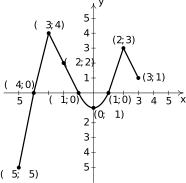
- Find the domain of .
- Find the range of .
- Find the maximum, if it exists.
- Find the minimum, if it exists.
- List the local maximums, if any exist.
- List the local minimums, if any exist.
- List the intervals where is increasing.
- List the intervals where is decreasing.
- Determine .
- Solve .
- List the -intercepts, if any exist.
- List the -intercepts, if any exist.
- Find the zeros of .
- Solve .
- Find the number of solutions to .
- Find the number of solutions to .
- Solve
- Solve
With help from your classmates:
- Find the domain of
- Find the range of
In Exercises -, use the graph of given below to answer the question.
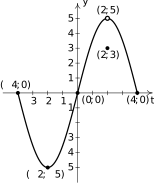
- Find the domain of .
- Find the range of .
- Find the maximum, if it exists.
- Find the minimum, if it exists.
- List the local maximums, if any exist.
- List the local minimums, if any exist.
- List the intervals where is increasing.
- List the intervals where is decreasing.
- Determine .
- Solve .
- List the -intercepts, if any exist.
- List the -intercepts, if any exist.
- Find the zeros of .
- Solve .
- Find the domain of .
- Solve .
- How many solutions are there to ?
- Does appear to be even, odd, or neither?
- Prove that if is an odd function and is in the domain of , then .
Let be the function defined as: if is a rational number, if is an irrational number. With help from your classmates, try to graph . What difficulties do you encounter?
NOTE: Between every pair of real numbers, there is both a rational and an irrational number …
Consider the graph of the function given below.
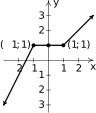
Figure 5.13 - Explain why has a local maximum but not a local minimum at the point .
- Explain why has a local minimum but not a local maximum at the point .
- Explain why has a local maximum AND a local minimum at the point .
- Explain why is constant on the interval and thus has both a local maximum AND a local minimum at every point where .
Explain why the function whose graph is given below does not have a local maximum at nor does it have a local minimum at . Find its extrema, both local and absolute and find the intervals on which is increasing and those on which is decreasing.
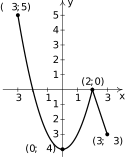
Figure 5.14 For each function below, find the local maximum or local minimum and list the interval over which the function is increasing and the interval over which the function is decreasing.
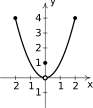
Figure 5.15 Function I 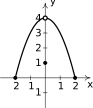
Figure 5.16 Function II
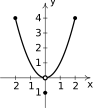
Figure 5.17 Function III 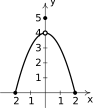
Figure 5.18 Function IV
Answers
- ,
- ,
- ,
- , ,
- , ,
- ,
- To find the domain of , we start with the domain of and exclude values where . Hence, the domain of is .
- To find the range of , we start with the range of (excluding ) and take reciprocals. If , then . If , then . Hence the range of is .
- none
- none
- ,
- ,
- , ,
- , ,
- Neither.
- Local maximum: , no local minimum. Increasing: , decreasing: .
- No local maximum, local minimum: . Increasing: , decreasing: .
- No local maximum, local minimum: . Increasing: , decreasing: .
- Local maximum: , no local minimum. Increasing: , decreasing: .
Adapted from Precalculus with Integrated Calculus, edition 4i, by Carl Stitz and Jeff Zeager (stitz-zeager.com), licensed under CC BY-NC-SA 3.0. Changes were made: reformatted as an accessible XYZ web edition. License: CC-BY-NC-SA-3.0.