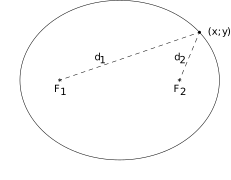
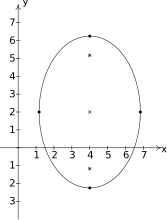
In the definition of a circle, Definition 7.1, we fixed a point called the center and considered all of the points which were a fixed distance from that one point. For our next conic section, the ellipse, we fix two distinct points and a distance to use in our definition.
Figure 7.45 for all on the ellipse
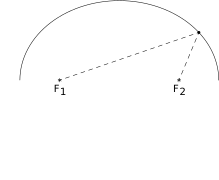
We may imagine taking a length of string and anchoring it to two points on a piece of paper. The curve traced out by taking a pencil and moving it so the string is always taut is an ellipse.
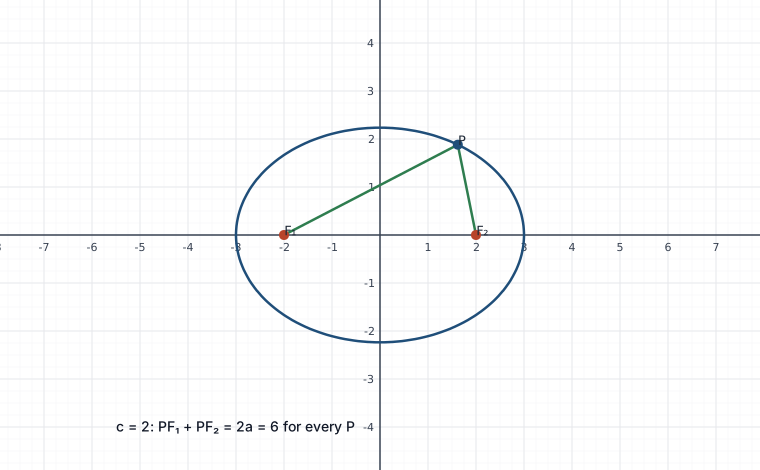
Interactive figureThe string construction: PF₁ + PF₂ is constantMove the Focal distance c and Position of P sliders.
An ellipse with semi-major axis a = 3 and foci F₁, F₂ at (±c, 0), where c is a slider. The point P moves around the ellipse on its own slider, and the two segments to the foci are the taut string of the section: their lengths change as P moves but their sum stays 2a = 6. Slide c toward zero and the foci merge at the centre — the ellipse rounds into a circle of radius 3 — and slide it toward 3 and the ellipse flattens toward the segment between the foci.
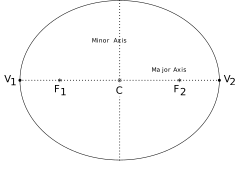
The center of the ellipse is the midpoint of the line segment connecting the two foci. The major axis of the ellipse is the line segment connecting two opposite ends of the ellipse which also contains the center and foci. The minor axis of the ellipse is the line segment connecting two opposite ends of the ellipse which contains the center but is perpendicular to the major axis. The vertices of an ellipse are the points of the ellipse which lie on the major axis. Notice that the center is also the midpoint of the major axis, hence it is the midpoint of the vertices. In pictures we have,
Figure 7.46
An ellipse with center ; foci , ; and vertices ,
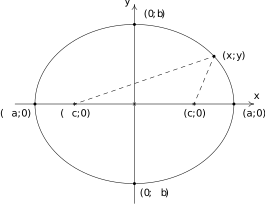
Note that the major axis is the longer of the two axes through the center, and likewise, the minor axis is the shorter of the two. In order to derive the standard equation of an ellipse, we assume that the ellipse has its center at , its major axis along the -axis, and has foci and and vertices and . We will label the -intercepts of the ellipse as and (We assume , , and are all positive numbers.) Schematically,
Figure 7.47
Note that since is on the ellipse, it must satisfy the conditions of Definition 7.4. That is, the distance from to plus the distance from to must equal the fixed distance . Since all of these points lie on the -axis, we get
In other words, the fixed distance mentioned in the definition of the ellipse is none other than the length of the major axis. We now use that fact is on the ellipse, along with the fact that to get
From this, we get , or , which will prove useful later. Now consider a point on the ellipse. Applying Definition 7.4, we get
In order to make sense of this situation, we need to make good use of Intermediate Algebra.
We are nearly finished. Recall that so that
This equation is for an ellipse centered at the origin. To get the formula for the ellipse centered at , we could use the transformations from Section 1.7 or re-derive the equation using Definition 7.4 and the distance formula to obtain the formula below.
Some remarks about Equation 7.4 are in order. First note that the values and determine how far in the and directions, respectively, one counts from the center to arrive at points on the ellipse. Also take note that if , then we have an ellipse whose major axis is horizontal, and hence, the foci lie to the left and right of the center. In this case, as we've seen in the derivation, the distance from the center to the focus, , can be found by . If , the roles of the major and minor axes are reversed, and the foci lie above and below the center. In this case, . In either case, is the distance from the center to each focus, and . Finally, it is worth mentioning that if we take the standard equation of a circle, Equation 7.1, and divide both sides by , we get
Notice the similarity between Equation 7.4 and Equation 7.5. Both equations involve a sum of squares equal to ; the difference is that with a circle, the denominators are the same, and with an ellipse, they are different. If we take a transformational approach, we can consider both Equations 7.4 and 7.5 as shifts and stretches of the Unit Circle in Definition 7.2. Replacing with and with causes the usual horizontal and vertical shifts. Replacing with and with causes the usual vertical and horizontal stretches. In other words, it is perfectly fine to think of an ellipse as the deformation of a circle in which the circle is stretched farther in one direction than the other.2
As with circles and parabolas, an equation may be given which is an ellipse, but isn't in the standard form of Equation 7.4. In those cases, as with circles and parabolas before, we will need to massage the given equation into the standard form.
To Write the Equation of an Ellipse in Standard Form
Group the same variables together on one side of the equation and position the constant on the other side.
Complete the square in both variables as needed.
Divide both sides by the constant term so that the constant on the other side of the equation becomes .
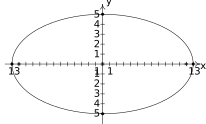
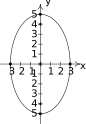
As you come across ellipses in the homework exercises and in the wild, you'll notice they come in all shapes in sizes. Compare the two ellipses below.
Figure 7.52Figure 7.53
Certainly, one ellipse is more round than the other. This notion of `roundness' is quantified below.
In an ellipse, the foci are closer to the center than the vertices, so . The ellipse above on the left has eccentricity ; for the ellipse above on the right, . In general, the closer the eccentricity is to , the more `circular' the ellipse; the closer the eccentricity is to , the more `eccentric' the ellipse.
As with parabolas, ellipses have a reflective property. If we imagine the dashed lines below representing sound waves, then the waves emanating from one focus reflect off the top of the ellipse and head towards the other focus.
Figure 7.55
Such geometry is exploited in the construction of so-called `Whispering Galleries'. If a person whispers at one focus, a person standing at the other focus will hear the first person as if they were standing right next to them. We explore the Whispering Galleries in our last example.
Exercises
In Exercises -, graph the ellipse. Find the center, the lines which contain the major and minor axes, the vertices, the endpoints of the minor axis, the foci and the eccentricity.
In Exercises -, put the equation in standard form. Find the center, the lines which contain the major and minor axes, the vertices, the endpoints of the minor axis, the foci and the eccentricity.
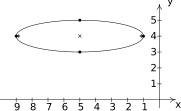
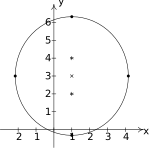
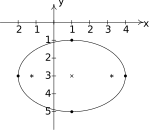
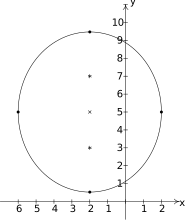
In Exercises -, find the standard form of the equation of the ellipse which has the given properties.
Center , Vertex , Focus
Foci , Vertices .
Foci , length of the Minor Axis
Vertices , ; Endpoints of the Minor Axis ,
Center , Vertex , eccentricity
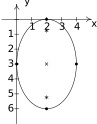
All points on the ellipse are in Quadrant IV except and . (One might also say that the ellipse is “tangent to the axes” at those two points.)
Repeat Example 7.4.5 for a whispering gallery 200 feet wide and 75 feet tall.
An elliptical arch is constructed which is 6 feet wide at the base and 9 feet tall in the middle. Find the height of the arch exactly 1 foot in from the base of the arch. Compare your result with your answer to Exercise in Section 7.3.
The Earth's orbit around the sun is an ellipse with the sun at one focus and eccentricity . The length of the semimajor axis (that is, half of the major axis) is defined to be astronomical unit (AU). The vertices of the elliptical orbit are given special names: `aphelion' is the vertex farthest from the sun, and `perihelion' is the vertex closest to the sun. Find the distance in AU between the sun and aphelion and the distance in AU between the sun and perihelion.
The graph of an ellipse clearly fails the Vertical Line Test, Theorem 1.1, so the equation of an ellipse does not define as a function of . However, much like with circles and horizontal parabolas, we can split an ellipse into a top half and a bottom half, each of which would indeed represent as a function of . With the help of your classmates, use your calculator to graph the ellipses given in Exercises - above. What difficulties arise when you plot them on the calculator?
Some famous examples of whispering galleries include St. Paul's Cathedral in London, England, National Statuary Hall in Washington, D.C., and The Cincinnati Museum Center. With the help of your classmates, research these whispering galleries. How does the whispering effect compare and contrast with the scenario in Example 7.4.5?
With the help of your classmates, research “extracorporeal shock-wave lithotripsy”. It uses the reflective property of the ellipsoid to dissolve kidney stones.
Answers
Center Major axis along Minor axis along Vertices Endpoints of Minor Axis , Foci
Figure 7.57
Center Major axis along Minor axis along Vertices Endpoints of Minor Axis , Foci
Figure 7.58
Center Major axis along Minor axis along Vertices Endpoints of Minor Axis , Foci
Figure 7.59
Center Major axis along Minor axis along Vertices Endpoints of Minor Axis , Foci
Figure 7.60
Center Major axis along Minor axis along Vertices Endpoints of the Minor Axis Foci
Figure 7.61
Center Major axis along Minor axis along Vertices Endpoints of the Minor Axis , Foci
Figure 7.62
Center Major axis along Minor axis along Vertices Endpoints of the Minor Axis , Foci
Figure 7.63
Center Major axis along Minor axis along Vertices Endpoints of the Minor Axis , Foci
Figure 7.64
Center Major Axis along Minor Axis along Vertices , Endpoints of Minor Axis , Foci ,
Center Major axis along Minor axis along Vertices Endpoints of Minor Axis , Foci
Center Major axis along Minor axis along Vertices Endpoints of Minor Axis , Foci
Center Major Axis along Minor Axis along Vertices , Endpoints of Minor Axis , Foci ,
Center Major Axis along (the -axis) Minor Axis along Vertices , Endpoints of Minor Axis , Foci ,
Center Major Axis along Minor Axis along Vertices , Endpoints of Minor Axis , Foci ,
Jamie and Jason should stand feet from opposite ends of the gallery.
The arch can be modeled by the top half of . One foot in from the base of the arch corresponds to either . Plugging in gives and since represents a height, we choose feet.
Distance from the sun to aphelion AU. Distance from the sun to perihelion AU.
Adapted from Precalculus, 3rd corrected edition, by Carl Stitz and Jeff Zeager (stitz-zeager.com), licensed under CC BY-NC-SA 3.0. Changes were made: reformatted as an accessible XYZ web edition. License: CC-BY-NC-SA-3.0.
These eBooks are a prerelease and are not yet certified conformant with WCAG 2.1 AA or ADA Title II. Every page is built against an automated accessibility gate, and the published editions will meet ADA Title II requirements when they release in late September 2026. If something is unusable, please tell us.