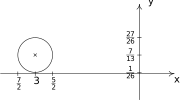
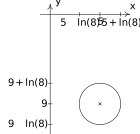
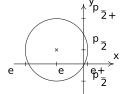
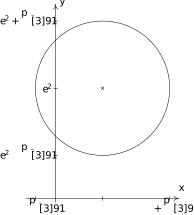
Recall from Geometry that a circle can be determined by fixing a point (called the center) and a positive number (called the radius) as follows.
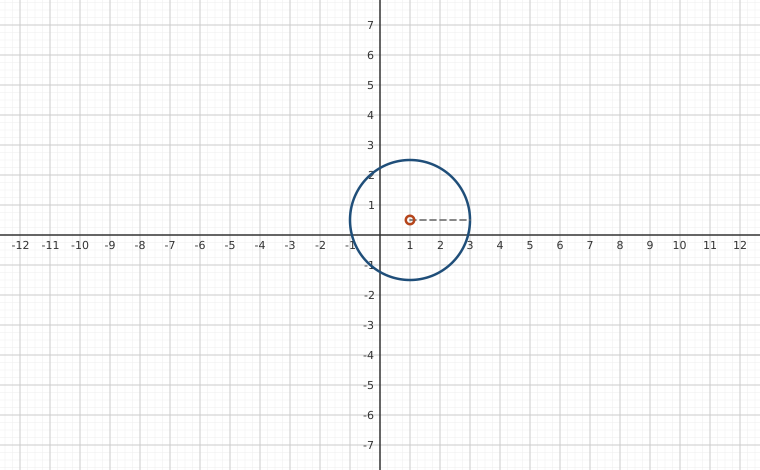
Interactive figureA circle is a center and a radius: (x − h)² + (y − k)² = r² on three dialsDrag the Center x-coordinate h, Center y-coordinate k and Radius r sliders.
XYZ Graph · viewer build 5edf91b
The circle is drawn from its definition: every point at distance r from the center (h, k). The marked center and the dashed radius segment are the two ingredients, and the standard equation (x − h)² + (y − k)² = r² is the Distance Formula applied to them. Slide h and k and the whole circle rides along with its center; slide r and it grows or shrinks about that center, the dashed radius stretching to match. Reading h, k and r off an equation is exactly reading this picture backwards.Figure 7.16
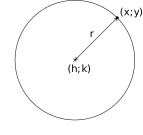
From the picture, we see that a point is on the circle if and only if its distance to is . We express this relationship algebraically using the Distance Formula, Equation 1.1, as
By squaring both sides of this equation, we get an equivalent equation (since ) which gives us the standard equation of a circle.
If we were to expand the equation in the previous example and gather up like terms, instead of the easily recognizable , we'd be contending with If we're given such an equation, we can complete the square in each of the variables to see if it fits the form given in Equation 7.1 by following the steps given below.
To Write the Equation of a Circle in Standard Form
Group the same variables together on one side of the equation and position the constant on the other side.
Complete the square on both variables as needed.
Divide both sides by the coefficient of the squares. (For circles, they will be the same.)
It is possible to obtain equations like or , neither of which describes a circle. (Do you see why not?) The reader is encouraged to think about what, if any, points lie on the graphs of these two equations. The next example uses the Midpoint Formula, Equation 1.2, in conjunction with the ideas presented so far in this section.
We close this section with the most important1 circle in all of mathematics: the Unit Circle.
Exercises
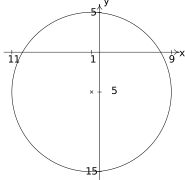
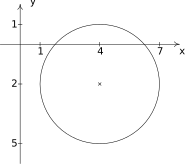
In Exercises -, find the standard equation of the circle and then graph it.
Center , radius
Center , radius
Center , radius
Center , radius
Center , radius
Center , radius
In Exercises -, complete the square in order to put the equation into standard form. Identify the center and the radius or explain why the equation does not represent a circle.
In Exercises -, find the standard equation of the circle which satisfies the given criteria.
center , passes through
center , passes through
endpoints of a diameter: and
endpoints of a diameter: ,
The Giant Wheel at Cedar Point is a circle with diameter 128 feet which sits on an 8 foot tall platform making its overall height is 136 feet.2 Find an equation for the wheel assuming that its center lies on the -axis and that the ground is the -axis.
Verify that the following points lie on the Unit Circle: , , , and
Discuss with your classmates how to obtain the standard equation of a circle, Equation 7.1, from the equation of the Unit Circle, using the transformations discussed in Section 1.7. (Thus every circle is just a few transformations away from the Unit Circle.)
Find an equation for the function represented graphically by the top half of the Unit Circle. Explain how the transformations is Section 1.7 can be used to produce a function whose graph is either the top or bottom of an arbitrary circle.
Find a one-to-one function whose graph is half of a circle. (Hint: Think piecewise.)
Answers
Figure 7.19
Figure 7.20
Figure 7.21
Figure 7.22
Figure 7.23
Figure 7.24
Center , radius
Center , radius
Center , radius
Center , radius
This is not a circle.
Center , radius
Adapted from Precalculus, 3rd corrected edition, by Carl Stitz and Jeff Zeager (stitz-zeager.com), licensed under CC BY-NC-SA 3.0. Changes were made: reformatted as an accessible XYZ web edition. License: CC-BY-NC-SA-3.0.
These eBooks are a prerelease and are not yet certified conformant with WCAG 2.1 AA or ADA Title II. Every page is built against an automated accessibility gate, and the published editions will meet ADA Title II requirements when they release in late September 2026. If something is unusable, please tell us.